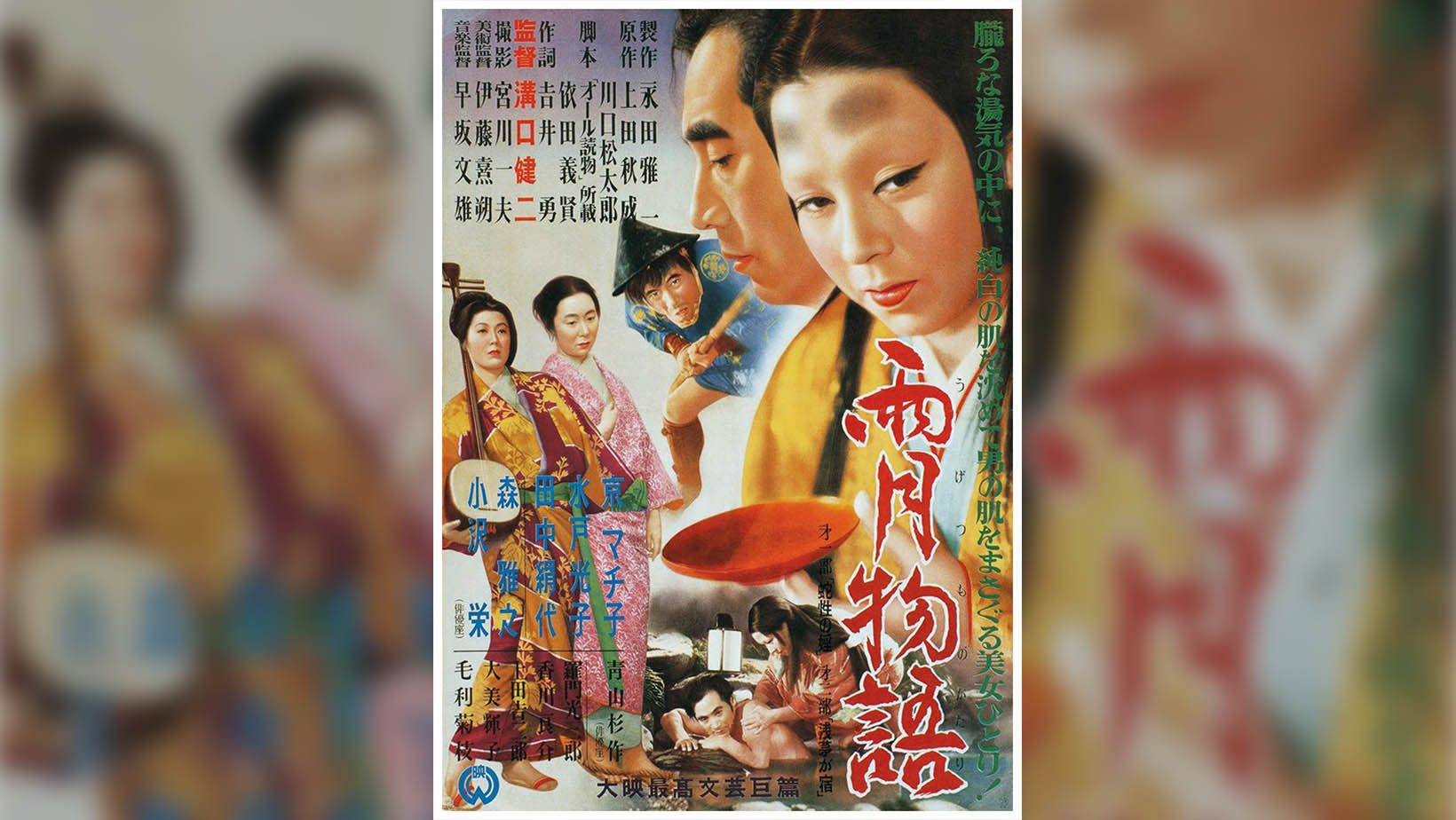




It’s understandable why Japanese filmmakers focus so often on the feudal era in their horror cinema. It’s a setting so naturally horrific in the plight and pain of the peasant class that few supernatural elements are necessary to invoke dread in audiences. The stark reality of daily life alone is enough to make the viewer cringe and their skin crawl.
The cruel irony of Ugetsu (1953), directed by Kenji Mizoguchi, is that these moments of reality are its harshest and scariest. The film is a ghost story with no sense of danger and a villain that lacks intrigue. The concern lies with the characters escaping their real-life horrors and not the spirit that offers one a better alternative.
It opens with an enemy army raiding an impoverished village, where Genjuro, a potter with lofty ambitions of upward mobility, desperately works to keep his kiln lit before the soldiers arrive. His neighbors flee from the rapidly approaching torches to the safety of the forest, as the marauders enslave the men and r*pe the women in their path. But Genjuro is steadfast in remaining. His wife pulls at his clothes, pleading with him to leave, but if the fire goes out, they’ll be ruined. The tension in this scene is palpable, and it surrounds the fate of some clay pots.
Genjuro’s brother-in-law, Tobei, also entertains his own grand delusions. He fancies himself a samurai, and he begs to be made a vassal of the local warlord. The actual samurai instead mock and beat him for his troubles. Like Genjuro, he sees the pottery business as a means to an end: with enough money, he can buy his own armor and a fancy spear. Fast-forwarding to the second act, his dreams actually come true. He affords his prize after a successful day of business in the city, and he is made a noble after presenting the warlord with the stolen head of a rival general.
In chasing his fortune, however, he leaves his disapproving wife to return home alone. Out on the road, a group of soldiers accost her, push her to the ground, and drag her into a hut. Her r*pe is only implied but is no less horrific, as the soldiers absolve their sins with coins they drop on the floor. The whole sequence is brutally direct and dispiriting, the largest imprint left by the film.

But this bluntness comes at a cost. The trials of Tobei and his wife are meant only as the subplot, yet they steal the entire show. Genjuro’s story, meanwhile, leaves much to be desired. In the city, he meets a noblewoman and her handmaiden when they purchase a large portion of his stock. They instruct him to bring the goods to her country manor, where he will receive his payment. Upon his arrival, things quickly become romantic, and the lonely noblewoman soon asks for his hand in marriage. The whirlwind affair excites Genjuro, and he, like Tobei, leaves his wife to fend for herself.
The reveal is hardly shocking. The noblewoman is, in fact, a long-dead spirit that has returned to experience the love that she never had in life, and the scattered hints of her true nature aren’t exactly subtle. There’s little to process once a priest divulges the twist to Genjuro (and the audience) near the story’s climax. The film commits the cardinal sin of telling instead of showing, and this lack of nuance equates to a lack of interest.
Is there a moral to the tale? It’s hard to see one through the tangled plot. It is not explicitly anti-capitalist, despite its cautionary tale of greed, and any subtext related to war lacks focus. If anything, it seems to rail against personal aspiration, a particularly unsatisfying conclusion. I’m sure that there’s a cultural element that I’m missing here, which is, of course, no fault of the film or its director. It leaves me at a loss nonetheless.
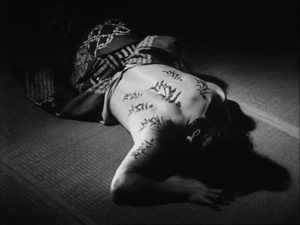
Ugetsu is not a bad film. It’s simply an unremarkable one. The narrative flows freely, but its execution is clunky. Moments of dread are offset by a meandering horror story that isn’t horrifying, and the whole presentation would have been better served if left as a historical drama. It’s crushing ending, as effective a scene as the attack on Tobei’s wife, is the only supernatural aspect that truly works in its favor. But the weight of it alone is not enough to offset the preceding ninety minutes.
Then again, its success instigated an entire movement. It won multiple awards such as the Silver Lion Award in Venice, and it opened Western audiences to the world of Japanese horror. Alas, these are only this reviewer’s personal opinions and are hardly facts set in stone.
More Film Reviews

Philosophy of a Knife (2008) Film Review | An Extreme Horror Documentary
“It’s not my fault that I’m Japanese… yet it’s my greatest sin that I am.” -The Human Condition I: No Greater Love (1959) During the Second World War, Unit 731…

Alpha Male (2022) Film Review – The Absurd Temple of Bromanity!
Struggling to quit smoking, Piotrek’s fiancée signs him up for a course at an institute focused on providing help for men. However, after a room mix-up, he finds himself in…

Blood in the Snow Film Festival BITS 2021- Short Films Spotlight
Blood in the Snow (BITS) is a Toronto-based horror film festival that is presenting its 9th annual line-up at the Royal Alexander Theatre from November 18-23, 2021. Festival director Kelly…
![The Ghost Station (2022) Film Review [FrightFest]](https://www.grimoireofhorror.com/wp-content/uploads/2023/08/The-Ghost-Station10-365x180.jpg)
The Ghost Station (2022) Film Review [FrightFest]
The Ghost Station is a 2022 South Korean horror thriller, written and directed by Yong-ki Jeong, with additional writing from Soyoung Lee, c, and Koji Shiraishi. Takahashi and Shiraishi are…

Till Death (2021) Film Review – Separation Can be a Nightmare
Till Death is the adaptation of a screenplay written by Jason Carvey and is also the directorial debut for S.K. Dale. Megan Fox plays the role of Emma, a young…

Film Review: I Drink Your Blood by David Durston
B-movies have become a staple in popular culture over the recent years, with cult classics from the 1970s and 1980s finally receiving the wider attention they rightly deserve. I Drink…