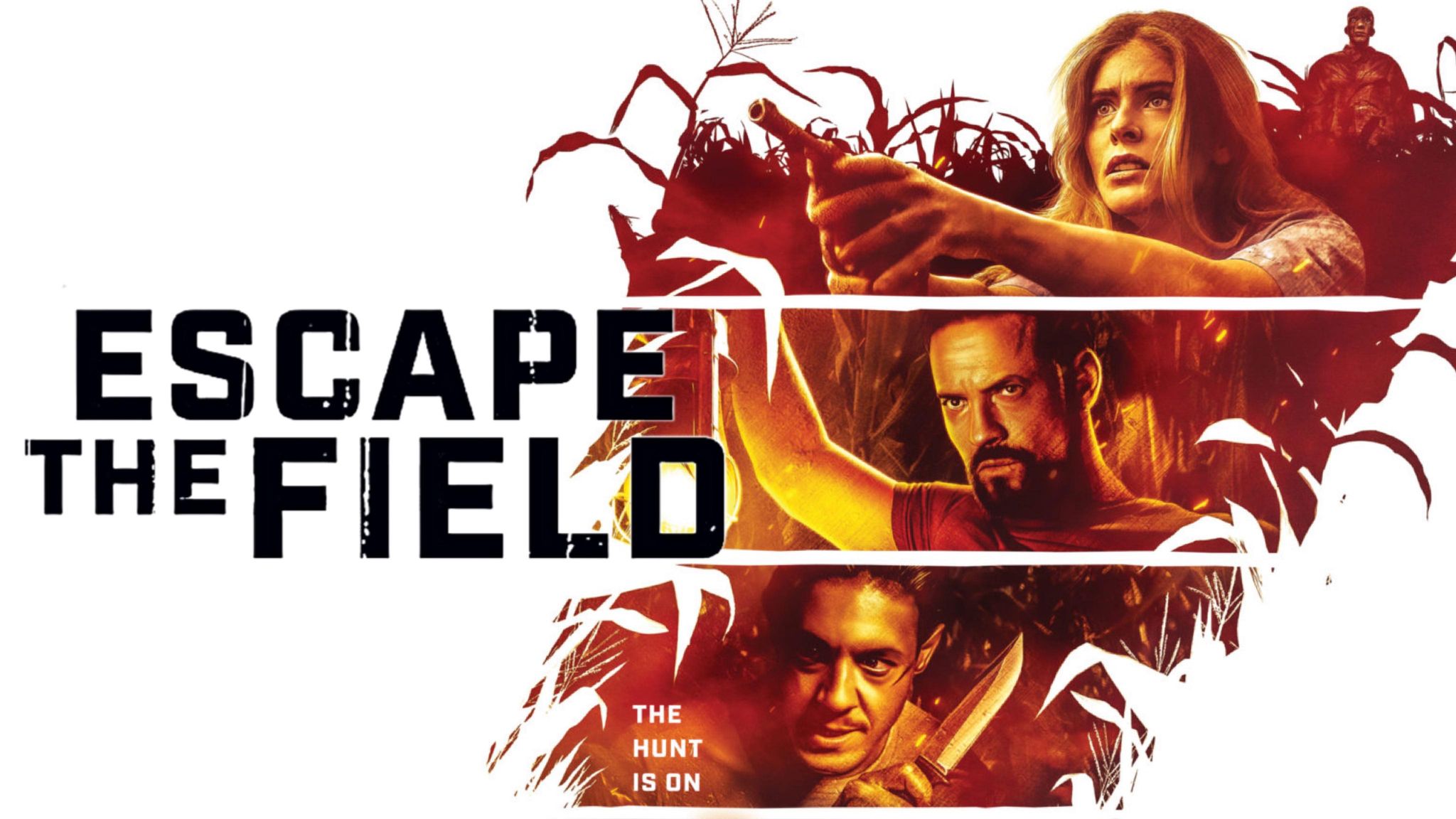





A group of unconnected strangers wakes up in a mysterious field filled with rotting crops as well as no small number of deadly traps. Who, or what, has brought them here, and for what purpose? The items left on their unconscious bodies may hold answers if they can just work out what to do with these clues before something stalking them in the corn manages to pick them all off one by one…
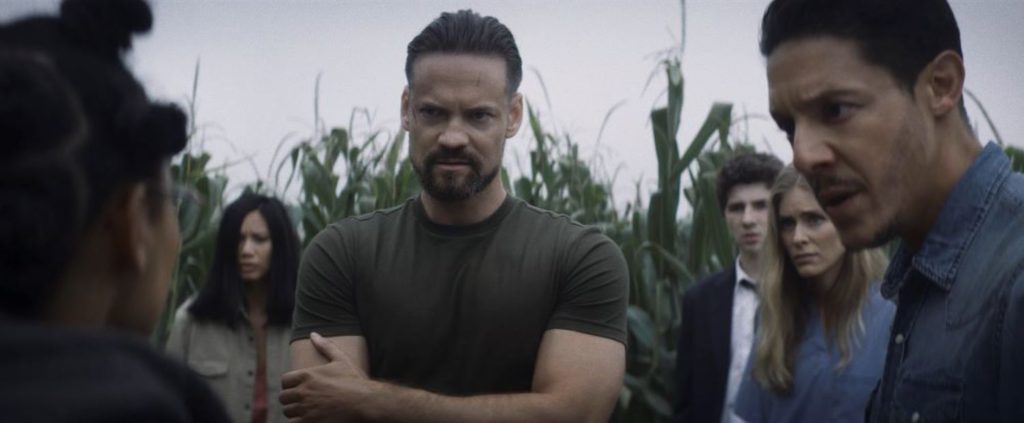
Lionsgate Studio is releasing into cinemas a new entry in the very specific “spooky field” subgenre. Comparisons to Joe Hill and Stephen King’s In The Tall Grass on Netflix are going to be inevitable, but unfair. Escape the Field is more mystery than confusion-driven, the field here representing a puzzle to solve rather than a hungry eldritch abomination – having more in common with Cube or the recent Escape Room franchise. This is a streamlined mystery box, Lost on fast forward. There’s an almost alarming breakneck pace to the feature that on the one hand is a refreshing experience in a world of streaming series set to string along binge-watchers, yet the speed events move at here is also a double-edged sword. There’s never quite enough time to care about the characters or the scenario as the audience keeps on moving along from one thing to another being breezed past on the screen. Without time to linger, there’s no real-time to mentally unpack what’s happening. This crafts a pretty novel experience without an ounce of fat on it, but it fails in other ways as a coherent story. Especially for a story so mystery-driven.
What Escape the Field does right makes for a pleasant enough time. Waking up in a field full of strangers with no idea how you got there is only the setting, the premise is the paranoia and panic that follows. A cast filled with actors you recognise but can’t quite place the name of all do a fair job of running with their pretty thin characters, despite events going so broad and wasting so little time it can sometimes give the feeling it’s just stuff happening at random to shallow trope characters going through the motions in a maze. Characterisation still is present, at times impressive in its subtle delivery that eschews wasting any time with hand wringing exposition. Clothing, mannerisms, and speech patterns get the audience up to speed with minimal wasted time. Yet this is the double-edged sword of Escape the Field, by taking such a no-nonsense accelerated approach to tell a story, everyone’s character arc gets told in broad strokes that lean heavily into familiar tropes.
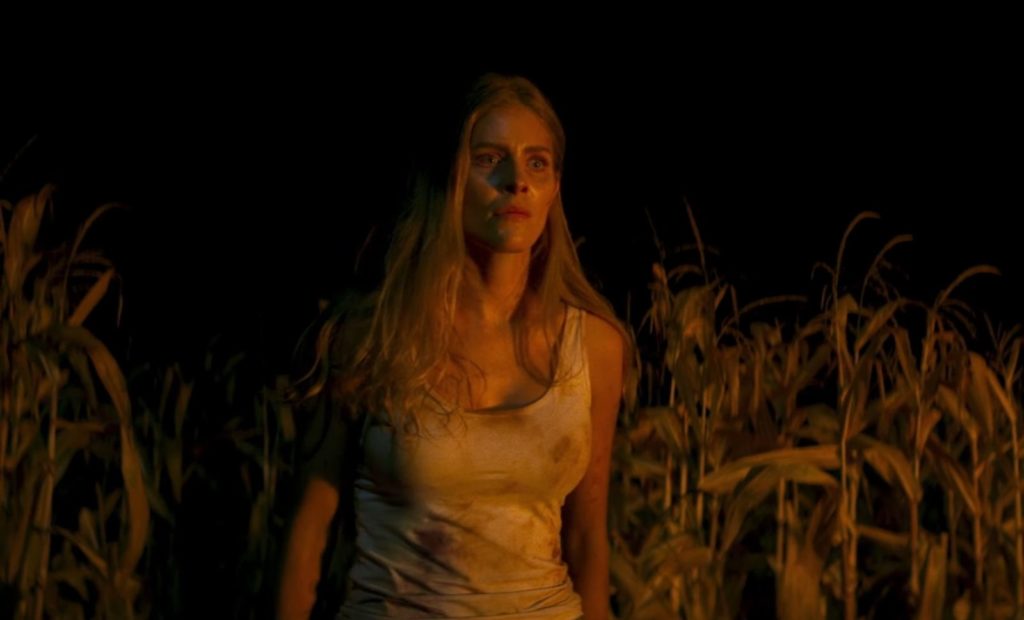
Similar to the performances of the cast, the cinematography on display is solid and no-nonsense. Everything feels to a high studio standard that deserves a theatrical release: daylight scenes are crisp, night scenes are lit to be easily followed while still oppressively dark, and the sound mixing is clear whether it’s quiet or turned up to high gear for action (an underrated achievement that lower budget horror can fall afoul of). I’m not entirely sure how much of the setting was a designed set and what was on location; which is a testament to how good a job they have done constructing their creepy field to trap, challenge, and punish its cast of hapless victims. While it would be easy to make a disorientating field shot to be oppressively confusing and a boring mess due to how similar everything looks by design, despite this potential pitfall the deadly field and its mysteries remain compelling for the most part.
While a simple setting with streamlined plotting doesn’t necessarily mean the scenario will be boring, there’s a nagging sense throughout that Escape the Field could have been doing more. The filmmakers needed to go either deeper in character or plot, ideally both. What remains risks not being memorable once the credits have finished rolling. Only the very surface of the concept gets scratched, as much as all the elements for something great are present they don’t get fully explored. Still, Escape the Field represents an underserved subgenre of human lab rat horror, not to mention the very niche “creepy field” aesthetic, and it will have fans among those who just aren’t getting enough of this content elsewhere. Everyone else needs to be ready for a basic but competently made popcorn thrill ride that runs to a lean 88 minutes. It may yet have a more interesting sequel it could expand its ideas into, so supporting Escape the Field is a fair call for anyone interested in new genre IPs, but what was committed to the screen may ultimately be forgettable – if fun enough – studio horror fare.
More Film Reviews
When looking at the origins of sukeban media, the first representation of the genre came in 1967 with Taro Bonten’s Modern Delinquent Girl Stories manga; with the first proper sukeban… Slasher Horror With a Conscience It’s no secret that as a society, we have become obsessed with serial killers. The most popular podcasts and television series over the past decade… It was about halfway through watching Rob Jabbaz’s debut feature The Sadness that I realized I was in the hands of a maniac. Taipei resident Kat (Regina Lei) is hiding… Ten years ago in 1994, I was walking into the local bookstore to pick the new…wait….that was 27 years ago? Fine then, I will start over. Almost 3 decades ago,… After stepping away from filmmaking since 2019’s charming musical comedy Dance with Me, director Shinobu Yaguchi makes his return with Dollhouse (2025), a horror tale centered on a cursed doll,… When About a Place in the Kinki Region (2025) was first announced, I wasn’t able to discern that it was directed by Koji Shiraishi—the announcement came in the form of…
Three She-Cats (1966) Film Review – Paving The Way For Delinquent Women Cinema

Random Acts of Violence (2019) Film Review
The Sadness (2021) Film Review- A Powerful, Repellent Horror Spectacle
Fear Street Part One: 1994 Film Review – Nostalgia Soaked Horror

Dollhouse (2025) Film Review – A Perfect Example of How Effective Tropes Can Be When Handled Correctly

About a Place in the Kinki Region (2025) Film Review – Everything You Want from a Koji Shiraishi Film
Luke Greensmith is an Editor at the Grimoire of Horror and an active folklorist as well as working in film across a few roles. While this can cover quite a wide range of things, he’s a dedicated horror fan at heart and pretty involved with horror communities both online and local to him. You can find their folklore work on the Ghost Story Guys Podcast, their own LukeLore podcast, and accompanying the artist Wanda Fraser’s Dark Arts series as well as on the Grimoire of Horror itself.