





Village of Doom is a 1983 Japanese period crime thriller, written by Bo Nishimura and Takuya Nishioka, and directed by Noboru Tanaka. Primarily working as a Roman Porno director under Nikkatsu Studios, Tanaka began his directorial career with the softcore drama Beads from a Petal (1972) and continued to make many classic pieces of Nikkatsu’s memorable film catalog–such as (Maruhi) shikijô mesu ichiba (1974), Angel Guts: Nami (1979), and Rape and Death of a Housewife (1978).
After a diagnosis of tuberculosis prevents him from joining the military and serving in World War II, a young man becomes ostracised by the members of his small, rural village. As a result, the emotionally distraught man executes a spree of mass murder to take revenge on those who excluded him.

Based on the infamous real-life tragedy of the Tsuyama Massacre, Village of Doom is a visceral reenactment of the killing spree that occurred in Kamo, a small village near the city of Tsuyama, Okayama Prefecture on May 21, 1938. Mutsuo Toi, a 21-year-old man, who, after being diagnosed with Tuberculosis, goes on a brutal killing spree after being shunned by the entire village. Using a Remington M11/Browning Auto-5 shotgun, Katana, and axe, the perpetrator savagely murdered 30 people, injured 3, and took his own life in what is still considered one of the deadliest mass shootings in Japanese history.
Taking the time to construct its narrative organically, Village of Doom introduces the majority of its plot through naturalistic, character-driven interaction rather than a scrolling info dump like many true crime horrors of the time. The period, characters, and story are all introduced incrementally, weaving an intrinsically beguiling tale that will absorb its audience fully. Additionally, beginning with our protagonist’s life before his unfortunate diagnosis, the film’s themes of ostracisation and isolation hold more weight when introduced–effectively conveying the negative effects this has on Tetsuo’s psyche.
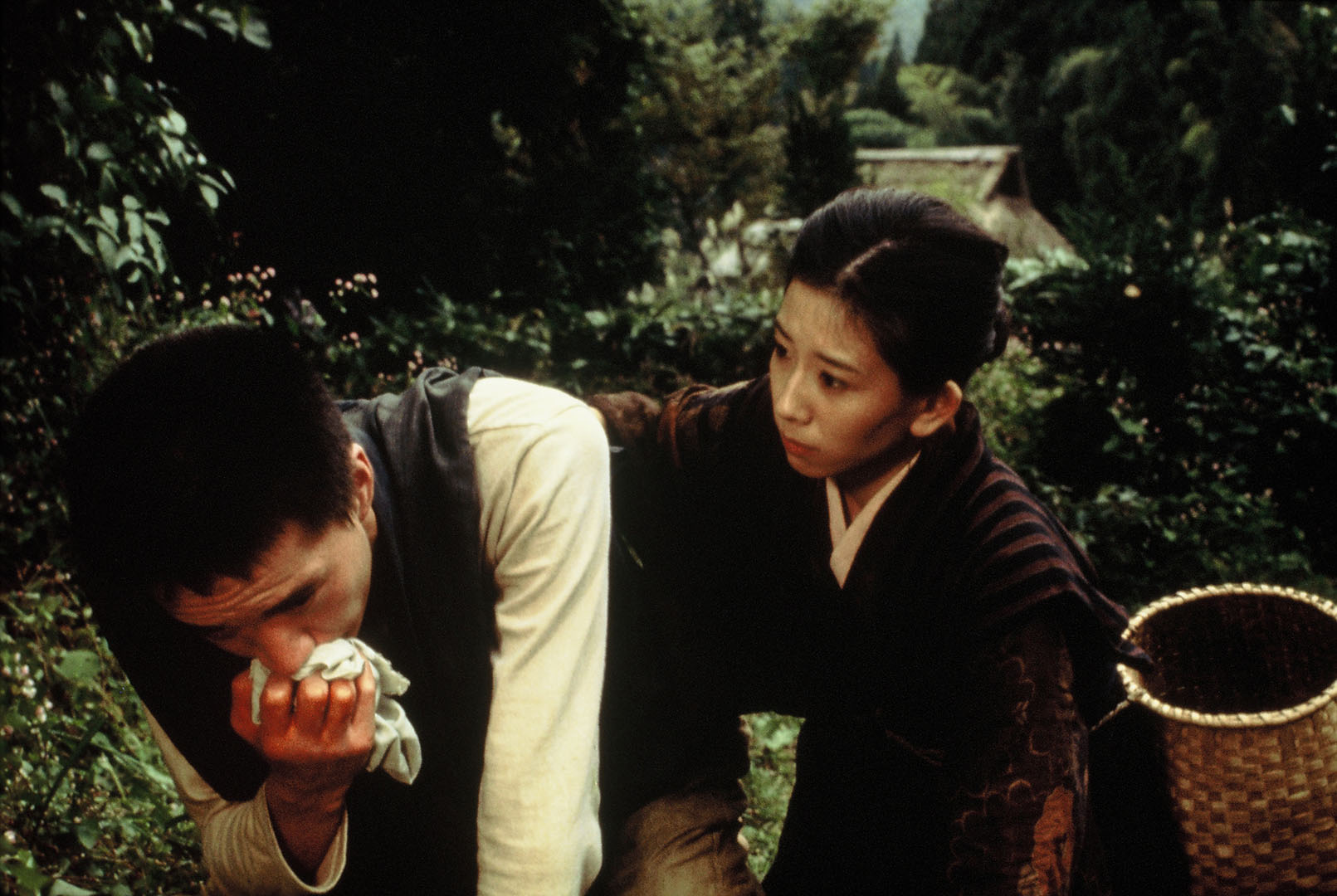
While Village of Doom is presented as a tragedy piece, Tanaka certainly hadn’t forgotten his roots in Roman Porno–featuring several scenes of softcore sex littered throughout the film. Furthermore, the third act provides an unhindered depiction of graphic violence as our protagonist’s killing spree begins–providing an overtly visceral rampage of bloody carnage. As such, the film undoubtedly resides closer to the pinku eiga/exploitation genre.
Although several of these murders happen off-screen, thanks to some effective cinematography and gruesome effects, these scenes are still depicted as undeniably ferocious. However, the majority of these cold-blooded acts are fully visualised, holding very little back in terms of brutality–murdering men, women, and children indiscriminately. From gunshot wounds, stabbings, and an impressive head explosion, these barbaric acts are actualised through some astounding practical special effects–unquestionably strengthening their impact.

A brutally realistic recreation of a historic mass shooting, Village of Doom’s blending of true crime, pinku, and exploitation culminates in an adroitly sanguinary experience overall. With fantastic performances, a slow-burning narrative, and grisly special effects, Tanaka’s masterful direction truly captures the horrors experienced that fateful night in 1938–sure to entice fans of both true crime and Japanese cinema.

Village of Doom (1983) can be purchased from Unearthed Film’s website here.
More Film Reviews
Echoes from the Grave Film Review – Modern Retellings of the Classic Works of Poe
I’m sure in one way or another, everyone is at least somewhat familiar with the works of Edgar Allen Poe. From the plethora of film adaptations as well as their…
![Pareidolia (2023) Review – A Short Film with Big Scare [FrigthFest]](https://www.grimoireofhorror.com/wp-content/uploads/2023/08/Pareidolia-10-365x180.jpg)
Pareidolia (2023) Review – A Short Film with Big Scare [FrigthFest]
Pareidolia is a 2023 short horror film directed by Aaron Truss, whose previous work includes the wonderful full-length documentary Cult of VHS (2022). Amazingly, this newest project was brought to…

The Exile (2025) Film Review – Bengali Folk Horror
The manner in which mainstream Bengali cinema sidesteps serious horror, almost as though it were a contagious disease, is a phenomenon deserving scrutiny. Bengali culture, from its expansive literary canon…

Black Friday (2021) Film Review – Capitalism is Hell
In the anti-consumerist horror comedy Black Friday, a ragtag group of toy store employees try to fight off an infectious horde of customers during the worst day of the year…

Stopmotion (2023) Film Review – The Magic of Animation
A bizarre blend of Phil Tippett’s Mad God and Dario Argento’s Suspiria, Robert Morgan’s feature debut Stopmotion (2023) is an indie horror film that weaponizes the maddening process of stop…

Ghostbusters: Afterlife – Film Review from a Nostalgic Fan
IN THE BEGINNING In 1984, Ghostbusters was the first film I was allowed to see in the theatre without my mother. My friends and I sat close to the screen,…

Hey there, I’m Jim and I’m located in London, UK. I am a Writer and Managing Director here at Grimoire of Horror. A lifelong love of horror and writing has led me down this rabbit hole, allowing me to meet many amazing people and experience some truly original artwork. I specialise in world cinema, manga/graphic novels, and video games but will sometime traverse into the unknown in search of adventure.