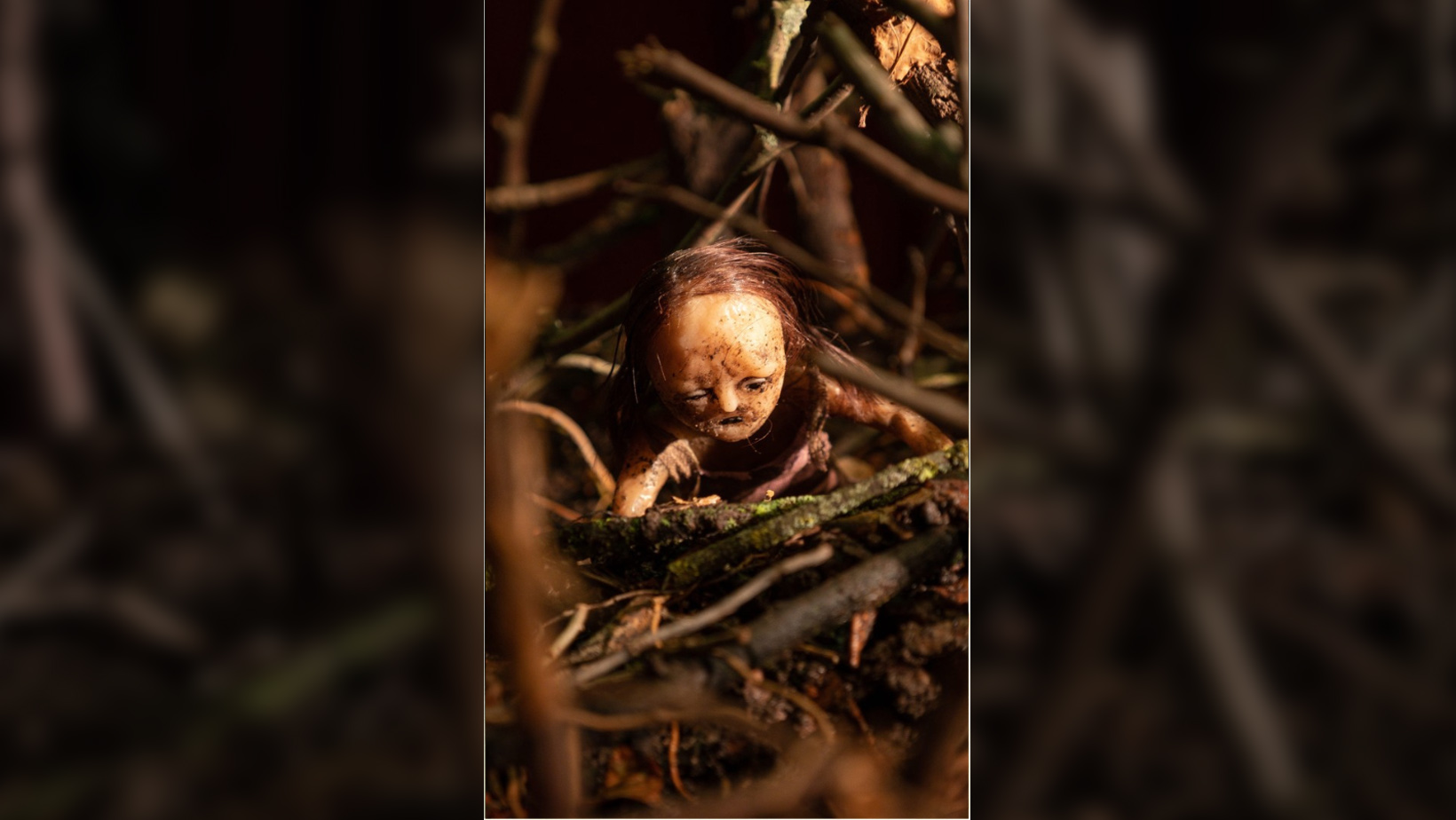





A bizarre blend of Phil Tippett’s Mad God and Dario Argento’s Suspiria, Robert Morgan’s feature debut Stopmotion (2023) is an indie horror film that weaponizes the maddening process of stop motion animation to aim at its audience’s nerve endings, with fabulously gnarly results.
If Phil Tippett’s epic 2021 passion project uses stop-motion animation to look outward with expansive hell-scapes demonstrating the cruelty of existence, then Stopmotion uses it to look inward at the human psyche, and the treacherous bond between an artist and their art. Daughter of a legendary stop motion artist, the unstable Ella Blake (Aisling Franciosi) struggles to break free from her mother’s reign over her autonomy and her mind. But when confronted with a rare opportunity to tell her own story, she confuses hallucinations for reality and spirals into a nightmarish reckoning: to create a truly unique and personal film… she must put a piece of herself into it.
Franciosi’s performance as Ella is enchanting, and channels Jessica Harper’s immortal portrayal of Suspiria’s final girl Suzy Bannion both in expression and appearance. Morgan wants us to see what Ella sees; we assume her twisted, fantastical perspective through the lashings of vibrant, nonsensical colours engulfing the frame (Léo Hinstin’s cinematography being another nod to Argento, perhaps) and brilliantly expressive production design by Felicity Hickson that seems to bend and contort her, and subsequently our, surroundings. The fierce creativity and wackiness in the stagings and settings of sequences is a testament to the gutsy ambition of the Shudder-backed indie project. Stopmotion uses any potential limitations due to its small budget as strengths, crafting an ambiguous, dream-like world where logic and reason sit firmly in the backseat, privileging its devilishly daring imagery. Morgan and Robin King’s storytelling is economical and the editing by Aurora Vögeli is razor sharp: no filler, just killer.
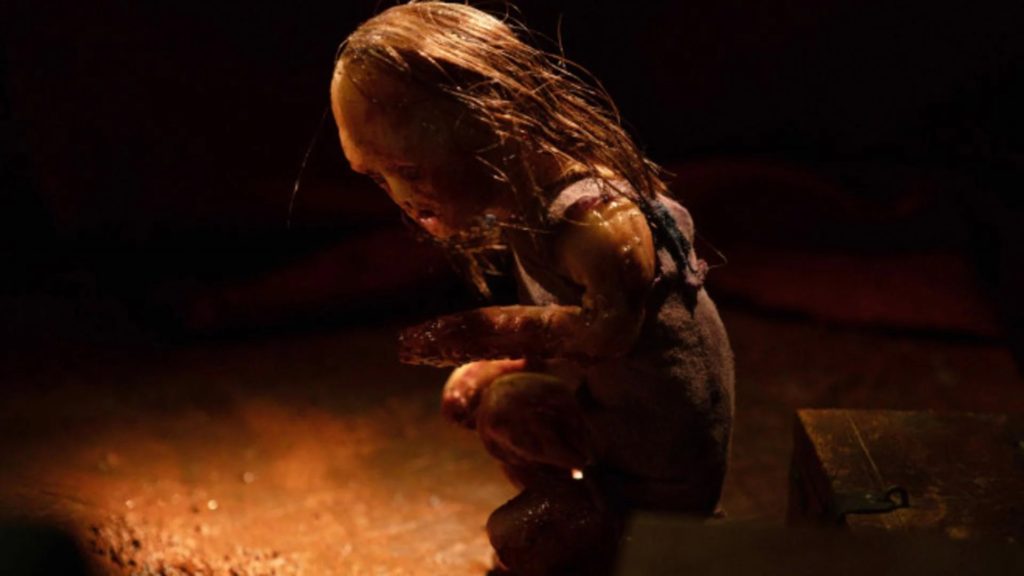
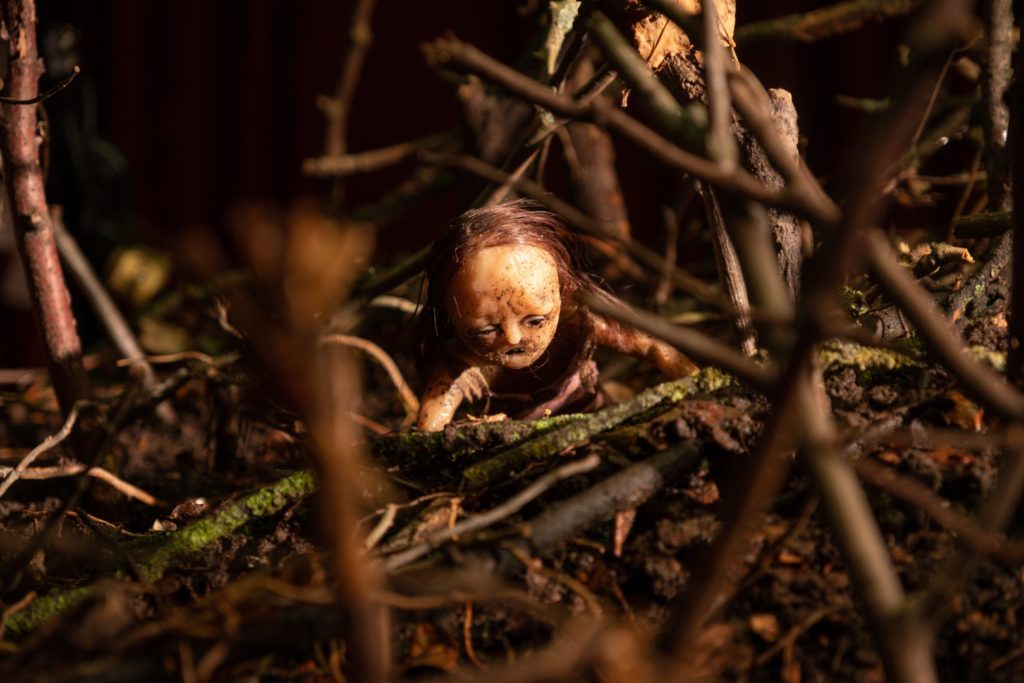
The stop-motion indents themselves are fantastic: little nightmares wrought out of twisted adaptations of children’s fairy tales, unsettling sound design, and a uniquely horrifying mixture of flesh, wax, and dirt molded into creepy figurines. Sometimes these excerpts are so involving that adjusting to the normality of live-action is difficult, and we are left yearning for the next installment of Ella’s project, which depicts a little girl being terrorised by a sinister figure named ‘The Ashman’. This story is an allegorical key into the locked door of Ella’s trauma; the key fits the lock, but the door still isn’t budging. The film undoubtedly produces more questions than answers, particularly in the off-the-wall final five minutes of terror, but it still tactfully manoeuvres through complex topics and themes throughout the 93-minute runtime.
This is undoubtedly a film about filmmaking. Although Stopmotion is a feature-length debut, Morgan has a backlog of stop-motion animation short films, dating back to 2009. His YouTube channel is a dungeon of Freudian nightmares that melds Lynch with Cronenberg: a collection of meticulously laboured-over projects that are brimming with talent in relaying stories and building atmosphere. The grotesque masterpiece Belial’s Dream exemplifies the attention to detail required for stop-motion horror animation, and its dark introspection leaks into the character of Ella in Stopmotion. Morgan, more than anyone, understands how much one must give to this art form, evident in the rigorous sequences where Ella’s mother orders her to move the figurines mere millimetres to capture the illusion of movement, berating her if she goes even slightly wrong. Suffering is intertwined with art from the very beginning.
The creative process is hell for Ella: she leaves her work behind, distracts herself by spending time with her kind-but-facetious boyfriend, and even takes ecstasy at a party in one standout sequence, yet she finds herself gravitating back to her mother’s house, slaving away under the harsh studio lighting, fiending for artistic perfection. She is riddled with paranoia that her ideas will be stolen and that her relationships distract her from the story she was destined to tell, so she banishes herself to her work and only her work… to disastrous effects.
Stopmotion has you covered if you’re in the mood for a bloody practical effects spectacle, or conversely a psychologically tormenting love/hate letter to the addiction of filmmaking. A visceral thrill that maps the tired trope of the ‘tortured artist’ onto an underrepresented, refreshing medium where the innate madness required to make art is examined frame by frame, millimetre by millimetre.
More Film Reviews
Satanic Hispanics (2022) Film Review – A Kick-A** Horror Anthology
A police raid uncovers a mysterious figure who refers to himself as ‘The Traveler’ (played by Efren Ramirez), and as the sole survivor of a massacre, he is brought in…
Benny Loves You Review – Toy Story: Murderous Millennial Edition
Anyone who’s read Straight Outta Kanto’s previous reviews will know that I like my budgets low and my horror, comedy. That being said, when going in to what one knows…
Cosmetic DNA Film Review (2020) – Fashionable Androcide
Part of the JFFH (Japan Film Fest Hamburg) 2021 line-up, Kenya Okuba’s Cosmetic DNA was a title that instantly caught my attention with the flashy trailer promising a techno-laden, neon-drenched…

Resident Evil: Welcome to Raccoon City (2021) Review – Itchy, Tasty!
Welcome to Raccoon City is very different in style from the Resident Evil movies featuring Milla Jovovich. While also live-action, it embraces a very different feel and quality, though is…
![Haunted Ulster Live (2023) Film Review – Tune In for Horrors Near You [Unnamed Footage Festival 7]](https://www.grimoireofhorror.com/wp-content/uploads/2024/03/Haunted-Ulster-Live-Title-Card-365x180.jpg)
Haunted Ulster Live (2023) Film Review – Tune In for Horrors Near You [Unnamed Footage Festival 7]
In the tradition of pseudo-local-TV broadcasts like Ghostwatch and WNUF Halloween Special, homegrown horror heads to N.Ireland in Dominic O’Neill’s Haunted Ulster Live. Set in 1998, TV newscaster Gerry Burns…
Baby Assassins (2021) Film Review – Moe Moe Kyun!
I didn’t really have a whole lot going during my high school years. I went to class and did stupid hijinks with my friends, but I mostly just watched movies…