





Urotsukidoji II: Legend of the Demon Womb is a 1991 adult-oriented sci-fi horror anime film written by Toshio Maeda, Shô Aikawa, and Kôichi Ôhata, and directed by Hideki Takayama. The film is the second part of the anime adaptation of the infamous ero guro series, comprised of Urotsukidoji: Legend of the Overfiend (1989), this film, Urotsukidoji III: Return of the Overfiend (1992), Urotsukidoji IV: Inferno Road (1993), the incomplete Urotsukidoji V: The Final Chapter (1996), and the attempted reboot of the series, New Urotsukidōji: New Saga (2002).
Unbeknownst to Jyaku and Megumi, in 1944, the Nazis attempted to summon the Overfiend’s nemesis: the Lord of Chaos (Kyō-Ō). Top scientist Dr. Münchhausen and his son invented a perverse death-rape machine to summon the Lord of Chaos—but the machine overloaded, helped to destroy half of Berlin—leaving Münchhausen II alive, but psychologically scarred.

During his adolescence, Münchhausen II discovers his father’s journal and tries to uncover the secrets of the Jyujinkai and the Makai. He finally succeeds and reawakens Kohoki—a demon banished to hell for eternity—into the human realm, and the two form an infamous partnership.
Cut to the present day, and Münchhausen II is trying to fulfill his father’s work—to summon the Lord of Chaos—but to make sure it will work this time, he needs a human sacrifice. And it just so happens Tatsuo’s cousin Takeaki Kiryu is on the next plane to Osaka…
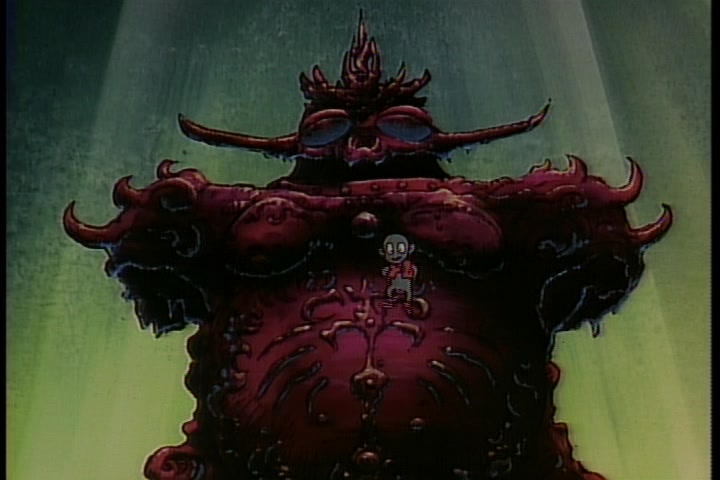
Serving as both a direct sequel and a slight prequel to the first film, Urotsukidoji II: Legend of the Demon Womb’s narrative adheres to the blend of dark fantasy, horror, and extreme eroticism established previously. The grotesque imagery and nihilistic tone underscore the narrative’s core themes of corruption, destiny, and the fragility of human morality expertly. Furthermore, the adult content still plays a key role in the juxtaposition of extreme violence. However, while there are notably fewer of these scenes than previously, being somewhat less central overall, they remain excessively explicit.
Additionally, this sequel expands on the previously established mythos of the three realms—Human, Demon, and Man-Beast—delving deeper into the apocalyptic prophecy surrounding the Overfiend. Urotsukidoji II: Legend of the Demon Womb attempts to build on the chaotic cosmology of its predecessor by introducing new characters and deepening the lore.
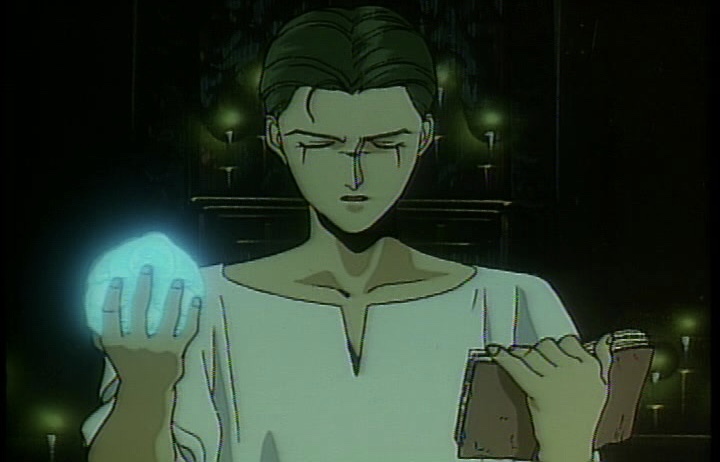
Retaining the grim fascination of the first film, Urotsukidoji II: Legend of the Demon Womb certainly doesn’t disappoint when it comes to its visceral content. The violence depicted is impressively gruesome as before, with plenty of indiscriminate dismemberment, mutilation, and disembowlings the series has become synonymous with. Additionally, the film’s sexual content is equally vivid, delivering an evocative display of grotesque eroticism. However, while both films implement a similar disturbing tone with their content, Demon Womb is undoubtedly less intense than its prequel–giving the audience more breathing room between these scenes than before.
An overall improvement from its prequel, Urotsukidoji II: Legend of the Demon Womb builds on the foundation laid by its predecessor to refine the overall formula of the genre. With its astounding hand-drawn animation, complex themes, and extreme violence, the anime is sure to entice fans of the previous entry, ero-guro fans, and adult anime enjoyers alike.

More Anime Review
It is an undeniable fact that some horror fans also can be huge softies. We enjoy our healthy dose of gore, scares, and violence, but we are not dead inside…. In 2015, someone posted on 4chan asking a simple question: “What’s the most ***** up thing you have seen on the Deep Web?” Skipping all the explanations why this question… Crimson Climax is a three-part erotic yuri horror drama based on the Adult visual novel game Hotaruko by Tiger Man Project. The anime was directed by Daiitiya Otosime and Katsuma… Sometimes love makes you crazy, and sometimes makes you want to stab someone right in the middle of their chest. Just as the Japanese term defines it, a “yandere” is… Alien from the Darkness (Inju alien) is a 1996 adult sci-fi horror anime OVA, written by Shino Taira and directed by Norio Takanami, and distributed by Pink Pineapple. This title… With the latest Higurashi series wrapped up as of just last week, it’s time for a spoiler-filled review for the fans that want to dissect the heart (and other organs)…
Natsume’s Book of Friends (2008) Anime Review – A Wholesome Horror
Urban Mysteries: The Search for Saki Sanobashi AKA Go for a Punch

Crimson Climax (2004) Anime Review – A Dark Tale of Human Sacrifice, BDSM, and Murderous Mannequins

Top 7 Yandere Anime Characters That Are Not Yuno Gasai
Alien from the Darkness (1996) Anime Review

Higurashi no Naku Koro ni Gou (2021) Review: A Deep Dive into Time Loops of Discomfort

Hey there, I’m Jim and I’m located in London, UK. I am a Writer and Managing Director here at Grimoire of Horror. A lifelong love of horror and writing has led me down this rabbit hole, allowing me to meet many amazing people and experience some truly original artwork. I specialise in world cinema, manga/graphic novels, and video games but will sometime traverse into the unknown in search of adventure.