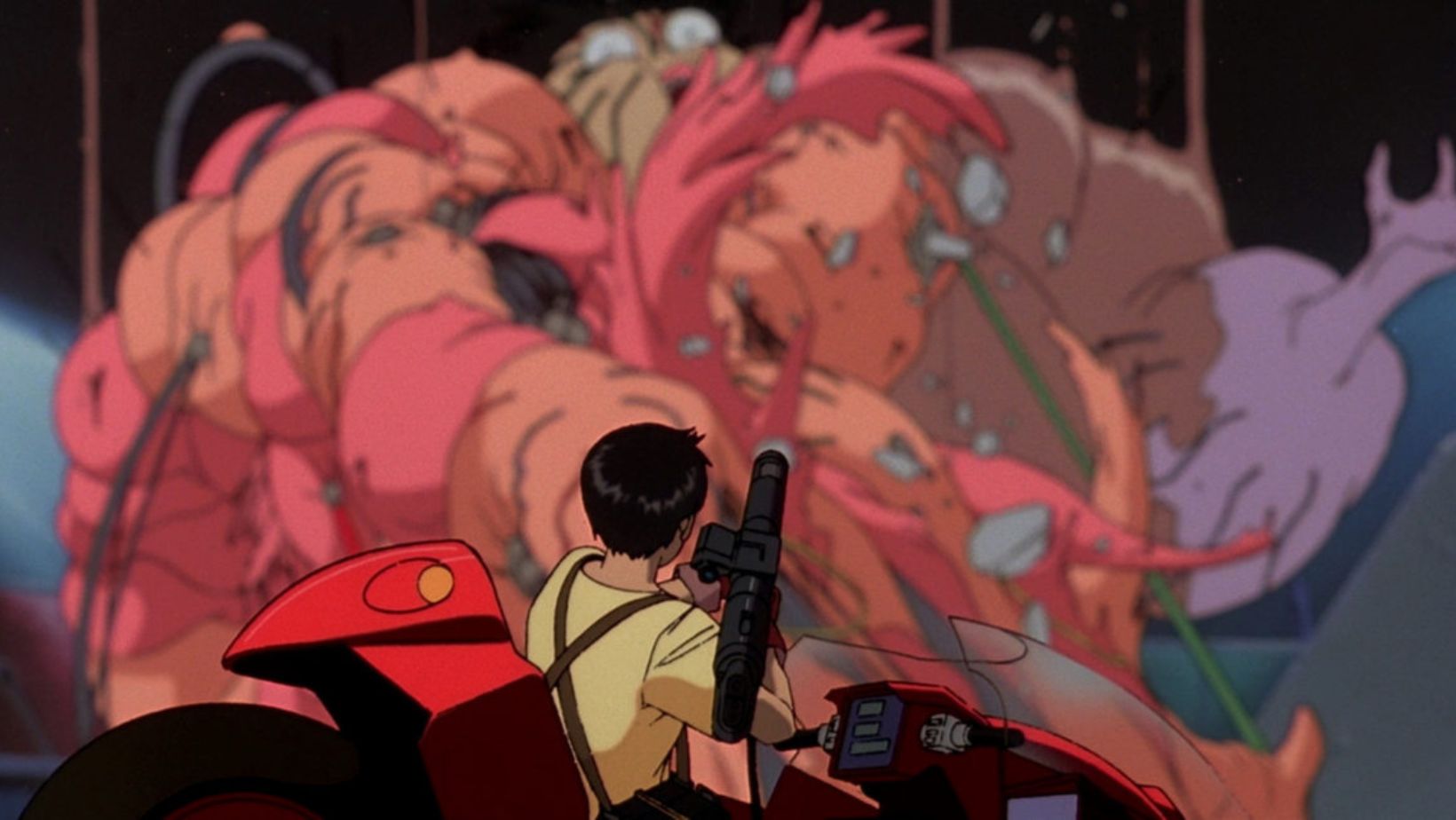




Akira (1988) is a classic film, no doubt, as a cyberpunk adventure set in a decaying Tokyo, no different from the dystopian lifestyle of Neon Genesis Evangelion in which the traumatic circumstances have parallels. Corruption, terrorism, and crime are rife – safety is a negligible concern in the downtrodden society of casual indifference. The film is a perfect example of darker contemporary Japanese animation and a rare instance of anime being praised to the level of fine art – it even exists as common knowledge amongst film buffs. Value of the film aside, however, and also the overall concepts, I would like to highlight particular sequences which are horrifying – proof a film doesn’t need to be overtly (or wholly) horror to have moments of such. The first is a nightmare showing the futility of our protagonist and the second of the body horror of a friend’s mutation into a powerful, immature tyrant.
The bleak society is a cushion for the atmospherically repressive and somber tone contouring a cynical plot of conspiracy and destruction – a bitter baseline for the narrative to follow. We witness Shōtarō Kaneda, who leads an unruly biker gang (known in Japan as bōsōzoku) named ‘The Capsules’, as they prowl the chaotic streets of Neo-Tokyo. His, however, misfortune leads him into an encounter with a dangerous entity – an Esper endowed with profound psychic abilities – which the Japan Self-Defense Force is ruthlessly hunting. Kaneda, and his companions, are soon embroiled in the scheme of the military seeking to research and utilize these Espers for their own agenda – The Project.
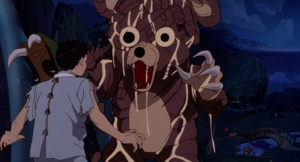
A favourite scary moment of mine is when the Espers develop an interest in Tetsuo for his potential and he has an experience serving as an agonizing prelude to his horrifying change. He experiences an unforgettable nightmare – induced by the Espers’ will or perhaps a consequence of his involvement in their affairs – which is a deeply unnerving sequence of note: animate toys crawling around his bed in a stalking fashion, an oversized teddy bear and rabbit looming over him in the darkened room as they both leak a viscous liquid, the room itself melting into toy blocks and a malicious air pervading his powerless response to such surreal terrors beyond his human abilities. As the hallucinations of rogue toys shatter, the Espers are unveiled levitating – they’re likely behind the creepy ordeal (or some may postulate it was merely imagined). The scene is memorable as a moment of pure horror in an otherwise grounded plot until later as his psychic powers are unleashed onto society.
The experience of otherworldly forces, and the conventional world being distorted with a dream logic (or psychic control), is a disturbing situation – nothing is safe, sane, and sound anymore. The unshackling of physical laws is a significant insinuation of the impending disasters as psychic forces become unrestrained and uninhibited – they will unravel dangerously to potentially repeat a crisis that contributed to the world being in the unruly state we presently see, probably worsening the misery of everyday life, as a harrowing fate not unlike postwar countries.
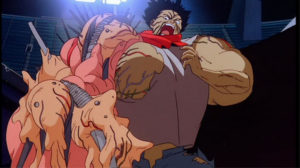
Tetsuo – a close friend of Kaneda and secretly a rival of his – subsequently develops his psychic powers, transforming him into a monstrous form worthy of body horror and likely inspiring ‘Tetsuo: The Iron Man’; mutating into a bulking, grotesque figure who endangers the whole of Neo-Tokyo from the extent of his immense but indiscriminate powers. Immature but empowered, Tetsuo becomes a hulking menace whose childlike disregard enables him to cause carnage without a second thought – risking the possibility of another ‘singularity’ to annihilate the whole city due to uncontrolled psychic energies.
These psychic forces – transcending any human abilities to be unpredictable if not uncontrollable (despite the military’s hubris) – have scary implications to the society comprised of typical lives trying to restore a stable way. As with Tetsuo’s final explosive form, or his nightmare prior to his psychic state being realised, humanity is relatively ineffective to do much in their constrained capabilities – they are powerless to withstand the might of these otherworldly threats emerging and are paralysed to simply endure; these will change the world, even the people themselves, arbitrarily. Fear is the only reaction to such an extreme force bending the reality we know – be it playfully induced surrealism or mass destruction of urban areas – while humanity is rendered moot in will to the upheaval.
Film Reviews
In 2009, House of Wax’s Jaume Collet-Serra gave us the modest hit Orphan starring a pre-Conjuring era Vera Farmiga as a mother who, after the death of their unborn child,… Director Koji Shiraishi takes a dip into cryptozoology in Senritsu Kaiki File Kowasugi! File 03: Legend of a Human-Eating Kappa (shortened to File 03). In this third installment in the… Christopher Landon is turning out to be a director I can depend on to deliver stylish and raunchy horror flicks, so I was so excited when “Freaky” first appeared with… READER WARNING: Ghosts starring in this review may contain an excessive amount of exploding glitter. Konnichiwa! Bonjour! What’s the story, bud!? Straight Outta Kanto here, bringing you a big fat… The Human Trap, a 2021 film by director Lee Moon-young, is a bizarre South Korean indie horror movie that teaches us to trust no one and always look out for… If you ask a Western horror fan, they can probably tell you exactly when they first heard about Hideo Nakata’s cult classic Ringu (1998). Whether it was due to the…
Orphan: First Kill (2022) Film Review – There’s Still Something Wrong With Esther

Senritsu Kaiki File Kowasugi! File 03: Legend of a Human-Eating Kappa (2013) Film Review- Now it’s a cryptid!
FREAKY (2020) Film Review: Was Freaky and I Liked It a Lot!

Sick Nurses (2007) Review – An Absolutely Outrageous EVENT of a Movie

The Human Trap (2021) Film Review – An indie Horror Diamond in the Rough
![The J-Horror Virus (2023) Documentary Review – How Japanese Horror went from Tape to Trend [Nippon Connection]](https://www.grimoireofhorror.com/wp-content/uploads/2024/06/j-horror-virus-2023-cover-365x180.jpg)
The J-Horror Virus (2023) Documentary Review – How Japanese Horror went from Tape to Trend [Nippon Connection]

Some say the countdown begun when the first man spoke, others say it started at the Atomic Age. It’s the Doomsday Clock and we are each a variable to it.
Welcome to Carcosa where Godot lies! Surreality and satire are I.
I put the a(tom)ic into the major bomb. Tom’s the name!