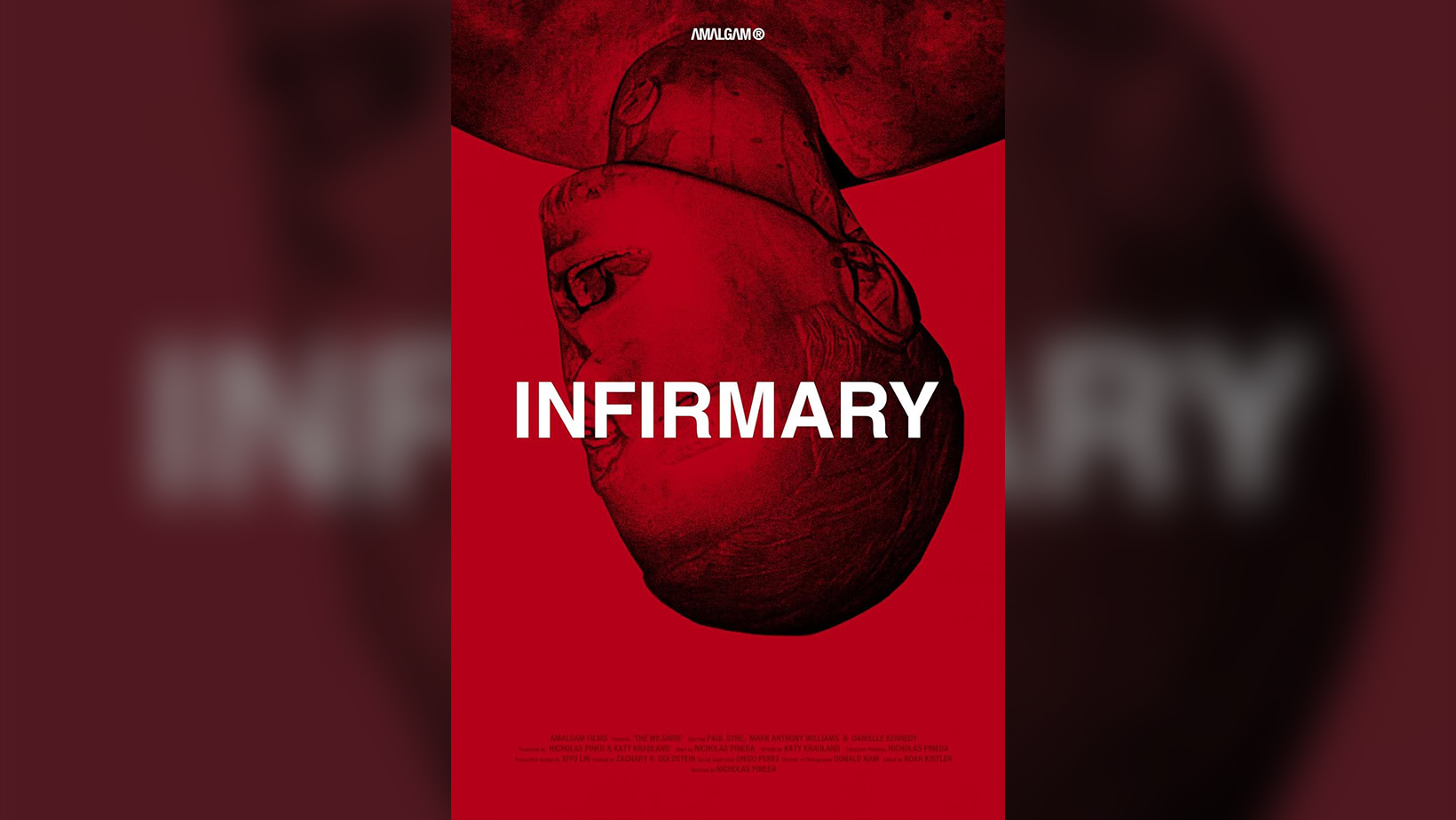





The feature-length debut from director Nicholas Pineda, Infirmary (2026), is a found footage horror film set in a decaying hospital/asylum with a dark past. Here, a young security guard, Edward (Paul Syre), is working his first shift at the Wilshire Infirmary under the guidance of veteran guard and ex-cop Lester (Mark Anthony Williams). A break-in is the start of their problems, as the building’s troubled past manifests in the bizarre mannequins that litter its hallways, relics of decades of cruelty and experimentation by its previous owners.
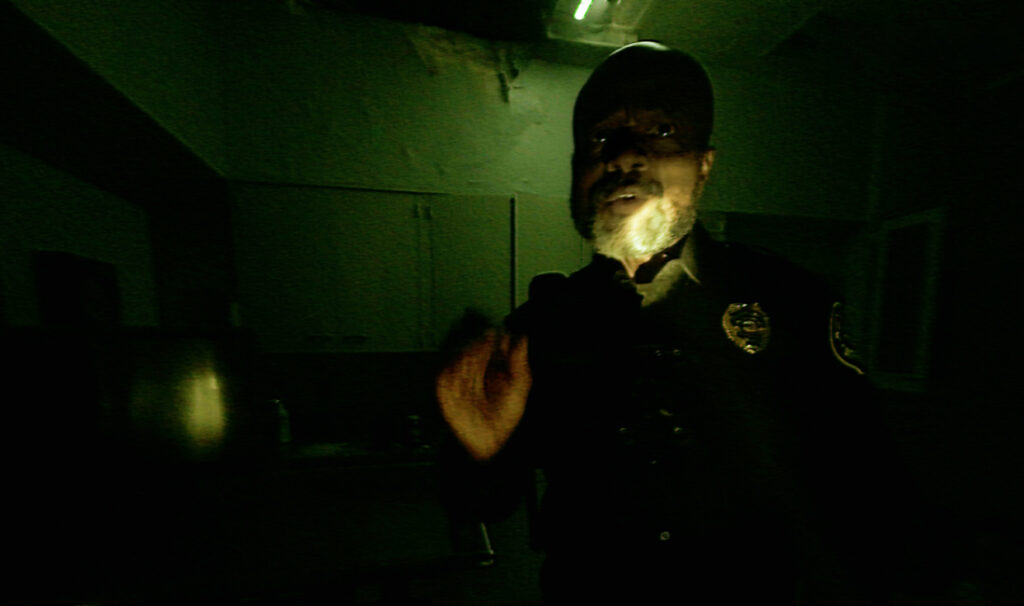
Billed as a character-driven found-footage horror movie, setting oneself in that mindset to start helps immerse oneself in the story. Indeed, the film does an exceptional job of creating a portrait of who Edward is, which also unravels a bit over the course of the runtime, with some clever hints here and there about his true background versus how he presents himself. The protagonist, while soft-spoken and mild-mannered, is nonetheless perfectly cast in Paul Syre. Comparatively, Williams’ Lester adds an oddly charming opposition to the introverted Edward with their banter carrying much of the early film. As a character study, the film succeeds by not being overtly heavy-handed, presenting little tidbits slowly, and offering a degree of mystery throughout.
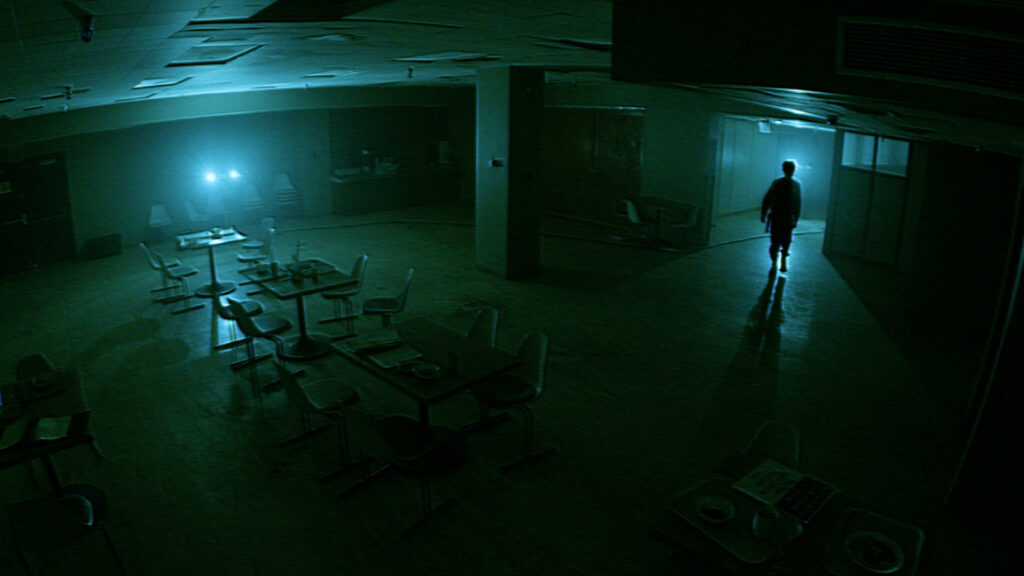
Still, we are here for a horror movie, right? The character development is integral, but all that is meaningless if it can’t pull the trigger when it comes to creating terror. Thankfully, Pineda delivers dripping atmospheric dread, offering a more cinematic vision of found footage, with multiple camera angles via body and security cam, and a phenomenal score from Stephan Bolch, aka Theatre of Delays. The score, as someone who listens to ambient and industrial noise on occasion, offers pretty masterfully crafted soundscapes up there with the best of them, and it utterly immerses one in the terror on screen; the score alone makes Infirmary deserving of the theatrical experience or a good home sound system.
Katy Krauland, who adapted the script from Pineda’s story, successfully builds the lore of Wilshire Infirmary through dialogue. Moreover, it exists in a slightly vague territory that will pique the viewer’s interest without giving too much away; we know the source of the evil but not its exact machinations. It is not frustratingly ambiguous either, but rather the story leaves lingering questions that will keep the movie churning over in viewers’ minds after the credits roll. While the premise does not feel wholly original and falls within familiar genre tropes, it brings enough excitement to put it at the forefront of the saturated found-footage genre.
With as much praise to be thrown at the production, it is important to take a step back, as the format itself always deserves some caveats. The production does at times show its budget, including a blink-and-you-miss-it man behind-the-monster moment. As a found footage fan, minor semas showing is something you tend to acknowledge and move past it. The found footage genre has always existed to champion indie filmmakers and give them the groundwork to express creativity on a budget and further hone their craft. Pineda made the most of the format, delivering an utterly unforgettable experience in found footage horror.
Of course, reactions here will undoubtedly be divisive, as the use of a score is bound to be contentious, and the slow-burning, heavy focus on atmosphere and character development will be a deterrent for those who love the genre for its potential to deliver non-stop scares. The build-up, the teasing of something more sinister bubbling up from the basement of the derelict building, culminates in the more terror-driven final 10-20 minutes of the film, but not everyone will perceive it the same way.
Given my understanding of preferences and the greater found footage fandom’s reception of new movies, I can only offer my own perspective. Infirmary may not be a purist found footage experience, but Pineda and team create an atmospherically stifling horror experience that uncomfortably worms its way into your psyche; give it your full attention, and totally immerse yourself in the visuals and soundscape here, and you are guaranteed an experience that is already poised to be one of the best indie horror films of 2026.
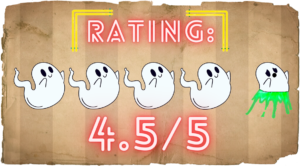
We watched Infirmary (2026) As Part of this year’s Dances With Films NY 2026.
More Film Festival Coverage
When the seventh chapter, titled Disinformation rolled in, the narrator and confessor, Dr. Laura Gale started to talk about things “that are not.” She began debunking famous alien encounter stories that had… Pussycake (Emesis) is a 2021 Argentinian sci-fi horror, written and directed by Pablo Parés, with additional writing from Maxi Ferzzola and Hernán Moyano. Pablo is no stranger in the directorial chair, having over thirty-six productions under his… A Savannah Haunting was an odd but compelling watch at the online edition of the 2021 Dracula Film Festival in Romania. Directed by William Mark McCullough, who is a prolific… Warning to those with mycophobia – this is not the film for you. Gaia is a South African ecological horror film, full of mushroom monsters, skin-crawling body horror and raving… Santiago Mendoza (Harold Torres) is a successful tabloid crime photographer in Mexico City, who has developed a hard exterior in order to deal with the extreme violence he photographs. One… Alongside their dedicated Shorts Showcase (both Canadian and International), the Toronto After Dark Film Festival offers bitesize extras for those attending. Each of the main features is preceded by a…
The Gulf of Silence (2020) Film Review – No Contact! (Unnamed Footage Festival 666)
Pussycake (2021) Film Review – Curiosity Killed the Pussycake
A Savannah Haunting (2021) Film Review – Southern Values And Visitations
Gaia (2021) Film Review: God is Real, and She’s a Fungus
Disappear Completely (2022) Film Review – The Horror of Losing Oneself
![TADFF 2023 Canadian Shorts (Pre-features) [Toronto After Dark Film Festival]](https://www.grimoireofhorror.com/wp-content/uploads/2023/10/Untitled-design-18-365x180.jpg)
TADFF 2023 Canadian Shorts (Pre-features) [Toronto After Dark Film Festival]