





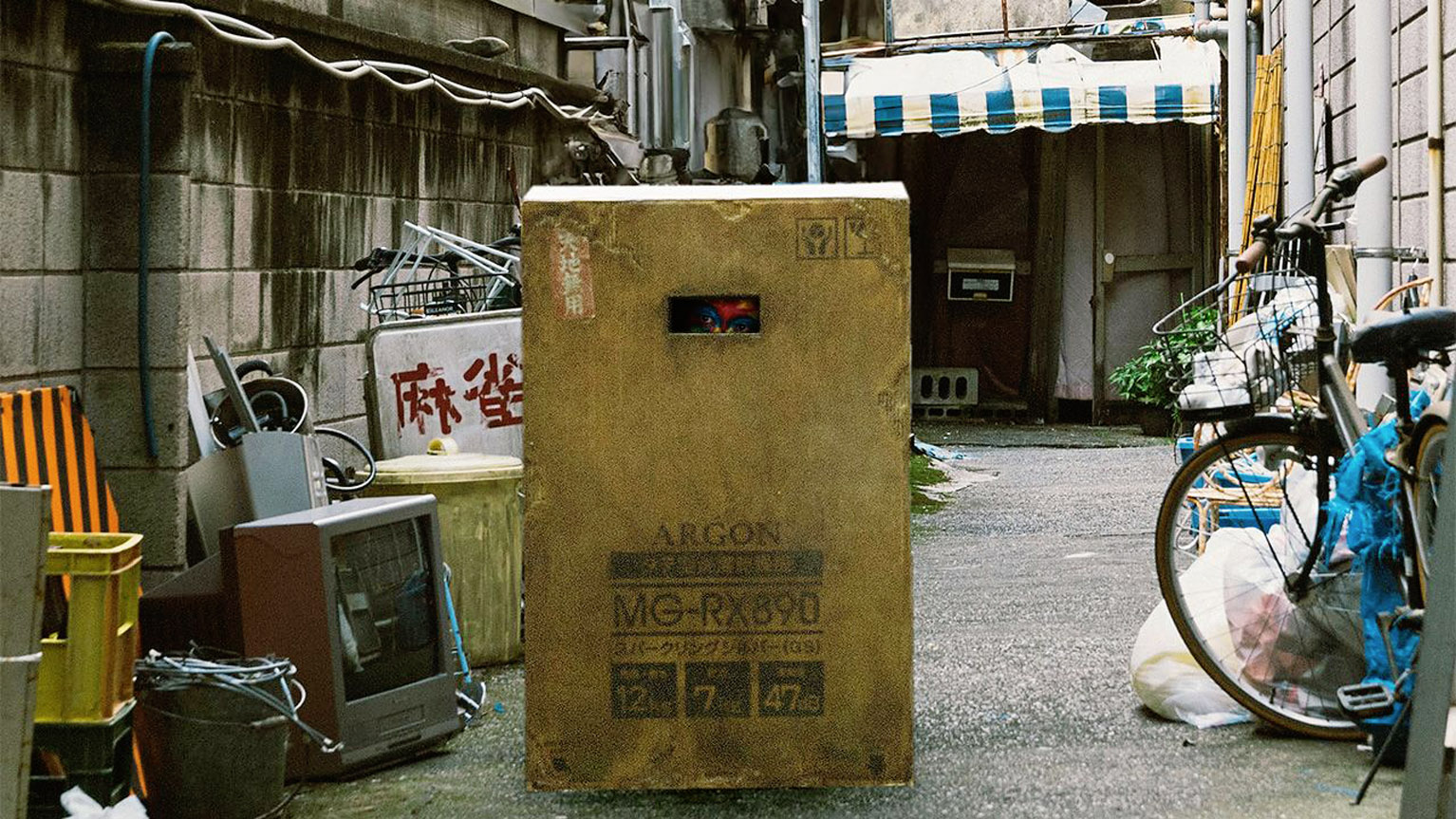
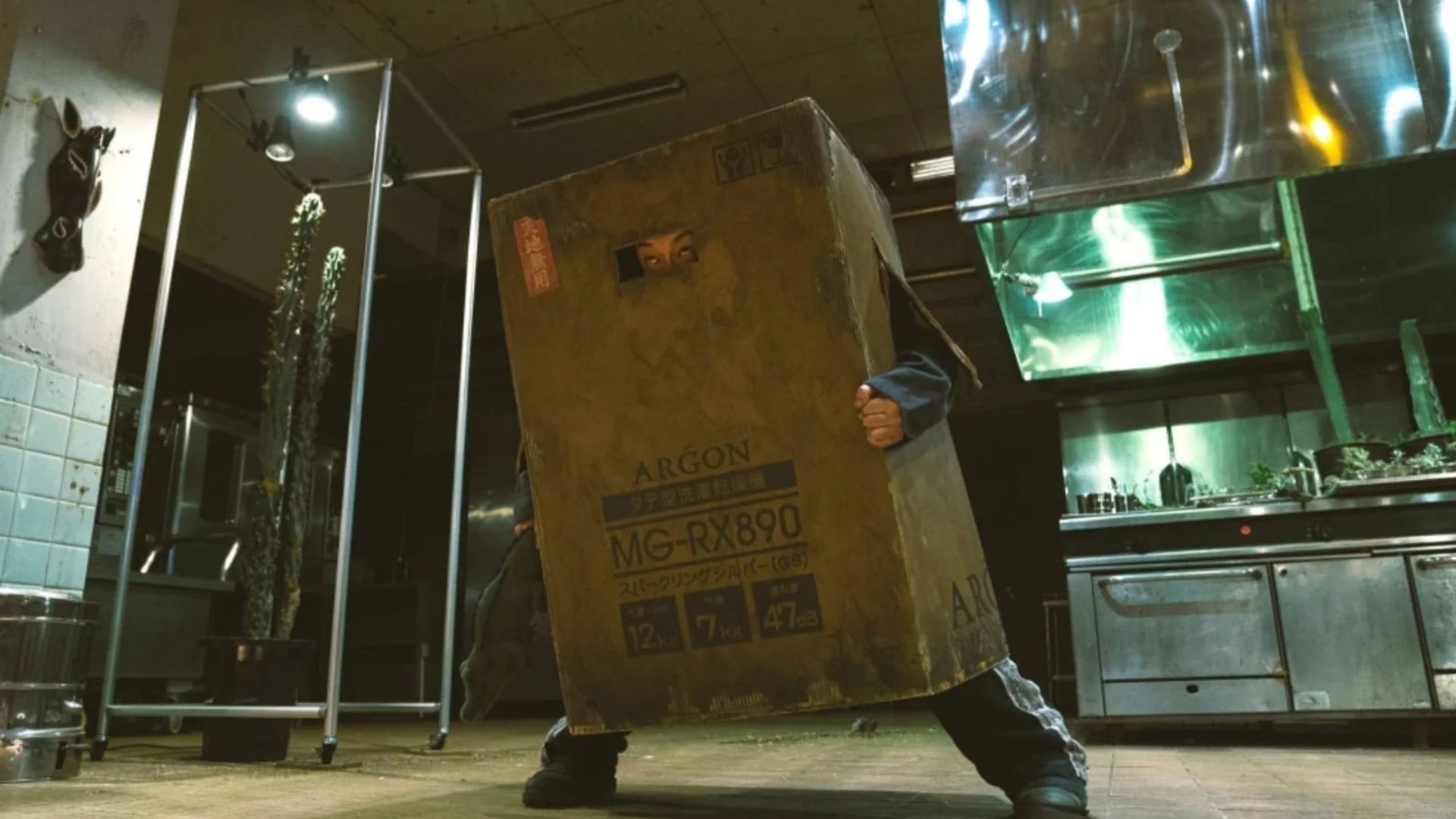
Less based on and more inspired by themes of obsession explored in the acclaimed book of the same name by Kobo Abe, The Box Man (2024) marks the return of director Gakuryû Ishii after 2018’s Punk Samurai Slash Down. The story, or what semblance of narrative there is, follows a nameless man who lives in a box, having killed its previous inhabitant after becoming obsessed with the secrets held within an isolated existence. Battling off others obsessed with the box, the man becomes obsessed with a young nurse, Yoko (Ayana Shiramoto), who works for a ‘fake doctor’ (Tadanobu Asano) whose own desire to understand the solitary existence of a box man leads him to do a series of odd experiments—eventually, the two face off against each other both physically and metaphysically.
Do not pity the box man; instead, the box is a portal to a different world, one of infinite knowledge and the very secret to unraveling the meaning of existence itself. Those who learn that such secrets are within reach will do anything to become the box man themselves.
Opening with this principle, director Gakuryû Ishii makes it evident that the work is among his more abstract endeavors, while still maintaining a punk-inspired philosophy that celebrates freedom from societal norms (constraints). For the first twenty minutes or so, The Box Man adopts a more frenetic approach to filmmaking, falling somewhere between the director’s other works Electric Dragon 80,000 V and That’s It. It’s an ideal way to kick off the film, leading with a heavy emphasis on style fans have come to appreciate, while also providing a hook to draw in potential new initiates into the mad world of Isshi’s cinematic world.
Despite a strong first 30 minutes (or so), from here, The Box Man will either lose viewers entirely or ensnare them deeper into its abstract form of storytelling. Notably, the ‘fake doctor’s’ desire and the box man’s obsession with his assistant/nurse raise a number of abstract and meta concepts about what it means to embrace the ‘box life.’ Quantifying the nuances that shape the philosophical exploration of what it means to withdraw from society is difficult without watching the entire film. This is further complicated by the introduction of the concept that the written word is essential to confirm one’s existence, and meddling with this can rewrite existence itself.
The Box Man comes across as Gakuryû Ishii’s most reflective and accomplished work to date, while still maintaining the stylized visuals and dark humor that avoids pretentiousness in the existential themes explored. The story here is nuanced and requires introspection from the viewer, as well as a degree of connection to the concept of finding peace in solitude. For myself, there was certainly an odd romanticism in the idea of transforming a normal existence into an observer of the world with profound knowledge. However, this may not be a universal theme that everyone can connect with.
What is more tangible from Ishii’s abstract approach is how brilliantly the concept complements the movie’s visuals. The Box Man is a movie constructed of rectangles, with much of the cinematography evoking an industrial, ‘Piet Mondrianian’ nightmare. Moreover, the nameless protagonist views the world through a slit in his box, which also happens to be the same aspect ratio as the film itself. Not only are certain shots perceived from the perspective of looking out from the box, but there is also a meticulous and purposeful approach to the placement of shapes and the framing of shots. The film’s climax has the most prominent use of rectangles in framing, as well as addresses certain elements of how box man sees the world in a clever and inventive way.

Another clever visual interpretation of the work lies in the concept of needing the written word to prove existence. This yields a visually haunting chain of scenes when the doctor invents a story to try to free himself from a crime he is planning to commit. The discussion, framing, and movement of the actors is so foreign to the film’s cinematic style and appears more like a stage theater reading. I found myself utterly entranced by Ishii’s visual approach at specific points, more so than by the unfolding story.
Addressing some odds and ends, the performances in The Box Man are suitably adequate. As a long-time fan of Ishii’s work, I always felt it was less of a platform for actors and, instead, earning some cool points to fully commit to the absurdity of it all, anal enemas included. The score, as always, is spot on as music has long been an integral part in all of Ishii’s creative visions.
Despite this, the film has a few negatives. The runtime starts to drag, but there is nothing that feels like it was fluff or should have been omitted; if anything, a bit more action would have been welcome, as the few fight scenes with the box man are delightful. Additionally, The Box Man marks Ishii’s most abstract work to date. The pieces start to fall into place near the end, but the lengthy runtime, coupled with many moments open to interpretation, makes it a challenging film to approach at times.

Ishii is one of the last few real punk filmmakers, and The Box Man renewed my faith in outrageous and rebellious Japanese cinema. Moments of utter punk rock and outsider cultural elements reveal that Ishii still has a great deal of steam, whereas other filmmakers’ edge have dulled with time.
I, too, want to be a box man and experience the joys of letting everything go and becoming one with the universe. Until I shed my disgusting ‘comforts of home’ and ‘running water’ for the comfort of the box, I am grateful for this wonderfully absurd and poignant gem from Ishii.

The Box Man (2024) is Available to Own or on VOD Through Third Window Pictures.
More Film Reviews

Meiruko-chan (2025) Film Review – Serviceable, if Not Flawed
Meiruko-chan is a 2025 Japanese supernatural horror/slice of life film written and directed by Yoshihiro Nakamura. Beginning his career with the horror film series Honto ni Atta! Noroi no Video,…

Memories of Murder (2003) Movie Review – A Cynical Investigation of Hopeless Incompetence
Memories of Murder is a 2003 South Korean thriller that served as Bong Joon-ho’s breakthrough film – it brought him the acclaim to later direct profound films such as ‘Parasite’…

On the 3rd Day Film Review – Fantasia Festival 2021
Anyone who’s been in a car accident understands disorientation; the lack of clarity of what just happened, the realization that time does indeed slow down, it’s not some old wife’s…

The Mildew from Planet Xonader (2017) Film Review – Beautifully Moist
The Mildew from Planet Xonader is a 2015 English-language Italian splatter horror film, written and directed by Giulio De Santi and Neil Meschino, with additional writing from Dave Fogerson and…

Vicious Fun (2020) Film Review – An Aptly Titled Horror Comedy
I honestly haven’t had this much “fun” while watching a horror movie in quite a long time. Shudder release Vicious Fun is true to the name; it carries immense nostalgic…

They Call Her Cleopatra Wong (1978) Film Review – Singapore’s First and Only Female Action Hero
Whilst Wong is a very common name in Singapore and China, Cleopatra certainly isn’t! The name actually reveals the main inspiration for this film: the blaxploitation heroine – CIA agent…