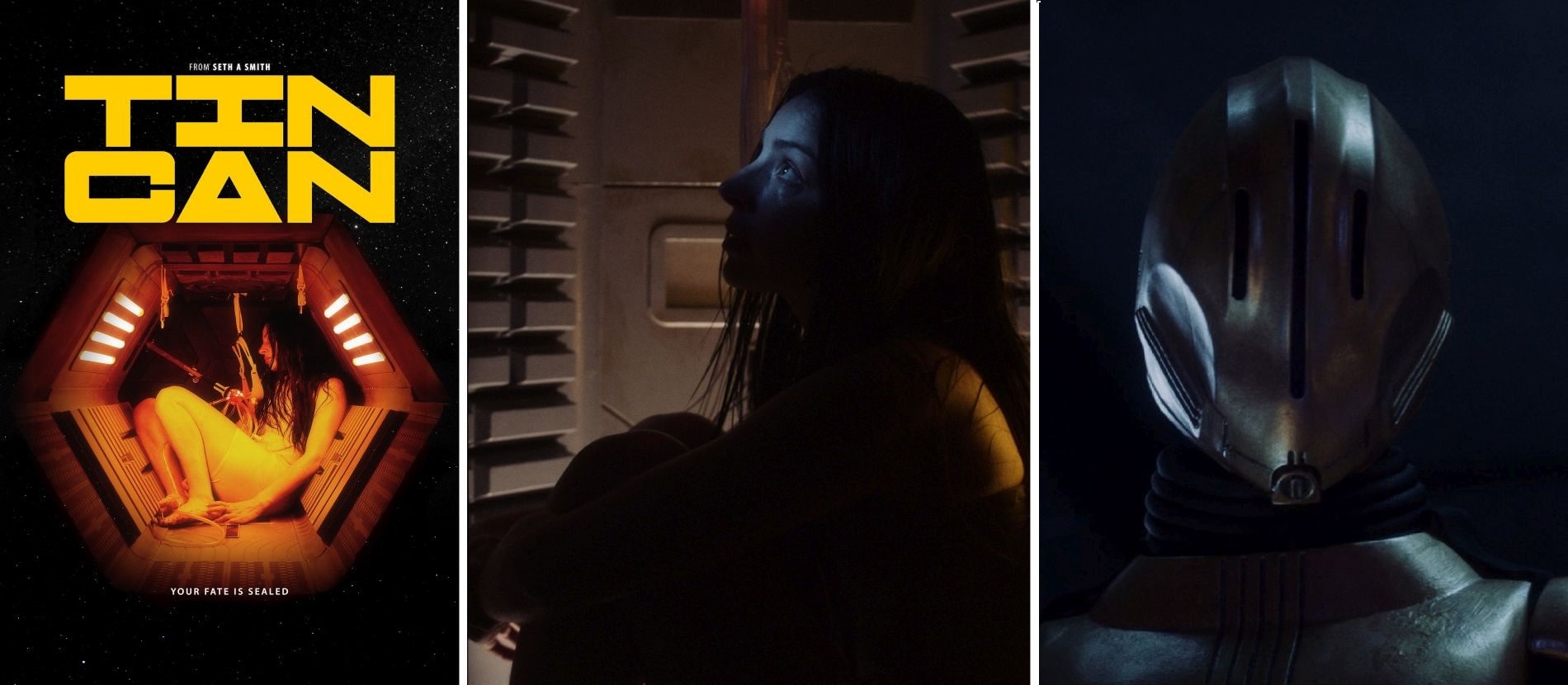
Seth A. Smith’s Tin Can is a confinement horror with staying power, managing to walk the audience through no less than seven different subgenres, and delight them with delirious imagery, and a dazzling series of twists. One of the most ambitious and thought-provoking movies of the year, watching Tin Can feels like binging the latest season of Westworld, coupled with Come True‘s love for artful symmetry, The Wizard of Oz‘s Tin Man symbolism, and Annihilation‘s strange fascination with infinite growth and cells that never die.
Anna Hopkins (The Expanse, V/H/S94) plays Fret, a virus researcher who believes she has found a way to stop the latest massive threat to society, a four-stage fungal infection dubbed Coral. The virus is a non-lethal one, but it changes the infected, and the company that hired Fret is also providing confinement chambers for the afflicted (freezing patients in the hope that a cure will be found until their awakening). However, Fret is soon abducted and finds herself trapped in one of those chambers, next to one of her coworkers, having to figure out who put her there and how to get out.
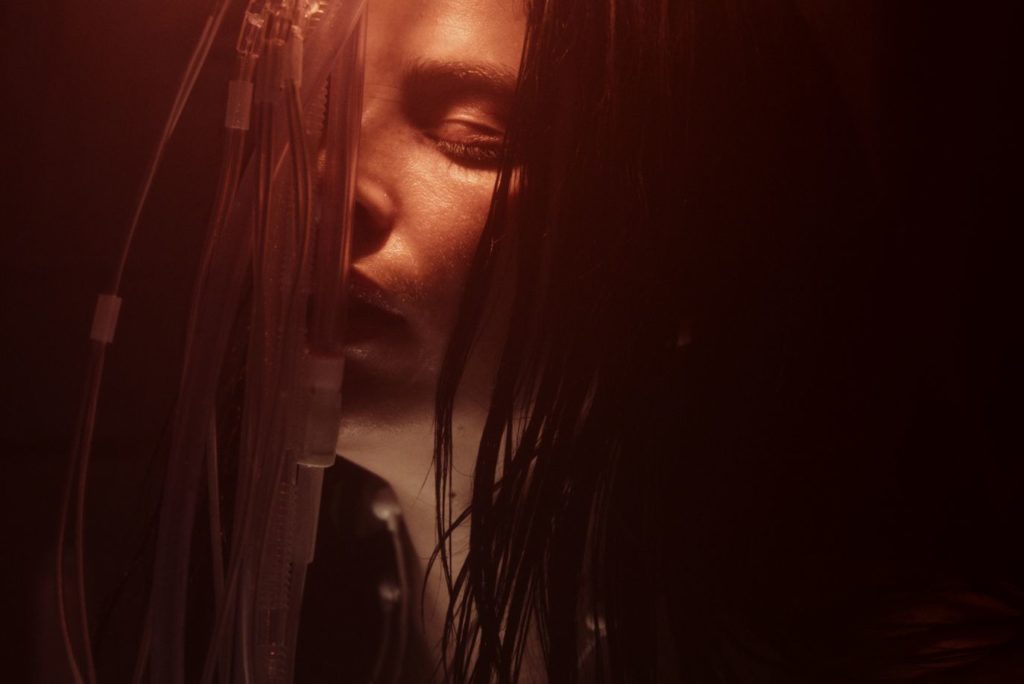
The confinement horror subgenre has delivered strong entries last year, with Meandre, Oxygen, and Ascendant managing to stand out in their attempts to go bigger and bolder; Meandre with its wild splashes of color and breathless time-trials, Oxygen with its relatable backstory and massive scope, and Ascendant by using verticality and choosing to tell its story in three separate films. With Tin Can, Seth A. Smith plays to his art-horror strengths, previously displayed in the 2017 film The Crescent: disturbing imagery that provokes the unconscious mind, storytelling requiring the viewer’s interpretation, sudden POV switches and a love for water motifs (baptism, death, other worlds and the drowned dead).
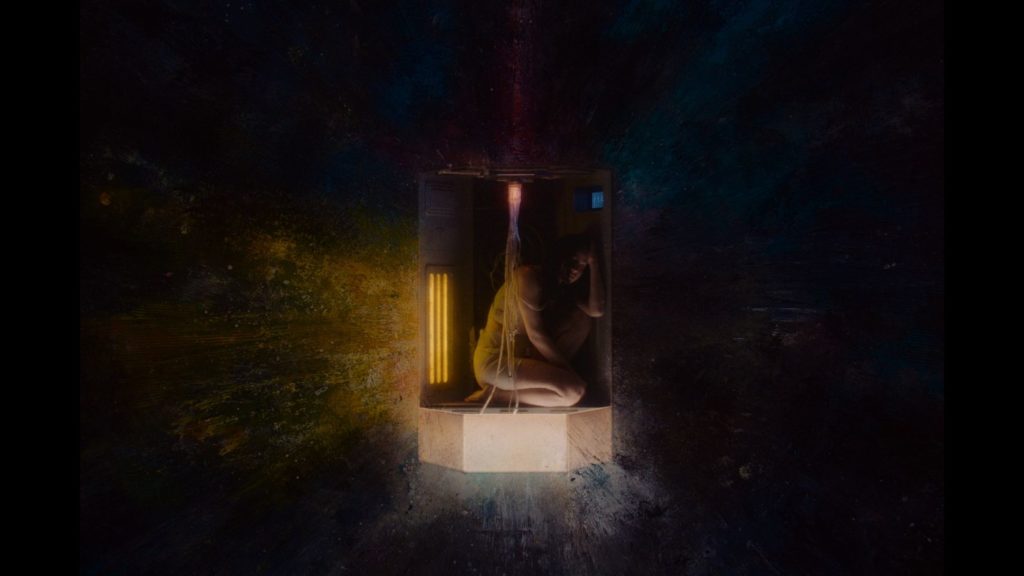
Tin Can is a film comprised of two very different halves: the first a combination of Meandre‘s colors and Oxygen‘s rich backstory, and the second a surreal U-turn into Come True/Annihilation territory. Smith is one of the finest horror architects, and if his previous movies were niche items, this highly polished effort is bound to attract a lot more attention. Immediately as creepy as The Crescent and Jessica Hausner’s Little Joe, Tin Can uses a beautiful gold-yellow filter as its “main” look, as well as dejected close-ups of the confined and rotating camera movements to establish a feeling of creeping dread. In terms of shot composition alone, Tin Can stands head and shoulders above recent similar efforts, and Smith dazzles with ingenious visualizations, both of the inside and outside of the chambers, the building’s architecture interspersed with geometric abstraction. Smith’s films are audiovisual storytelling brilliance, the images and the score in service to the story – the secondary colors inside the chamber represent the health status of the confined, and the silence is broken by Gothic piano stabs as Fret frantically slams every side of her tiny prison.
As far as themes and motifs go, the movie seems to deal with the morality of Fret’s job as a researcher, as well as corporate science, bioethics, and the “greater good” clashing with the human capacity for resentment. The confinement solution offered by the company, whether voluntary or involuntary, looks like a metaphor for the realities of quarantine and isolation. Anna Hopkins’s casting is a stroke of genius, as she has always excelled at playing morally-conflicted characters (The Expanse‘s Monica, V/H/S94‘s Holly Marciano, and Final Offer‘s alien representative), always making the viewers doubt whether her protagonists have any principles at all. The infection itself recalls the recent sea horror The Beach House, with shell-like crusts and colonies attached to the skin (even if Fret insists that it’s “not a marine coral”). Although the infected start slithering horribly in later stages, Fret regards the virus as a perfect society and points out to the cells reuniting.
This obsession with sublime geometry only hints at the beauty of the movie’s second half. Tin Can is not a “brainy” confinement horror, and it doesn’t put its protagonists through thrilling trials. Getting out is simply a brute force matter, perhaps more tied to corporate design flaws, not human ingenuity. However, what Tin Can brings to the genre is the proficient mixing of genres: terrifying medical horror, devastating revenge thriller, trippy art-horror, obsessive love story and “adapt or die” retro sci-fi, reuniting into a whole that’s as symbolically rich as any Robert Eggers film.
In addition to Fret’s plight, the movie gradually introduces its strangest (and strongest) element: the Gold, a faction of iron-people with an armor design similar to The Wizard of Oz‘s Tin Man and Doctor Who‘s Cybermen, speaking a muffled language which requires subtitles and behaving like jailers and custodians of a new world. The Tin Man symbolism ties in nicely with the movie’s bizarre love story, as well as the corporate ethics background. Historians have claimed that the image of the Tin Man (the woodsman who has lost his heart) in Wizard of Oz was tied to political cartoons from the 19th century, operating as a symbol of the dehumanization tied to industrial progress. However, L. Frank Baum expert Michael Patrick Hearn mentions that the Tin Man wasn’t meant as social commentary, even though it might seem that way to careful readers.
Baum did not intend his story to contain some overriding or underlying moral, as in Aesop’s fables or Perrault’s fairy tales. He was exploring a personal mythology, in which many truths could be expressed. The characters and incidents in the book may be viewed as symbolic, and symbols can represent many things at the same time [ … ] “But,” as W.H. Auden said of George MacDonald’s stories, “to hunt for symbols in a fairy tale is absolutely fatal.”
Likewise, drawing any conclusion about any underlying moral in Smith’s Tin Can is a matter of dreaming it, of producing an analysis, an interpretation. Smith keeps most of the violence off-screen, which invites a lot of questions, nonetheless proving to be a bold choice. He sometimes shifts the viewer’s gaze to microscopic levels as he works with the questions also posed by Westworld‘s fourth season: what is the Gold procedure? Is Fret a reliable narrator? Have we all been replaced, shaped into different “us” by recent events, by scientific and technological breakthroughs, and our own biological adaptability? Is love even possible in such an obsession-prone world? Even as Smith reveals a lot of “hows” along the way (and it’s far easier to connect some dots than with The Crescent), he doesn’t explain the “whys”, and Fret’s screams during a pivotal scene are probably going to require a lot of “ending explained” articles.
In conclusion, Tin Can manages to be a lot of things, while also having a strong sense of identity, continuing Seth A. Smith’s upwards trajectory. For fans of Anthony Scott Burns, Alex Garland, and the recent confinement horror titles, the movie is a total delight, with Smith’s touches feeling right for the story, and it skillfully employs symbols to great effect, revealing the deep collective post-COVID-era fears and insecurities.

More Film Reviews
Pig Killer is a 2022 American horror thriller, written and directed by Chad Ferrin. The film is a retelling of one of Canada’s most prolific serial killers, Robert William “Willy”… Films often feature Halloween as one of the most popular holiday settings. And this time, it gets a unique, Gaelic twist in this supernatural slasher from American writer-director Matt Sampere…. Fresh off its world premiere at Fantasia and coming exclusively to Shudder this week, director Rebekah McKendry’s new film Glorious is a mildly amusing slice of cosmic horror that does… Found Footage films have always been a personal favorite sub-genre of mine. Not only does it allow innovation on a budget, but the idea of drastically searching with a camera… Showing as part of the 2021 FrightFest lineup, King Knight marks the fifth feature length film of Richard Bates Jr. Reuniting with fan favorite actor Matthew Gray Gubler, who appeared… There’s something thrilling about watching a seasoned director’s first film. It’s like discovering the blueprint of what’s to come—a raw, unfiltered glimpse into the voice they’ll refine over the years….
Pig Killer (2022) Film Review – Canada’s Most Prolific Serial Killer

Creeping Death (2024) Film Review – Get Trick or Treated to Death this Halloween

Glorious (2022) Film Review – An Arterial Spray of Cosmic Horror
Fear Footage 3AM (2021) Film Review – A Frightful Return to Darkbluff

King Knight (2021) Film Review – A Coven Comes Undone
![Pornostar (1998) Film Review – Violence on the Streets of Tokyo [Nippon Connection]](https://www.grimoireofhorror.com/wp-content/uploads/2025/06/pornostar-1998-cover-365x180.jpg)
Pornostar (1998) Film Review – Violence on the Streets of Tokyo [Nippon Connection]