
Meeting your partner’s family for the first time can be a drag, having to find out how well you get along in the family dynamic or learn some truths you may not want to be privy to. It is a scenario that has been used in cinema in almost any genre, comedy, horror, drama etc. Yet, such encounters still can maintain audience curiosity–like a car wreck you can’t look away. Horror fans, in particular, rejoice when these awkward scenarios break down into abject horror, and Sebastian Godwin’s Homebound places the audience in the squeamish position of unearthing some dark family truths.
Following a young couple, Richard and Holly, the two head to visits Richard’s two estranged children Anna and Ralph. With the kid’s birth mother absent, the family tries to rekindle long-lost bonds but something is off in the household. Soon, Holly finds herself overwhelmed by the sensation of a dark truth through the kid’s malicious actions towards her and Richard manifesting his own emotional problems attached to his past life.
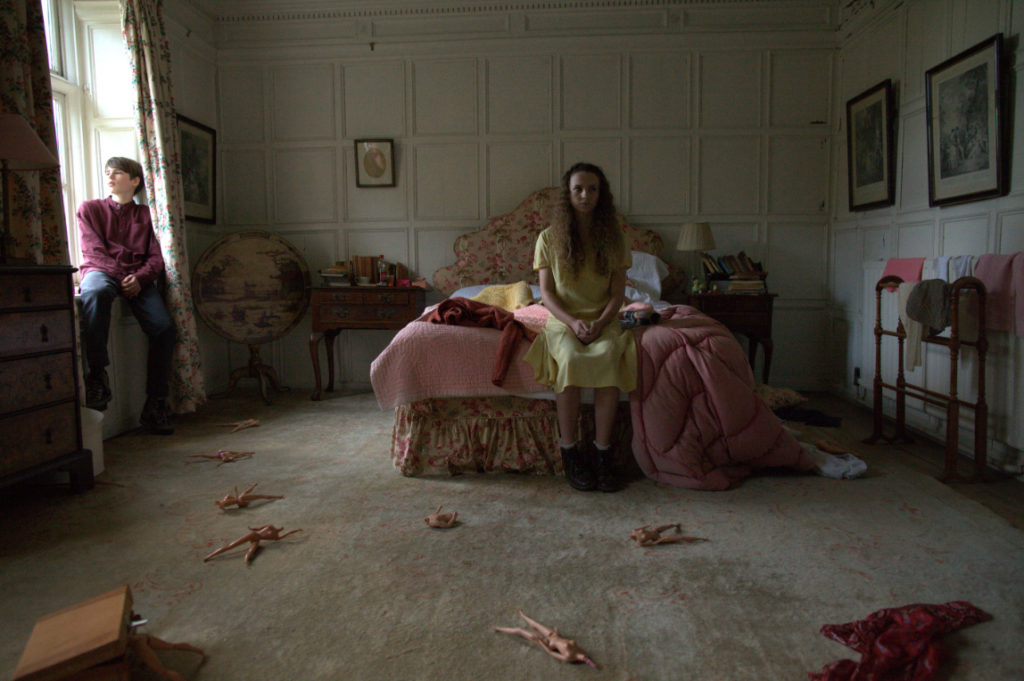
From the opening introduction, with its ominous and intrusive musical score, Homebound makes itself clear that it is going to be an uneasy experience. In fact, much of the production is defined by keeping the viewer on edge and guessing as to what is the underlying issues in the family dynamic that have made it so perilous for an outsider to navigate. Add in the learning of family traditions from a cautious outsider in Holly, such as chasing and slaughtering a goose for a feast, and the environment around the young woman becomes uncomfortably fragile.
Holly is certainly the focal point of any elements of dread or horror, and her navigating the children’s disdain and violence towards her puts the film in a constantly uneasy balance that makes the production intense despite the lack of disturbing imagery. In this regard, Sebastian Godwin taps into social fearw that we all face, having the expectations of normalcy, even joy, replaced with confusion and fear. If viewers will take anything away from the production, it will be Godwin’s ability to navigate complex emotions and weave them into an object of abject horror.
Of course, this film would not be successful if not for convincing performances, of which Aisling Loftus as Holly does a remarkable job of showing her fears and discomfort–her expressions conveying deep emotional trauma and loneliness due to the situation. Across from Loftus, Tom Goodman-Hill a Richard presents a menacing figure of male power struggling for the respect he feels is deserved (it is not). In fact, it is really easy to despise Richard and everything he does, but that is the point.
The film ends on a high-point with a twist ending that is, somewhat, predictable yet wonderfully delectable. It is the kind of twist that should be avoided via spoilers, but the conclusion of the story is definitely rewarding.

Looking at the presentation, visually the film stays rather serviceable. The cinematography feels largely focused on capturing drama between the family members over creating an overarching sense of dread. There are some shots that allude to something sinister early in the production, but these scenes don’t feel definitive to the vibe. This is not necessarily a deterrent as the direction and script imbue that sense of horror needed to sell the narrative, but the end product won’t impress anyone with abstract or artistic visual storytelling.
The score, on the other hand, is perfectly executed and pushes that pervasive sense of dread that oozes out of every corner of the family interactions. It is not something to be admired on its own, with its intrusive use of classical instruments, but it is perfectly apt in bringing terror to life in Homebound.
While Sebastian Godwin’s debut film is not particularly unique in both content and delivery, it is an intelligently constructed horror film that can really put the viewer at unease. Those who enjoy finding horror in simple human interaction will undeniably get a kick out of how he twists this family gathering into an object of horror. Personally, I can’t wait to see what Godwin comes up with next as with a bit more visual flair he could become a notable name in horror.
We Watched Homebound courtesy of Bluefinch Releasing as part of Frigthfest Glasgow 2021

More Film Reviews
Aimee Kuge’s directorial debut feature, Cannibal Mukbang, dares to ask, “How far would you go for love?” This unsettling yet darkly compelling film explores some of society’s most intimate, and… Even though the Asian horror movie craze is not as potent as it was back in the early 2000s, new titles have managed to make their way overseas and have… Evilenko is a 2004 English-language Italian true crime horror/drama written and directed by David Grieco in his first feature-length film. Malcolm McDowell plays the Soviet Union’s most notorious serial killer,… Susumu Nokoshi once worked for a top foreign financial company. He is now a 34-year-old homeless man, usually found around a park in Shinjuku. He then meets medical school student… Tokyo Decadence, also known as Topaz or Dreams of Topaz, is a 1992 S&M pinku drama, written and directed by Ryû Murakami. Although seen as a cult classic in Japan,… Making Off (also known as Devil’s Weekend) is a 2012 French extreme found footage film, written and directed by Cédric Dupuis in his feature-length directorial debut. The film is presented…
Cannibal Mukbang (2023) Film Review – A Visceral Feast of Love, Vengeance, and Toxic Appetites

Incantation (2022) Film Review – An Incredibly Competent Addition To Asian Horror And Found Footage Catalogs

Evilenko (2004) Film Review – A Crime Horror Flick Ripped From The Headlines

Homunculus (2021) Team Review – What Would Your Trauma Look Like?

Tokyo Decadence (1992) Film Review – The Decadence of Man

Making Off (2012) Film Review – Satirical Nastiness