





Director Oz Perkins (The Blackcoat’s Daughter, Gretel & Hansel) has carved a niche for himself as a purveyor of slow, dreamlike horror steeped in dread. Longlegs, his latest film, promises to be his most ambitious project yet: a serial killer procedural dripping with Satanic overtones, shot through a grainy 90s lens, and headlined by a whispering, almost unrecognisable Nicolas Cage. On paper, it’s the stuff of cult classic dreams. In execution, though, it’s a frustratingly hollow experience that leans heavily on mood while failing to deliver emotional or narrative weight.
The story follows FBI agent Lee Harker (Maika Monroe), a socially withdrawn rookie with an uncanny intuition, as she’s pulled into a decades-long series of seemingly ritualistic family murders. The killer leaves behind cryptic notes, unsettling symbols, and almost no evidence. Harker, who has a mysterious past of her own, begins to suspect a personal connection to the case – and to the elusive killer known only as “Longlegs.”

The premise sets up a lot of potential: the occult meets the procedural, with personal stakes and eerie aesthetics. And for a while, Longlegs rides that wave of potential with style. The film is undeniably atmospheric. Perkins knows how to compose a disquieting frame, and the visual language – washed-out tones, aggressive architecture, and disturbing flashes of infernal imagery – is strong. Combined with a droning, minimalist score and frequent use of silence, there are moments where Longlegs evokes genuine unease.
But atmosphere, unfortunately, is just about all it offers. The plot unfolds at a glacial pace, and not in a deliberate, tension-building way. The story is relatively predictable and tries to evoke a sense of David Lynch by relying on ambiguity, but it ends up being more tiresome than intriguing. None of the characters are particularly compelling – it’s usually fun to watch a socially awkward genius, but Lee Harker felt like such a clear rip-off of Clarice Sterling that it all felt too familiar. Her performance is subdued to the point of being disengaged, and while that might be intentional, it doesn’t give the audience much to hold onto.

Then there’s Nicolas Cage. Much of the pre-release buzz centered around his mysterious role, and while his brief appearances are visually striking and undeniably weird, they don’t add up to much. He’s buried under makeup and vocal distortion, delivering something between modern-day Marilyn Manson and your drunk nan at Christmas. For all the build-up around his character, Longlegs himself remains disappointingly shallow: a collection of quirks without a clear psychology or thematic purpose.
This lack of substance extends to the film’s themes. Longlegs hints at big ideas – intergenerational trauma, the nature of evil, fate versus free will – but doesn’t commit to exploring them in any meaningful way. It gestures towards depth with cryptic dialogue and recurring motifs (mirrors, symbols, whispered voices), but the effect feels more like window dressing than revelation. In the end, Longlegs was pretty underwhelming, with only a few scares, 40-year-old Satanic panic horror, and a few flashes of gore.
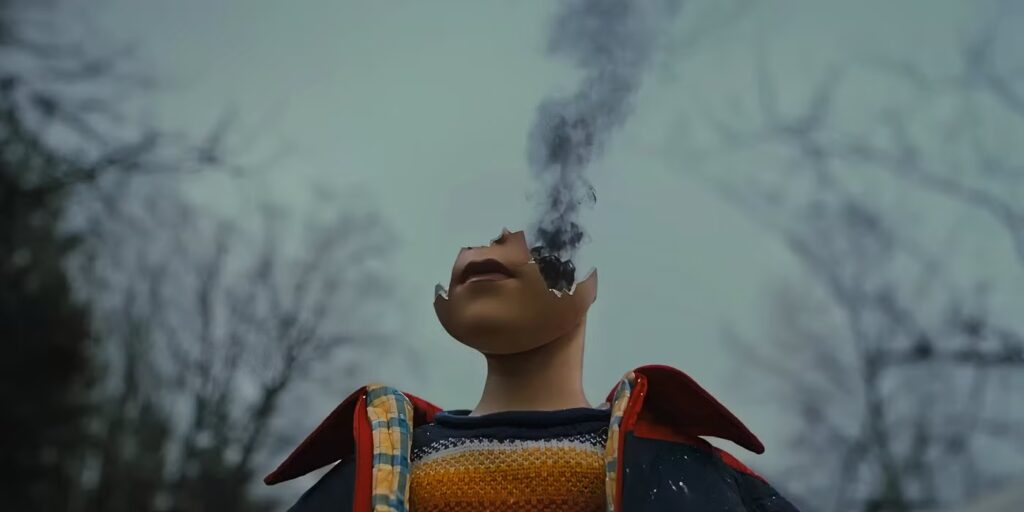
Fans of Perkins’ earlier work may appreciate the film’s slow-burn style and elliptical storytelling, but even compared to his previous outings, Longlegs feels inert. It’s a film of eerie vibes and intriguing suggestions that ultimately fizzles out instead of building towards anything impactful. It neither delivers the visceral thrills of a great horror film nor the psychological insight of a compelling character study.
To be fair, there are moments of visual cleverness and a few genuinely unsettling sequences. But they’re fleeting – flashes of inspiration in a film that too often feels like it’s trying to convince you something profound is happening, without ever actually making it so.
Longlegs looks and sounds like a horror classic in the making, but beneath its moody surface lies a thin, unsatisfying story with little emotional or intellectual payoff. Some of the jump scares might get under your skin, but you’ll wash them off soon enough.
More Film Reviews
If childhood memories could be distilled into pure energy, they would probably seem as radioactive as the golden glow emitted from the spray-painted wheat fields of The Reflecting Skin. Otherworldly,… Combine the carnage of slasher films and socially relevant commentary, and you’ve got the recipe for a horror film that cuts deep, literally and figuratively. For this writer, Initiation does… Our Happy Place is a gritty psychological thriller slash modern murder mystery written and directed by Paul Bickel. The film weaves in worries that could only be understood by major… Romi is a 2023 Canadian sci-fi horror, written by Susie Moloney, and directed by Robert Cuffley. Susie is most notable as a writer on the TV shows Blackstone (2015), and… Mercenaries for hire, James and Marshall are tasked with rescuing a scientist from an underground bunker in order to obtain the research she holds. However, the complex is crawling with… Online streamer ‘The Dark Lord of Love’s Park’ interaction with the online world consists of arguing with his chat, drinking himself into a stupor, and performing grotesque tasks for money….
The Reflecting Skin (1990): A Brief Examination of Vampires (and Other Bad Things) in Broad Daylight
Initiation (2021) Film Review – Pledges to Challenge Slasher Expectations

Our Happy Place (2024) Film Review – Roses for Raya
![Romi (2023) Film Review – Ghost in the Machine [Blood in the Snow Film Festival]](https://www.grimoireofhorror.com/wp-content/uploads/2023/11/Romi-cover-365x180.jpg)
Romi (2023) Film Review – Ghost in the Machine [Blood in the Snow Film Festival]

Death Valley (2021) Film Review – Action Packed Horror
![Leech (2024) Film Review – Disturbing Lolcow LARPing [Unnamed Footage Festival]](https://www.grimoireofhorror.com/wp-content/uploads/2025/03/Leech-2024-cover-365x180.jpg)
Leech (2024) Film Review – Disturbing Lolcow LARPing [Unnamed Footage Festival]

Jenny is a creative copywriter living just outside of Liverpool who loves horror, board games, comics, video games and industrial metal.