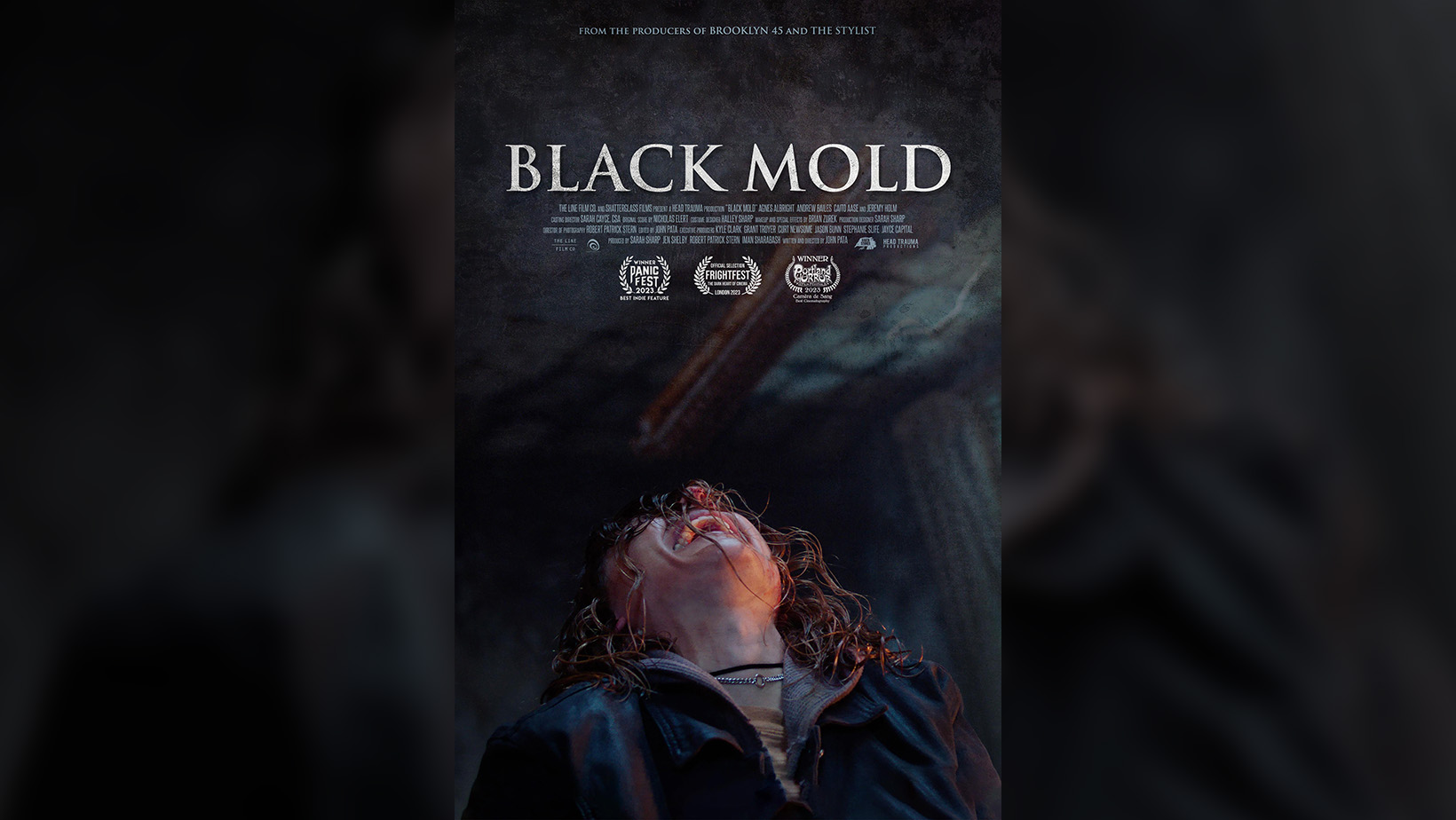





Black Mold is a 2023 American psychological horror film, written and directed by John Pata. The film stars Agnes Albright and Andrew Bailes as two Urbex photographers, Brooke and Tanner, who are on an exploration tour of abandoned houses on the outskirts of Milwaukee, looking to get some shots. Despite this, these buildings are just the warm-up for their main event: Franklin Hill, a dilapidated government testing facility that has been left to rot in disrepair for the last several decades. While the pair scout out the main building, they come across an erratic homeless man, who attacks and imprisons them. However, once they awaken from the attack, they realise that this paranoid vagrant is the least of their worries as the moldy environment starts to alter their perception.
From the very beginning, there is a level of ambiguity as to when the story takes place. Although a year is never disclosed, the lack of digital technology would suggest the film takes place around the 80s/90s. However, there are elements of the story that maintain a more modern feel, never fully leaning into any retro aesthetics or terminology. Nevertheless, this delivers a deliberate, non-intrusive dismissal of the standard “Damn, no bars” trope that plagues films with a more modern setting.
The film only subtly alludes to the negative effects of these moldy environments, even though it is present from the beginning. Bizarre occurrences plague the main characters. Even though these visuals presented are over the top, the audience is still left questioning the validity of what they are witnessing because each character experiences them as real. This creates a fascinating blurring of the line between reality and the horrific dreamscape.
Unfortunately, while successfully crafting an incredible atmosphere through the environments, the plot’s progression frequently stalls out with extended exposition dumps. The pacing slows to a crawl, hampering the rising tension that often stops dead rather than building into efficient horror. Indeed, that seems to be Black Mold’s biggest problem—its elements of horror are presented as an afterthought. Brooke’s personal past trauma is treated as a prominent story element but has a poor payoff. Undoubtedly, a more peripheral examination of this character arc would have allowed the story’s horror to play a more important role during the second act.
In spite all of this, Black Mold consistently delivers amazing visuals, utilising numerous techniques and approaches. The cinematography features a multitude of different styles, including a technical tracking shot during the opening, lots of soft focus shots, low angles, and wide shots, making great use of the large, decrepit environments. The film’s sound design is impeccably crafted, amplifying ambient sounds such as footsteps and glass cracking underfoot, while providing an exacerbating score to accompany the film. Subtly varying in range, slowly creeping in volume and intensity from quiet and calm to a rambunctious allegro; the sound design certainly assists in reinforcing a scene’s chaotic tone.
Whilst competently made and visually beautiful, Black Mold’s focus on exposition and mild disregard for its aspects of horror during the second act is ultimately its major problem. While the film can hardly be called bad, this certainly holds it back from being a truly great horror film. However, with its astounding visual design, intuitive score, and absorbing premise, the film is still an enjoyable experience that is sure to entertain.
We watched Black Mold (2023) at FrightFest 2023

More Film Festival Coverage
If you ask a Western horror fan, they can probably tell you exactly when they first heard about Hideo Nakata’s cult classic Ringu (1998). Whether it was due to the… A Wounded Fawn opens with a quote from Surrealist painter and author Leonora Carrington: “I suddenly became aware that I was both mortal and touchable and that I could be… In the sun-bleached stillness of Brookehaven, a rural town that feels both timeless and suffocating, two strangers form a fragile but radiant bond. What I Remember is the debut feature… We previously had the chance to check out Thomas Burke’s short film Camping Fun, a quick dive into a small cult that showed that Burke had the knack to channel… There are many different types of fears that can fester in the mind, everyone on some level knows what their greatest nightmare is – experiencing such emotions is an unavoidable… When the seventh chapter, titled Disinformation rolled in, the narrator and confessor, Dr. Laura Gale started to talk about things “that are not.” She began debunking famous alien encounter stories that had…![The J-Horror Virus (2023) Documentary Review – How Japanese Horror went from Tape to Trend [Nippon Connection]](https://www.grimoireofhorror.com/wp-content/uploads/2024/06/j-horror-virus-2023-cover-365x180.jpg)
The J-Horror Virus (2023) Documentary Review – How Japanese Horror went from Tape to Trend [Nippon Connection]
A Wounded Fawn (2022) Film Review – The Faun and the Muse
![What I Remember (2024) Film Review – A Glitchy, Heartfelt Tale of Queerness, Memory, and Rural Isolation [Unnamed Footage Festival]](https://www.grimoireofhorror.com/wp-content/uploads/2025/04/What-I-Remember-2024-cover-365x180.jpg)
What I Remember (2024) Film Review – A Glitchy, Heartfelt Tale of Queerness, Memory, and Rural Isolation [Unnamed Footage Festival]
SHC: Freak Accident (2022) Short Film Review – I’m Burning Up!
Alone With You (2021) Film Review – A Metaphysical Nightmare
The Gulf of Silence (2020) Film Review – No Contact! (Unnamed Footage Festival 666)
Hey there, I’m Jim and I’m located in London, UK. I am a Writer and Managing Director here at Grimoire of Horror. A lifelong love of horror and writing has led me down this rabbit hole, allowing me to meet many amazing people and experience some truly original artwork. I specialise in world cinema, manga/graphic novels, and video games but will sometime traverse into the unknown in search of adventure.