




If Ugetsu is what kickstarted the Japanese tradition of Edo Gothic, Kaneto Shindo may have perfected it with Onibaba (1964). It’s a horror film that doesn’t resort to horror, a ghost story with no ghosts. Its evils reside in all too familiar sources: resentment, human nature, and religious hypocrisy, all woven seamlessly through its narrative fabric, a blanket that covers its protagonists with inexorable shadow.
Firmly situated between two trends, its place in Japanese horror is one of transition. With its cinematographic bleakness and period setting, the influence of the previous decade’s Gothic films is readily apparent. The heightened sensuality, however, is a clear mark of the pinku films that came to be only two years prior. But Onibaba isn’t a cheap peepshow or a violent fantasy. Its sexuality is inherent to its story – not merely pornographic, but central to the conflict. It’s depicted as a wonderful virtue tainted by human vice, a natural instinct stained by base desires.
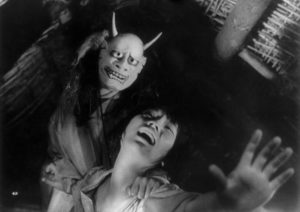
The film’s title literally translates as “demon hag,” and its relevance waits until the end to reveal itself. During a civil war in medieval Japan, two nameless women, one the mother-in-law to the other, survive by killing lost soldiers and selling their possessions. Their neighbor, Hachi, returns after deserting from the army with the older woman’s son. Her son was killed when the two attempted to steal food, and the old woman, bitter and angry, forbids Hachi from seeing her daughter-in-law, who seems to share her contempt.
The old woman’s misgivings seem justified – Hachi is a cynical coward, devoid of honor, and quite clearly out for his own self-interests. He is crass and disrespectful, every bit of the villain that the film’s opening makes him out to be.
But something happens as the second act commences. The young woman’s disgust is shown to be a façade. She seeks out Hachi, feigning revulsion, and quickly succumbs to his advances. There’s a sense of dismay as the two become inseparable as if the young woman has voluntarily thrown herself into unpredictable danger.
From what has she torn herself? Her husband is dead. She lives in abject poverty, robbing and killing to survive. In their rigid, patriarchal society, her safety is more guaranteed with another man. From this viewpoint, Hachi’s selfishness seems more of a blessing than a curse.

The narrative eventually agrees. It’s revealed that the old woman’s fears aren’t based on concern for her daughter-in-law – she’s simply torn apart by jealousy, no longer an object of desire. Her son chose the young woman, but his longings were non-threatening. With his death, this girl has now become a symbol of her lost virility, a trophy she wishes to possess so that no others may have it.
By this point, it’s plain that we’ve been deceived. The negative sentiments toward Hachi result from following the old woman’s perspective. She is an envious, spiteful widow who is afraid that the young woman will leave her to die. The film’s established reality begins to shift as her true nature is revealed. Desperate, she turns to religious conservatism – and a demon mask, stolen from a dead samurai – as her last chance at manipulation.
Shindo tracks this descent into darkness masterfully. The use of high contrast – mostly blackness with splashes of light – paints the screen in encroaching shadow, slowly becoming more pronounced as the story progresses. The film opens in daylight, in which the first act is almost exclusively set. As Hachi and the young woman begin their liaisons, she must escape to meet him at night, and as the setting grows darker, so does the old woman. Defined by jealousy at first, this darkness transitions to fear – the old woman dreads the young woman’s emancipation, and as she allows her darkness to change them both, her worst fears are guaranteed. Shadows that lent the demon mask a menacing glare now give it a look of terror, the wearer’s life irreparably shattered.
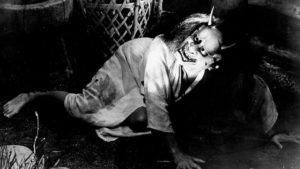
The one constant through this turmoil is Hachi. His character never changes, but the perception of him does. Although he ends the film as callous as he begins it, his fate becomes disappointing as the narrative’s perspective shifts. He is a hard man, but not an evil one – he simply wishes to survive and do so with a companion.
In the end, however, nobody is innocent. The old woman is a demon, the young woman kills to survive, and Hachi endorses, even enables, their way of life. But as the old woman notes, this is only temporary. Once the war is over, all of their lives will improve again. “But who knows when that will be?” Hachi retorts. He has already resigned himself to a life of hardship, one forced upon them by events outside their control. This reality, cold and severe, serves as Shindo’s final subtext: Onibaba is vehemently anti-war, with its true victims being the poor.
More Film Reviews
Farley Wilder is the local peeping tom in a small New Hampshire town, where his reputation has earned him the interest of a writer, Scarlett, and together the two begin… Stanleyville (2021) has a simple premise: five contestants compete in a contest to win a brand-new habanero-orange compact SUV. Maria joins hoping for a chance at transcendence, but the other… The Internet Age has transformed us in so many ways, even down to the way we tell stories to keep pace with advancing technology. Our fledgling fixation on screens has… Warning to those with mycophobia – this is not the film for you. Gaia is a South African ecological horror film, full of mushroom monsters, skin-crawling body horror and raving… Until c.1080 CE, the Temple of Uppsala stood tall and proud outside Gamla Uppsala, Sweden. The temple served as a place of worship and community dedicated to pagan deities such… Flammentod (Pyromaniac) is a 2023 extreme horror film written by Jean Rises and directed by Domiziano Cristopharo. Known as an author/publisher of extreme horror literature, as well as a horror…
Freaky Farley (2007) Film Review – The Perverted Hero We All Need

Stanleyville (2021) Film Review: Is the Car Really Worth It?
The Collingswood Story (2002) Film Review – A Pioneering Screenlife Film

Gaia (2021) Film Review: God is Real, and She’s a Fungus

The Ritual (2017) Film Analysis – The Demonization of Paganism

Flammentod (2023) Film Review – Fire, Fire, Light the Fire