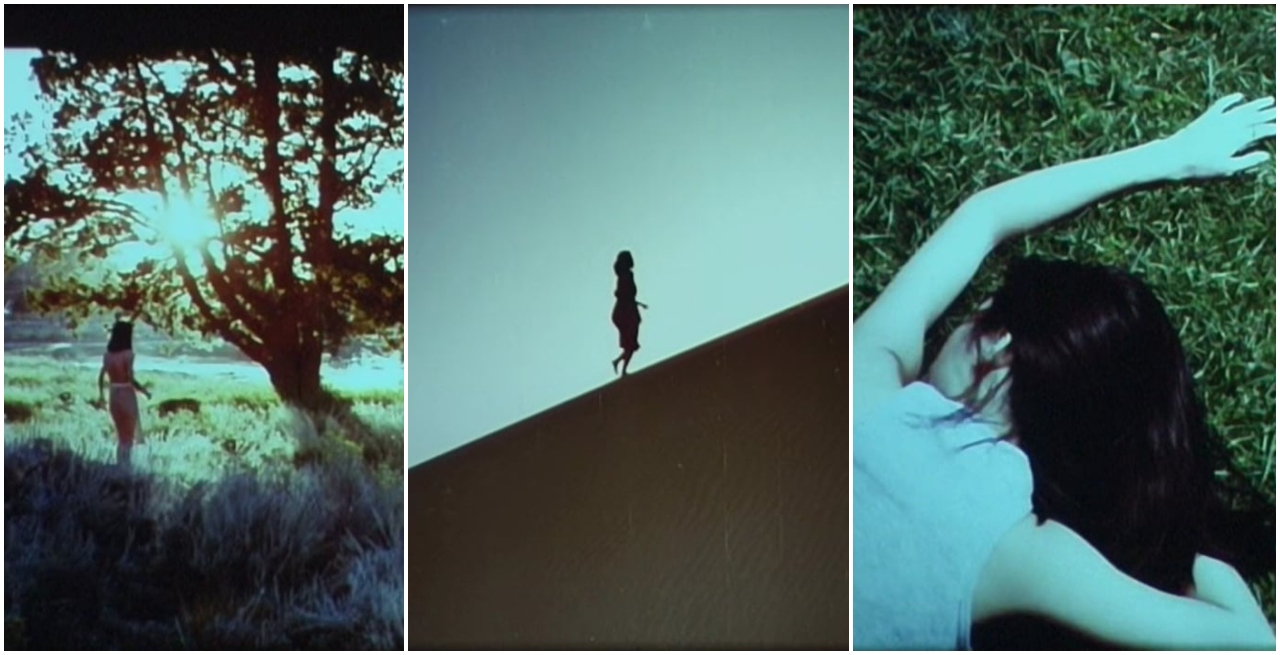





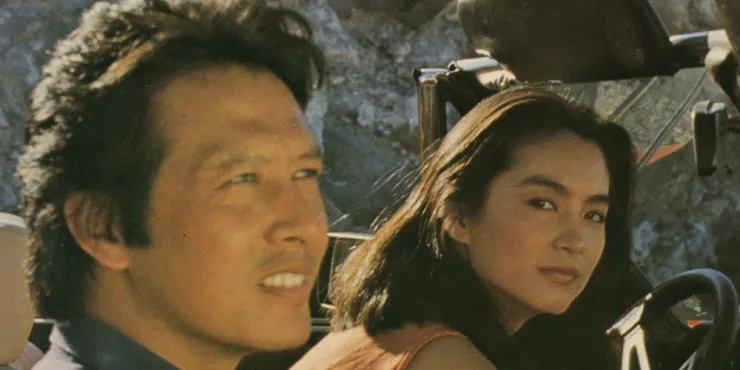
Ivy, played by Brigitte Lin Ching-Hsia, is a Taiwanese student living in San Francisco. She shares a dormitory with other students of her diaspora. The pupils consume most of their American life in gossip, anecdotes, and leisure. For Ivy, who appears to be a relatively serious character, chattering is secondary to spending time with pals Joy and Louie. Joy demonstrates suicidal inclinations, leading Ivy to secretly request her brother to fly to the US to see her. Chiu-Ching, Joy’s brother, appears, but his arrival advances the increasingly complex predicament of the quartet.
Initially, the creation of a love triangle appears to be the central conflict. Chiu-Ching and Ivy effortlessly fall in love, their compatibility facilitated by the former’s straightforward behaviour. As the narrative proceeds, love becomes the driving force behind every movement of the quartet, and additional relationships of various magnitudes are either witnessed or hinted at. Ranging from plausible to alarming, the chains create an intricate web, appropriating the English title of the movie.
The real complexity lies in the mental instability of Joy and Chiu-Ching. The siblings refuse medical treatment, which creates trouble for Louie and Ivy. Joy’s refusal to accept the creation of rapport between her brother and friend is not without merit, but it is her lack of communication that jeopardizes the delicate balance of equilibrium, preserving their collective life. Yet again, every direction the movie takes is driven by love, and ultimately it leads to a brutal massacre.
Patrick Tam Kar-Ming’s status in the West primarily pivots on his mentorship of Wong Kar-Wai, but in his native Hong Kong, he is recognized as an influential director. One of the leading lights in the exemplary Hong Kong New Wave, he, alongside the likes of Tsui Hark, Ringo Lam and Ann Hui, rewrote the way movies were created in Hong Kong. Tam’s signature traits encompass hyper-stylization, cautious assignment of the palette, and the inclusion of thrills, chills, and violence in midst of intricate romantic dilemmas.

Love Massacre certainly ticks all of the above-mentioned traits. While the only available version is a censored copy with reduced violence, it survives to gradually evolve into a thrilling slasher. Generating impact even before the opening credits, the film clenches the spectator with an icy grip, juggling love and fear with remarkable capability, with occasional junctures detecting a coalition of the two emotions in the psyche of the characters.
Tam started his movie career by creating a rather contemplative wuxia film in “The Sword,” and for his sophomore work, he shows a recklessly experimental self. He twists and turns genres, blends love and horror, creates an ominous atmosphere out of sensibly chosen colours contrasting each other in a muted scheme, and assigns likewise dreadful electronic music to top it up. The final concoction is strange yet flavourful.
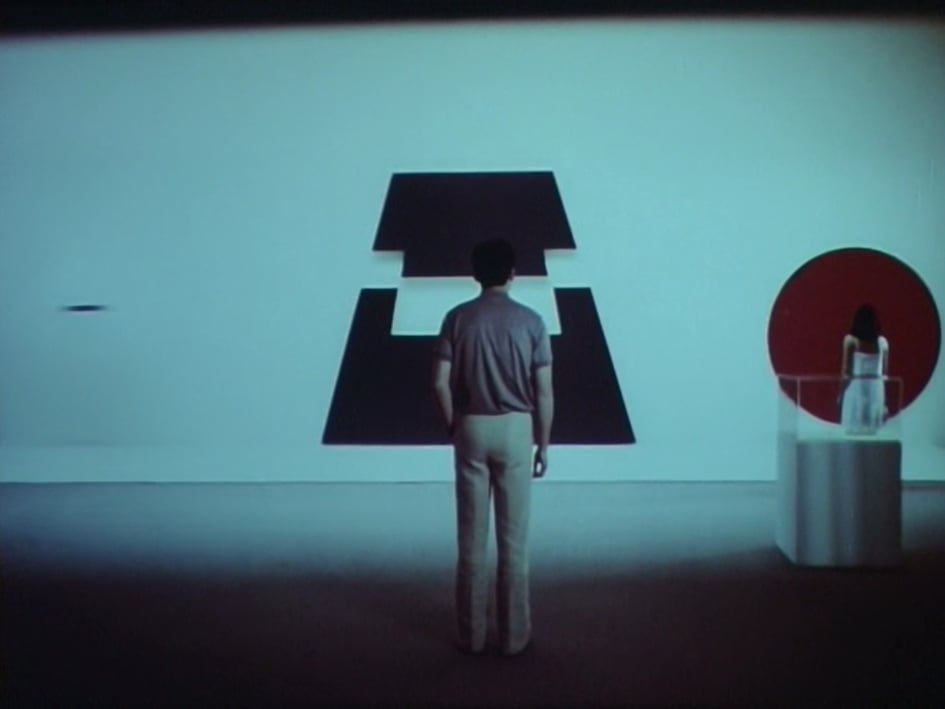
At times, even Tam comes across to be unaware of the narrative direction, and when he finalizes an ending, the censor board decides to viciously massacre (pun intended) each murder scene into an editing nightmare. Tam’s characters, too, hardly comprehend the future they are about to dive into. In a fantastic scene, Louie and Ivy visit an art exhibition. The art displayed in the gallery is rather abstract. They are conceptual and rely on their form and colours. Louie and Ivy are focused on a different notion of abstraction: fate seems sinister, and they possibly neither understand nor care about the art they glance at.
Acting is a department that leaves a lot to be desired. Brigitte Lin is expectedly terrific and Chang Kuo-Chu does the best in fulfilling the exaggerated murderous stares and expressions allocated to Chiu-Ching. Charlie Chin’s Louie is a real disappointment, with his acting inflexible and unstructured. Tina Lau is perhaps relatively better, but her performance as the volatile, unhappy Joy fails to add to the experience. Ann Hui, another pioneer of the Hong Kong New Wave, has a small yet significant role, in which she proves better than half the cast.
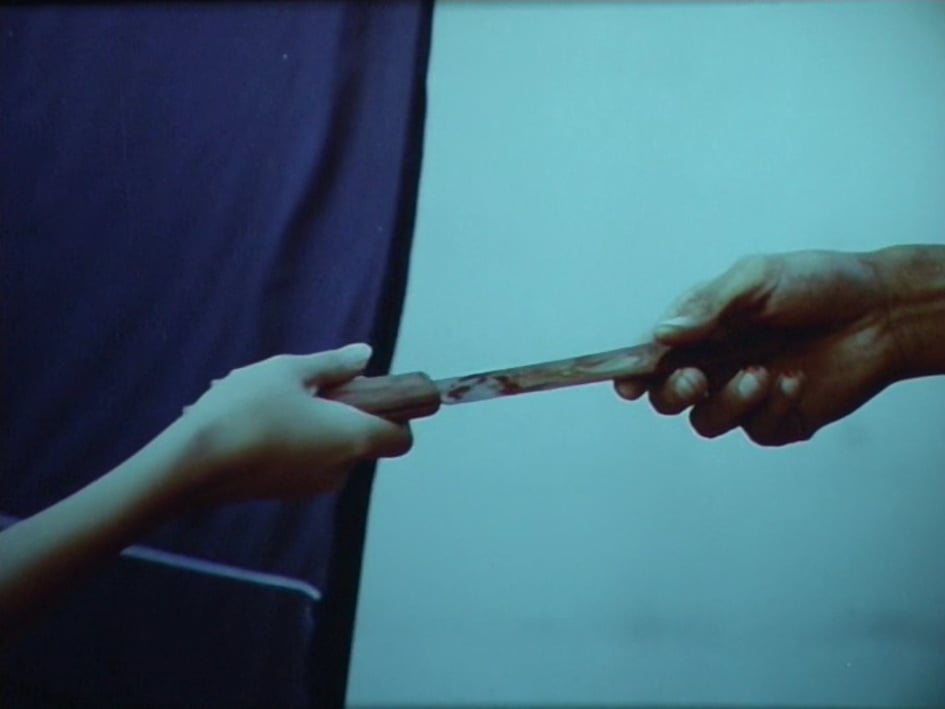
Love Massacre is a conceptual tragedy. Not everything observed in the film makes sense. Human validities of assessment and ethics, too, are blurred by Tam’s splendidness. Through a deeply abstract idea, the director overtakes the need for logic in the film. In a way, the film resembles the work of Godard: forfeited emotions return through unimaginable routes. Violence is crucial to the movie’s presentation, but even violence, blood, and slaughter fail to reach an absolute status in the film’s principles of love and warfare. Love triumphs over violence, and therein lies the true tragedy of the characters.
Although Love Massacre is censored and suffers from a range of disappointing acting performances, it is a chilling experience, even on multiple watches. Tam’s minimalism is the movie’s trump card, which binds the distanced, muffled world into a horrid hotspot for violence. Is it a masterpiece? Possibly it is. What is certain is the fact that Love Massacre is Hong Kong New Wave at its zenith, with genres liquefied by the raw talent of directors such as Tam.
More Film Reviews
An unassuming seaside town in southern England is thwacked, whomped, and clobbered by the resurgence of an enigmatic, squeaky-voiced, no-nonsense killer who brandishes a club to brutally execute his victims…. A young daughter, around four years old, watches a pop idol group cheerfully perform on tv with her father. Meanwhile in the kitchen, we see her mother dutifully preparing dinner,… “Haunted by the war in Iraq, a depressed and faithless Gabriel is approached by the mysterious Balthazar, who recruits Gabriel to stop the evil Archangel Michael from raising an army… When Norman Graysmith is invited into the home of an aspiring serial killer, Aidan Mendle to be exact, he believes he has the subject for a career-defining documentary. However, the… Forced to move when her mother gets a new job, a teenager called Sol has to face dangers ranging from power outages, bullies at a new school, the worrying behaviour… Horror filmmaking royalty collides in Two Evil Eyes (1990): a star-studded yet relatively niche anthology horror from the depraved minds of Dario Argento and George A. Romero. The dastardly duo…
Punch (2023) Film Review – Seaside Slasher Shirks Success
Dessert and Beyond: A Comparison Study of Conventional Vs. Unconventional Music in Asian Horror and Extreme Cinema

Angels Fallen: Warriors of Peace (2024) Film Review – Zamani’s Next Installment in the Angels Fallen Universe

When The Screaming Starts (2021) Film Review – Killer Comedy

The Night Belongs to Monsters (2021) Film Review – Argentinian Teen Outsider Drama With A Supernatural Edge

Two Evil Eyes (1990) Film review – Defrosting Forgotten Horror History