Shih Chun is Ho Yun-Qing, an intelligent student who fails his imperial examination and, after failing to find a respectable job well, decides to become a manuscript copyist. His minimal income compels him to do things he wouldn’t normally do, such as taking up the job to copy a Buddhist Sutra with themes and ideas about demons and spirits, which forms the core of the movie’s plot. He is sent to a secluded location, but as he attempts to copy the sutra, he notices that the location is far from quiet. Natural and otherworldly entities appear to alter his perspective, putting the lives of several individuals in jeopardy.
Ho’s gullibility will stun most viewers and even estrange some, but such is the essence of King Hu’s movies. Shih Chun practically reprises his role from A Touch Of Zen (King Hu, 1971), not through a mutual disposition, but through a somewhat familiar background and the exact credulousness that lets him fall into easy traps. The other characters observe the mischief, the audience comprehends the twist in the tale, but Ho beholds a ghost, turns pale in a momentary panic and shoves the last bit of suspicion out of his mind via a reassuring smile. Ho, an imaginative, scholarly man, shall show his bravery later, but his sweeping naivete is essential to kickstart and steady the narrative.
Still, the excessive gullibility does not detract from the intensity of the narrative, owing to the fact that it is a fable and never pretends to be anything else. Considering Propp’s structural model, it fulfils all expectations and functions as a conventional folktale in which the hero must be as innocent as they are daring. As a result, Ho is a legitimate hero. All ambiguity vanishes as the film enters its final hour. There are two sides: good and evil, and each key character’s loyalty is reasonably obvious.
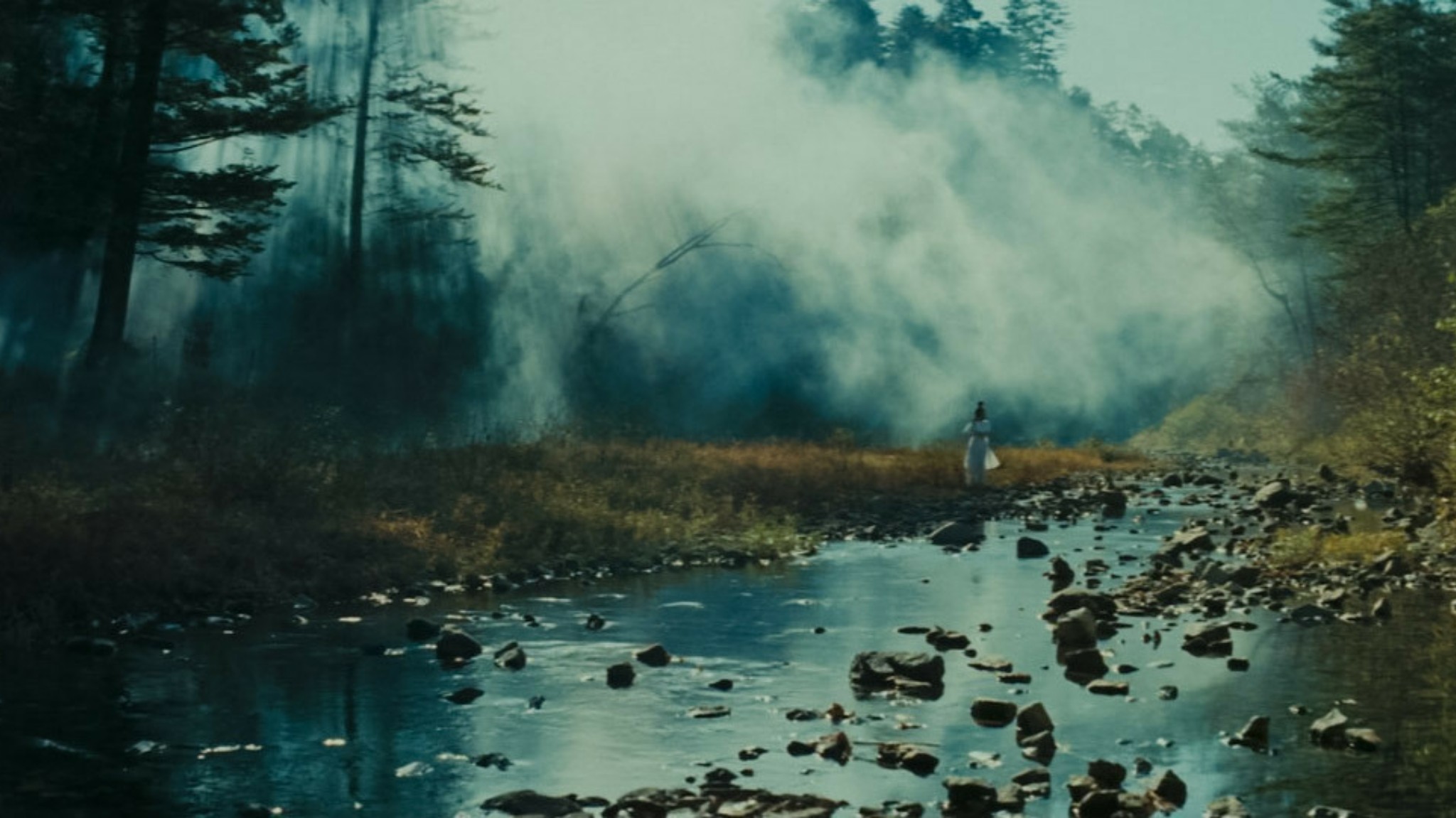
In King Hu’s world, wuxia cannot be segregated from nature. The movie begins with Ho witnessing the wrathful waves of the ocean and lush landscapes soon inundate the viewer in a world where the supernatural could be embraced without debate. Fog creates dreamy obstruction, leaves ruffle to alert, and a dusty, contemplative wuxia film emerges out of thin air. The few personalities occupy a depopulated world, and they, positioned at a no man’s land, act as innate parts of nature, instead of creating primarily artificial identities. This is where Ho, a man arising from the artificial realm, must assess his abilities and comprehend nature to become a hero.
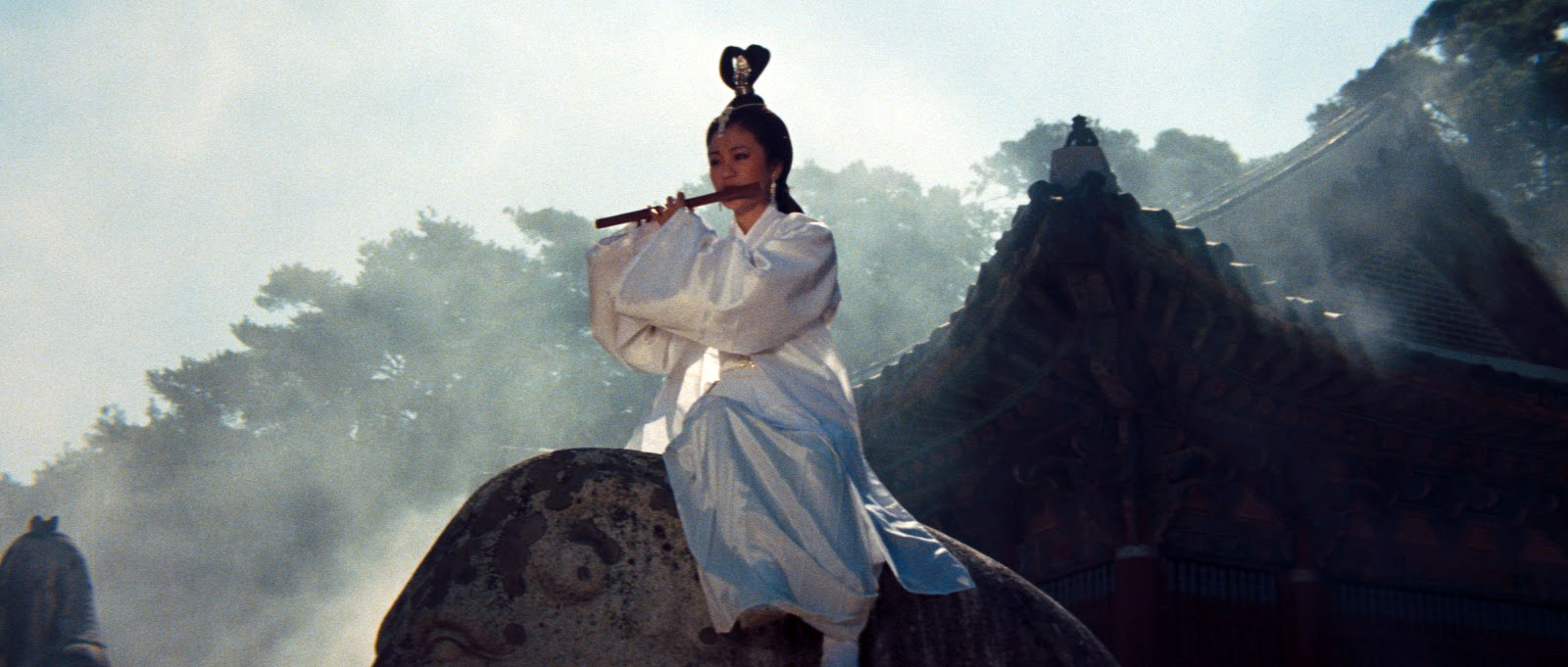
The film’s preoccupation with the Buddhist notions of death, rebirth and the spirit realm merits discussion. Ho is not a Buddhist, but throughout the film he comes to accept some of the religion’s set of notions. The manuscript Ho attempts to duplicate can release souls from a seemingly unfortunate existence, but it also allegedly enables the evil to take control of fiends and gain vast power. Death becomes a significant concept throughout Ho’s journey, especially during the final battle. The film, which till that point jogged at a methodical pace, letting the audience soak in the sceneries of the focal journey, evolves into a turbulent and rapid procession of events. Unravelling a battle where music receives as much importance as weaponry, the director takes the film to a dark, violent territory. By this point, lives are at stake, and the conflict is both a strategical tug-of-war between the two sides and a tempest of awe-inspiring atmospheric imagery.
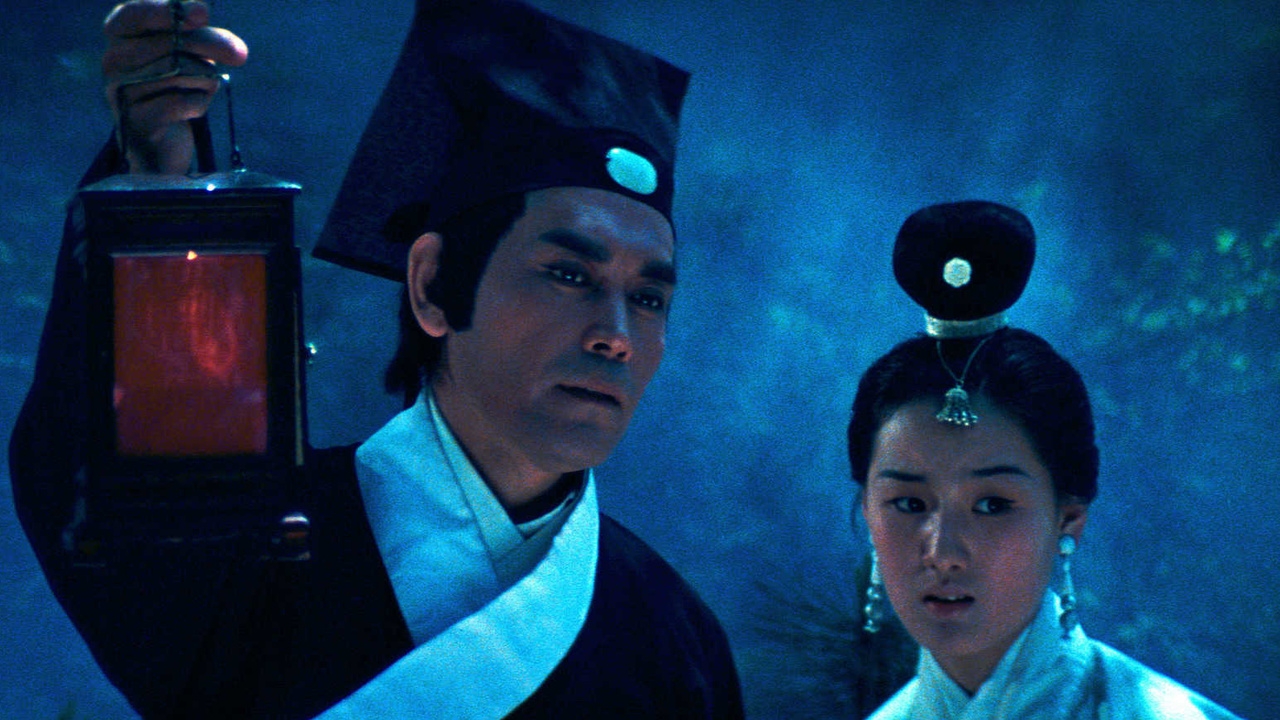
Shih Chun is typically terrific playing the superbly talented, wise, yet innocent hero. Hsu Feng, playing the captivating Melody, blends wickedness with allure in the best performance amongst a delivering cast. Sylvia Chang’s Cloud gains a boost in runtime as the movie unfolds and justifies it. Her character gains empathy from the audience and plays a crucial function in the finale. Henry Chan handles cinematography and it is his labour that establishes the atmospheric spectacle central to the movie’s reputation.
Legend Of The Mountain is an evocative twist in the filmography of King Hu, who till that point almost solely directed groundbreaking wuxia films. The spiritual component hidden in his oeuvre finally overtakes physical combat, grace overtakes story, the atmosphere overtakes the characters, and the result is an astonishing execution of a typical folktale-ish narrative, which certainly is one of his finest works.
More Film Reviews
Terrified, existing as one of the earlier Shudder exclusives, is a a supernatural horror film from Argentina that has seen a fair amount of accolades – it has been sitting… The Guest Room (La Stanza in Italian) is a 2021 Italian thriller directed by Stefano Lodovichi, making its debut as part of Grimmfest in Manchester UK. Shot in a single… The Quantum Devil is a 2023 American sci-fi horror, written and directed by Larry Wade Carrell, with additional writing from Zeph E. Daniel and Stephen Johnston. Beginning his career as… Dealing with an abnormal form of tinnitus, a young IT worker begins a series of experiments to figure out the abnormal nature of his condition. Bringing various objects into his… Musicals are my thing, they have been for as long as I can recall enjoying cinema, there is something so inherently magical about the world breaking out in song. For… Lady Snowblood is Toshiya Fujita’s 1973 Japanese exploitation flick, which inspired the likes of Tarantino’s Kill Bill and countless other directors, featuring the beautiful Meiko Kaji, also famous as Lady…
Terrified (2017) Film Review – Do You Believe in Pure Evil?

The Guest Room (2021) Film Review – Killing for Company
The Quantum Devil (2023) Film Review – Into the Quantum Realm

Masking Threshold (2021) Film Review – Madness up Close

Powertool Cheerleaders vs the Boyband of the Screeching Dead (2022) Review – Sing Into The Chainsaw!
Lady Snowblood Review (1973) – The Finest Japanese Exploitation