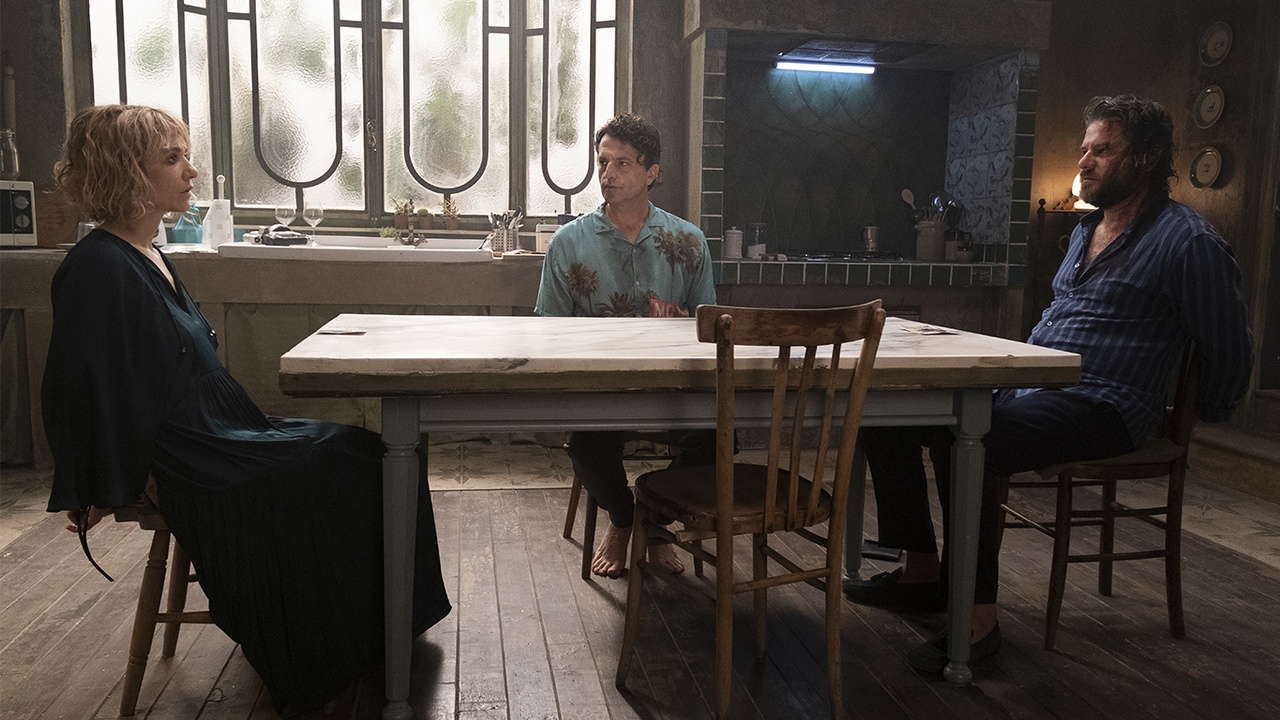




The Guest Room (La Stanza in Italian) is a 2021 Italian thriller directed by Stefano Lodovichi, making its debut as part of Grimmfest in Manchester UK. Shot in a single location and with an intimate cast, the film, on paper, may prove to be a challenge to many – especially being dialogue driven and subtitled for English audiences. However, if you are willing to immerse yourself in the experience, The Guest Room proves to be a highly engrossing experience that will keep your attention from start to finish.
The film opens to a woman in her wedding dress standing on the ledge of a window, preparing herself to jump. Just as it seems she is about to leap from the window, her doorbell rings, interrupting the suicide in progress. Stella steps down from the ledge to answer the door, to find a stranger insisting he has booked a room with her. Even though Stella informs the man that rooms have not been offered for reservation for quite some time, the stranger claims to know her husband, Sandro, whom he said had agreed to stop by to speak to him. Stella, having been backed into a corner and heavily guilt-tripped, begrudgingly agrees to allow this stranger to spend the night. Our eccentric stranger, Guilio, proceeds to make himself at home; but the situation turns hostile when Stella’s husband, Sandro, returns home to deal with this strange guest.
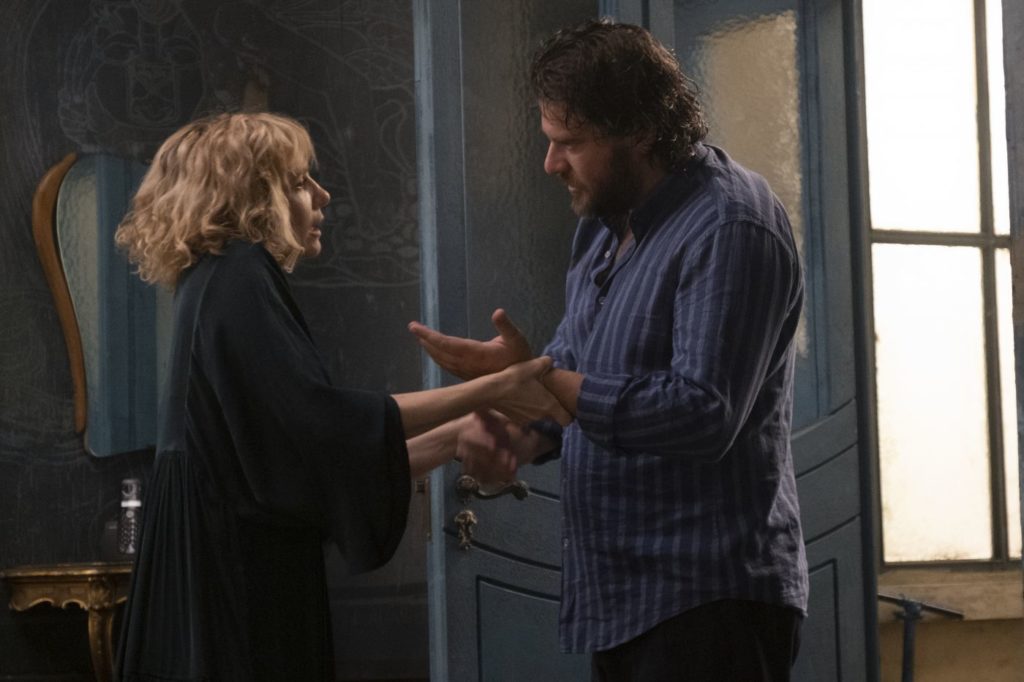
The Guest Room takes place exclusively inside of Stella’s home, and the film is centered on the three characters mentioned above. “Stella”, our bride in the window, is played by Camilla Filippi. Edoardo Pesce plays the part of “Sandro,” Stella’s husband who has been absent for some time. Finally, our eccentric stranger “Guilio”, played by Guido Caprino. The sheer simplicity of this production makes it all the more impressive, and Lodovichi’s ability to keep the viewer on the edge of their seat, despite the intimate cast and single location, is inspired. Lodovichi makes a bold move on such a small cast in a single location, but knocks it out of the park for this movie. The production opening on such a startling scene instantly captures the viewers’ attention, and within the first five minutes of the film, the viewer is in equal parts mystified and intrigued – crucial if the director hopes to capture the attention of a fickle English-speaking audience. Easily the biggest takeaway and attention grabber: Guido Caprino’s performance as “Guilio,” taking us through a wide array of moods and emotions as the plot slowly unfolds.
Despite being limited to a single space, the set does not feel claustrophobic at any point. The house in the production is overly large and dramatic, with impressive floor to ceiling windows and sweeping staircases. While the home is clearly magnificent, it exudes a feeling of neglect and depression. Heavy drapes cover most of the windows, and the viewer never sees the outside of the home or even outside any of the windows, adding to the feeling of intense isolation as the situation inside the home escalates. The emotional buildup of the movie is highlighted by close angles on the actors, which is where “Guilio’s” character shines the most, as Guido Caprino portrays his rapid descent to insanity.
The Guest Room is riveting from start to finish and culminates to a shocking and unforeseen climax that will leave the viewer stunned and awed. Who is this stranger, whose timely arrival interrupted a suicide in progress? How does he know so much about Stella and her husband? What secrets are they hiding? This movie is perfect for the spooky season and is highly recommended by this reviewer. This Italian gem is certainly worth the watch, it will appeal to horror cinema connoisseurs and the general public alike.

We Watched The Guest House as Part of the 2021 Grimmfest line-up

More Festival Coverage
Bringing the Greek Weird Wave touch to German cinema is Der Bunker director Nikias Chryssos, who in his second feature film does at times leave the impression that he’s working… Musicals are my thing, they have been for as long as I can recall enjoying cinema, there is something so inherently magical about the world breaking out in song. For… After purchasing a 360 camera, an aspiring filmmaker Nina Temich decides that she is going to follow her dream of being a film director. However, a trained dancer from an… Almost entirely free of dialogue, Looky-loo (2025) gives viewers the view from a killer’s own eyes as he stalks and plans multiple murders. The nameless killer, gains confidence with each… Showing as part of the 2021 FrightFest lineup, King Knight marks the fifth feature length film of Richard Bates Jr. Reuniting with fan favorite actor Matthew Gray Gubler, who appeared… In the aftermath of the Omega Pandemic, a devastating global catastrophe that has turned citizens into zombie-like monsters, a teenager named Salvador has become the caretaker of his younger siblings,…
A Pure Place (2022) Movie Review – Children Of Elysion

Powertool Cheerleaders vs the Boyband of the Screeching Dead (2022) Review – Sing Into The Chainsaw!
Putrefixation: A Video of Nina Temich (2022) Film Review – 360 Degrees of Horror
![Looky-loo (2025) Film Review – Through the Eyes of A Killer [Unnamed Footage Festival 7]](https://www.grimoireofhorror.com/wp-content/uploads/2024/03/Look-Loo-2023-review-365x180.jpg)
Looky-loo (2025) Film Review – Through the Eyes of A Killer [Unnamed Footage Festival 7]

King Knight (2021) Film Review – A Coven Comes Undone
![Párvulos (2024) Film Review – Blood is Thicker Than Water [Fantastic Fest 2024]](https://www.grimoireofhorror.com/wp-content/uploads/2024/09/Parvilulos-cover-365x180.jpg)
Párvulos (2024) Film Review – Blood is Thicker Than Water [Fantastic Fest 2024]

Lisa is a lifetime horror fan and Constant Reader originally hailing from upstate New York. She is certifiably obsessed with all things Stephen King, her love of reading and writing matched only by her love of dogs. After spending many years in the world of dog training and pet sitting, she has chosen to pursue her childhood dream of a career in writing.