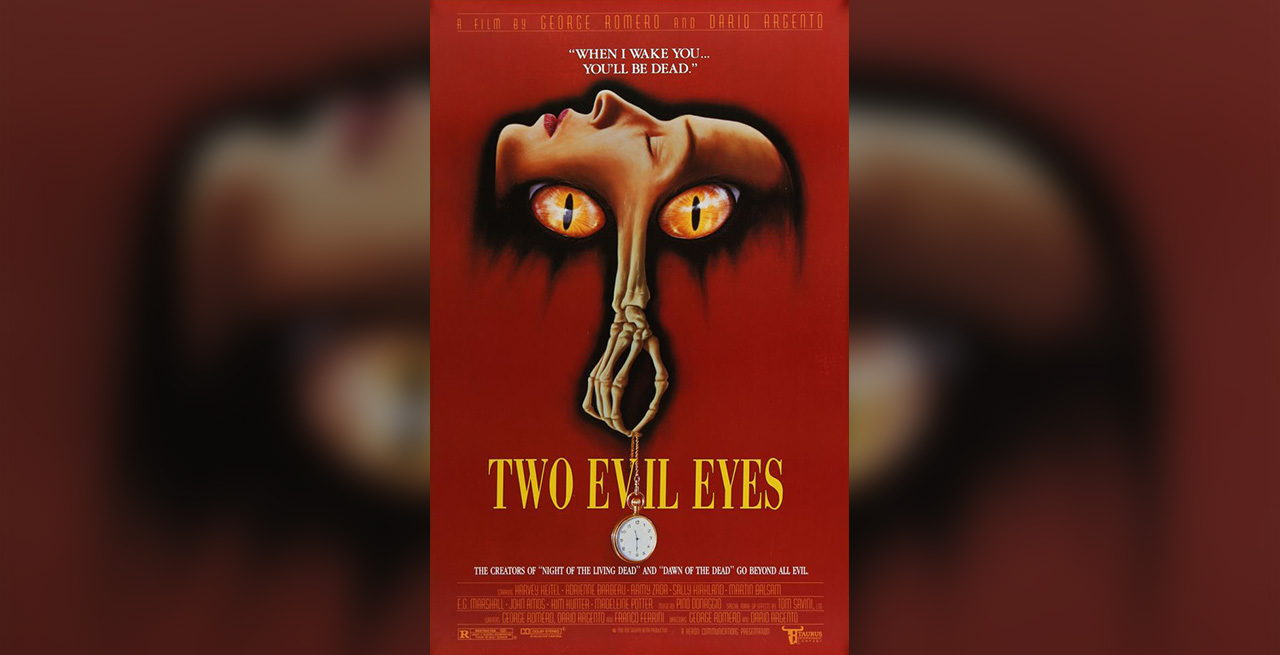





Horror filmmaking royalty collides in Two Evil Eyes (1990): a star-studded yet relatively niche anthology horror from the depraved minds of Dario Argento and George A. Romero. The dastardly duo first collaborated together on the eternal classic Zombi in 1978, more commonly known as Dawn of the Dead, where Argento re-cut, re-scored (a groovy Goblin record was thrown into the mix) and re-released Romero’s living-dead smash-hit for a bloodthirsty European market. Twelve years later, they fused their singular styles into a two-part anthology, operating as a delectably eerie melange of gothic storytelling.
Two Evil Eyes adapts two Edgar Allan Poe stories: Romero opts for the hypnosis-zombie chiller “The Facts in the Case of M. Valdemar” and Argento helms the highly-imitated classic “The Black Cat”. The translations to screen are a hodgepodge of ideas, techniques, and genre icons that act as a flawed but intriguing exercise, and a film that renders the slightly treacherous search for a copy (in the UK, anyway) very worthwhile for fans of cult cinema and horror auteur completists.

The lore is as alluring as the picture itself. Writer Stephen King (The Shining, Carrie) and director John Carpenter (Halloween, The Thing) were last-minute dropouts, leaving just Argento and Romero to pick up the pieces and build an ode to the ‘Godfather of Gothic Horror’. Alas, history has failed Two Evil Eyes, it now subsides in the weird, forgotten annals of illustrious filmographies. If you are not intrigued by its elusive legacy, then prepare to be intrigued by its nightmarish contents.
Romero’s segment rolls first; Jessica Valdemar (scream queen and John Carpenter favourite Adrienne Barbeau: The Fog, Escape from New York) is cheating her terminally ill husband Ernest out of his fortune. Her lover, Dr. Robert Hoffmann, hypnotises Ernest on his deathbed and makes him sign off his millions to Jessica. Bulletproof plan, right? Never underestimate the power of the subconscious. Disaster strikes when Ernest dies whilst under hypnosis. He is spiritually locked in between death and life… and physically locked in a fridge freezer, because Jessica and Robert decide that preserving his body until the money comes through would of course be the most logical and hygienic decision.
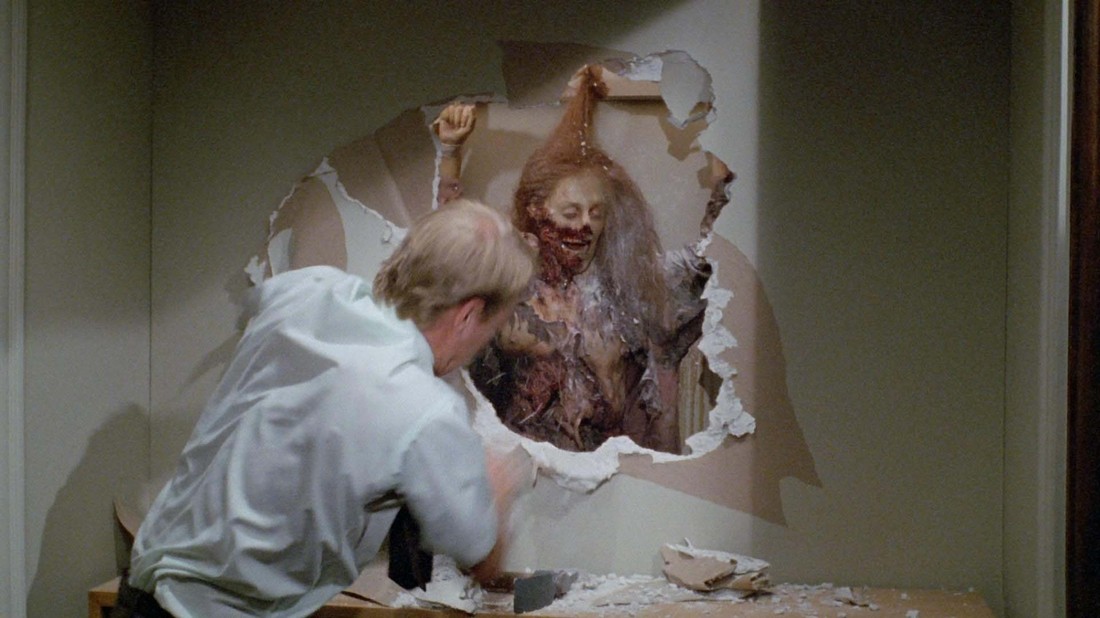
Melodramatic exposition and iffy dialogue soundtracked to an overbearing score take up large portions of this segment. Romero takes Poe very literally and loyally; he ditches exciting visual flourishes in order to ‘play it down the middle’. The grand finale is worth sticking around for, however. Blood splatters across dollar bills and chandeliers; Romero condenses Poe’s matricide-gone-wrong short story to a few shots that frame greed as the real evil. Fans of horror regular Tom Atkins rejoice; the beloved Halloween III: Season of the Witch and Maniac Cop star appears for a terrific stint as a detective towards the end of the segment. Also, the practical effects for Ernest’s frozen (and subsequently defrosted) state are brilliantly executed by none other than Romero’s right-hand man, legendary special effects supervisor Tom Savini, someone who makes a hilarious acting cameo as a tooth-plucking serial killer later on in “The Black Cat”.
Speaking of, Argento’s segment is vastly different in terms of adaptation, style, and personnel. If Romero’s take on Poe could be described as ultra-faithful, rigorous, and slow-burning then the words singular, unrestrained, and unhinged would be fair descriptors of Argento’s stab at the material.
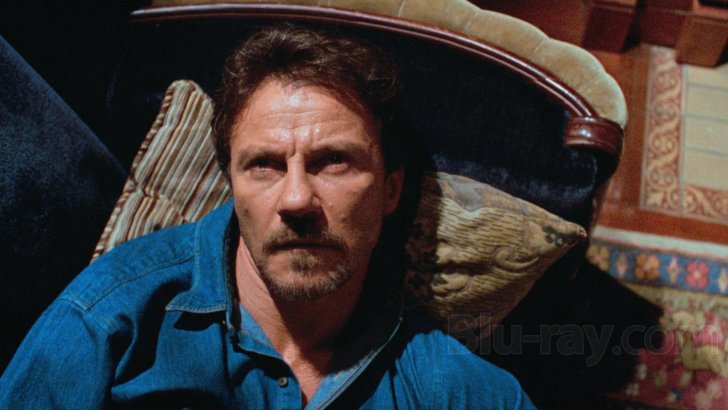
Rod Usher (played by THE Harvey Keitel) is volatile, abusive, and an alcoholic. He is also a crime scene photographer, which is a plotline entirely fabricated by Argento. Why? Well, when Rod attends a homicide in the first five minutes, we see a bloody, outstretched body sliced in half as a result of a huge, shiny pendulum that swings back and forth. Even though the body is long deceased, Keitel activates the machine and gets his kicks watching this violent spectacle in action, just like the audience does. A violent, voyeuristic set-piece that is characteristic of Argento’s style, but it is not completely without purpose. It is a reference to another Poe story: The Pit and The Pendulum, and a shining example of Argento’s ability to forge nuanced grotesquerie.
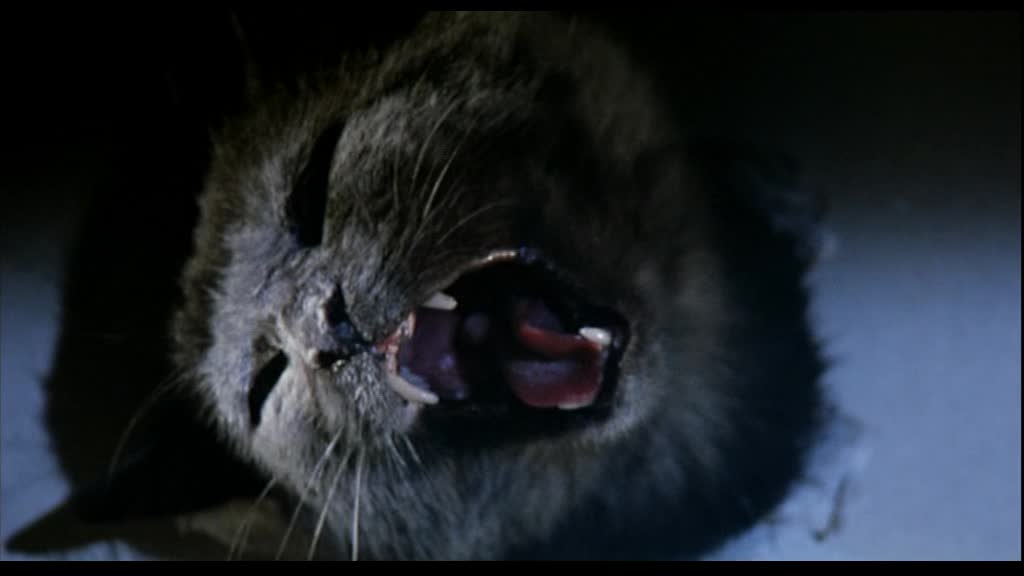
Following that excursion, Rod takes a dislike to his girlfriend’s beloved black cat, only for it to haunt and taunt him for weeks as he spirals into a discombobulated, drunken breakdown. There are perspective shots from the POV of a cat that is brilliantly photographed, and there are memorably creepy dark-room scenes where Rod is developing his crime-scene snaps. Keitel plays a hateful abuser to frightening perfection, a performance very similar to another role he had in the early 90s- Abel Ferrara’s gritty classic Bad Lieutenant. Luigi Cozzi, the Italian genre filmmaker, friend of Argento, and the 2nd AD on Two Evil Eyes, claimed that Keitel had a ‘passionate temperament’ and staged a tantrum about the costuming, a tension undoubtedly contributing to the manic, unpredictable aura attached to the character of Rod. This segment has everything, from dream sequences depicting medieval torture to revolting corpses of humans, cats, and half-human/half-cats that rot in the walls of a haunted Pittsburgh house.
Whilst some may pinpoint this film as the beginning of Argento’s decline into a filmography that was panned critically and forgotten historically (Romero too, although to a lesser extent), Two Evil Eyes is an exercise worth celebrating for what it is, rather than who and what could have been. A creative relationship between two horror legends immortalised onto celluloid: the unification of distinct cinematic approaches that adapt the formidable literature of Edgar Allan Poe. A film that is beneath Romero and Argento’s output of original material, but nevertheless deserves plaudits for its lofty ambition, humble dedication, and enthralling derangement!
More Film Reviews
The Guest Room (La Stanza in Italian) is a 2021 Italian thriller directed by Stefano Lodovichi, making its debut as part of Grimmfest in Manchester UK. Shot in a single… A film about the intersection of sexuality with food might initially feel like a pretty out-there pitch. However, anyone casually considering the topic will find that the concepts of hunger… In the Fall of 2022, the horror movie community got a jolt when the trailer for director Gerard Johnstone’s and screenwriter Akela Cooper’s sci-fi/horror film, M3GAN, dropped. The trailer’s… Showing as part of the 2021 FrightFest lineup, King Knight marks the fifth feature length film of Richard Bates Jr. Reuniting with fan favorite actor Matthew Gray Gubler, who appeared… A new woman replaces a mentally unwell mom, only for paranormal events to move in with the new stepparent. Every family has its demons, but what has riled them up… TikTok dances emanate eerily around you, a cacophony of booming cackles emit from influencers as they forcefully push their latest merch (that was most likely made in some far-off, exploitative…
The Guest Room (2021) Film Review – Killing for Company

Sexual Drive (2021) Film Review – Exploring the Eroticism of Food
M3GAN (2022) Film Review – The Creepy, Dancing Doll that Captured our Hearts

King Knight (2021) Film Review – A Coven Comes Undone
Father of Flies (2022) Film Review – Every Family Has Its Demons
#Chadgetstheaxe (2022) Film Review – Cancel Culture Gone Awry (Unnamed Footage Festival 666)