




Sadomasochism (noun)
: the derivation of sexual gratification from the infliction of physical pain or humiliation either on another person or on oneself. The term “sadism” has its origin in the name of the Marquis de Sade (1740–1814), who not only practiced sexual sadism but also wrote novels about these practices, of which the best known is Justine.
The Marquis de Sade is often viewed as a philosophical thinker and a literary anarchist: he was interested in igniting controversy by probing and subverting socio-political norms of the time. His novels have caused heated debate as to whether he was himself depraved like the antagonists and subjects of his novels, or whether he was more interested in highlighting the depravity that steeped the 18th-century clergy and aristocrats.
Writing in the late 1700s, Sade was a prominent and notorious figure connected to the French Revolution, a revolution that sought to expose hypocrisy and overthrow the French monarchy whilst stripping the power from the Catholic church. It’s important to understand this backstory before delving into his works such as Justine, which Alex Hernandez has taken a unique and reflective interpretation for his feature film. In doing so, Hernandez’s homage to his philosophy can truly be appreciated and understood.

Sade’s novels often included sodomy, torture, murder, sexual cruelty, and an intense focus on the link between pain and pleasure. The controversy this stirred in such a sexually “moral” and repressive time is still echoed today, with some critics looking at Sade’s work through a feminist lens arguing that his work served to outline the violence against women, whilst others believe his novels exploited women and delighted in their submission and control. Simone de Beauvoir famously wrote an essay titled ‘Must We Burn Sade?’ as a response to his novel Justine and proposed that Sade was in search of complete freedom, stating that “He made of his sexuality an ethic; he expressed this ethic in works of literature. It is by this deliberate act that Sade attains real originality.”
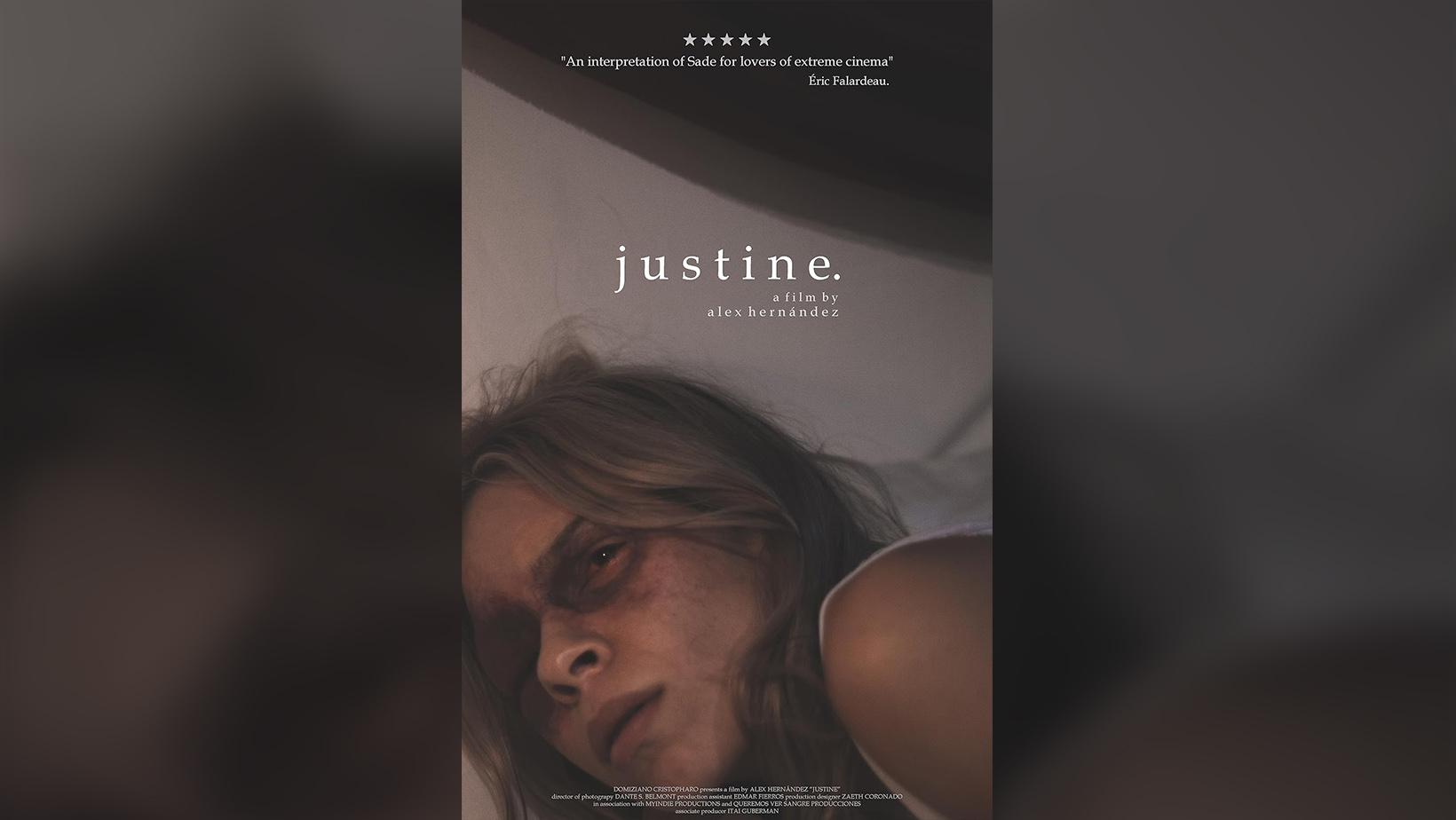
It’s clear that Sade had an intense passion for delving into pain and pleasure and saw it not just as a physical experience but a spiritual and philosophical one as well. In Alex Hernandez’s Justine, this philosophy takes centre stage, and the exploitation and degradation of Justine is almost a depraved sideshow. Justine follows a young girl (Dan Zapata) who tries desperately to preserve her virtue but instead finds incitement to vice by Dr. Rodin (Enrique Diaz Duran), a man obsessed with virginity. She recounts the story of her life, detailing the atrocities that have been committed upon her and those that she has willingly been a martyr in.
Hernandez states he was inspired by “The context of Sade’s works (that could) be adapted to any time. I like De Sade’s philosophy, and my version of Justine has something of that…It’s really just based on an episode where Justine meets Dr. Rodin. I liked the character of the doctor in the novel, but he only appears briefly. I expanded the character, giving him more of an identity.” Enrique Diaz Duran plays the role of the animalistic Doctor whose character is used as a mouthpiece to expound upon and magnify Sade’s philosophical thinking. This is effectively achieved through various monologues in the film, creating a poignant dialogue-driven character study of both Justine and The Doctor.

Although the film is an example of extreme cinema, it is equally a sensitive portrayal due to up close shots of Justine and The Doctor dominating the screen which at times leaves the viewer to infer for themselves the acts that are being committed, rather than them being subjected to every gruesome detail solely for shock value. Justine doesn’t delight in the exploitation of the young character. Instead, it allows Dan Zapata to create a powerful and provoking performance as Justine. This paired with Duran’s bestial and fervent approach creates an expressive foundation for the film to portray such blunt and appalling situations.
This isn’t to say that the movie is devoid of any extreme gore and violence, the film interweaves impressive practical effects for violent scenes and any gorehound’s thirst for blood will truly be satiated through this film. While the subject matter is extreme and portrays the torture of Justine along with themes of inc**t and n***ophilia, the cinematography and soundtrack create a stark juxtaposition to the content. The artistic and beautiful visuals seem incongruous with the severe violence Justine endures; Hernandez plays with a muted, sepia-toned palette which creates an intimate setting for Justine to recount her abuse. Light and dark are employed artfully, with a recurring image of a bright light being used as a refrain throughout the film, possibly to serve as a metaphor for Justine’s unwavering hope for humanity and virtuous spirit in the face of such horrifying acts. The soundtrack is opulent and highbrow, as Hernandez includes ever-present classical music to underscore and highlight the shifts in mood throughout the film.
Justine is certainly not an easy watch due to the disturbing and vicious content but can be appreciated for the stylistic cinematography that is not often employed in extreme cinema. If you’re interested in Justine, it will be available for viewing from TetroVideo soon!
More From The Purveyors of Extreme Cinema
August Underground’s Penance is a 2007 extreme found footage horror film, written and directed by Fred Vogel, with additional writing from Allen Peters and Cristie Whiles. The film is the… Rave (Svartklubb) is a 2020 Swedish body horror film written and directed by Nils Alatalo in his first feature-length debut after graduating from film school. The film stars Isabelle Grill… Mexico Barbaro II is a 2017 horror anthology film, with segments written and directed by Diego Cohen, Christian Cueva, Ricardo Farias, Adrian Garcia Bogliano, Michelle Garza Cervera, Carlos Meléndez, Alfredo… Invitation Only (Jue ming pai dui) is a 2009 Taiwanese extreme horror, written by Sung In and Carolyn Lin and directed by Kevin Ko as his first feature-length film. Kevin… We are happy to present our interview with Rob Jabbaz, director of The Sadness as an incredible debut. The Sadness has achieved all kinds of accolades throughout festival circuits and is… The Old Man: The Movie (Vanamehe film) is a 2019 Estonian stop-motion animation, written and directed by Oskar Lehemaa and Mikk Mägi with additional writing from Peeter Ritso. The film…
August Underground’s Penance (2007) Film Review – Rocking Round The Christmas Tree

Rave (2020) Film Review – We’re Off to the Discotech

Mexico Barbaro II (2017) Film Review – A Grisly Romp South of the Boarder
Invitation Only (2009) Film Review – An Invitation You Cant Refuse
Rob Jabbaz Interview – Director of The Sadness

The Old Man: The Movie (2019) Film Review – “Adventures, Robots, Explosions”