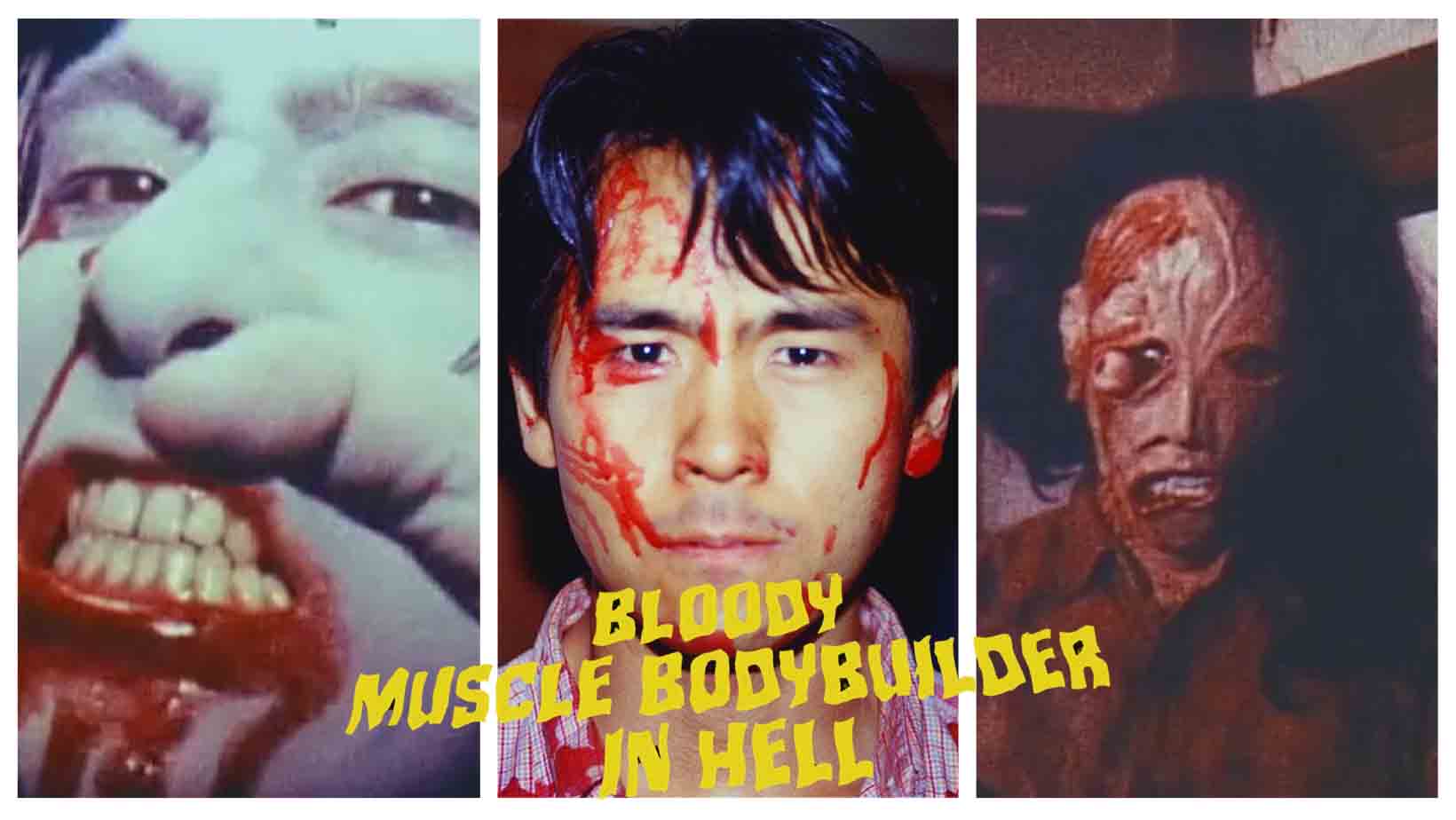




Being one of the most attributed inspirations in filmmaking, filmmakers around the world have cited The Evil Dead series as a motivation to create cinema for themselves. The mastery of the low-budget filmmaking process, which led to various highly esteemed horror films, still hold its own to this day in the horror genre – ingenuity salvaging the aspirations of numerous scripts. Directors such as Eli Roth, Edgar Wright and Peter Jackson, just to name a few, are open on the subject of how The Evil Dead influenced them as creators, but none may be as dedicated to a single influence as Shinichi Fukazawa and his film Bloody Muscle Bodybuilder in Hell.
What is it?
Bloody Muscle Bodybuilder in Hell is an independent Japanese horror film written, directed, produced, edited and starring Shinichi Fukazawa. Touted as “The Japanese Evil Dead”, the film originally began production in 1995 to explain the retro aesthetic, and was worked on over a period of 15 years before finally having a limited release in 2012. It finally received a larger distribution to wider markets in 2014 and the complicated production history naturally intrigued film enthusiasts.
“After a surprise phone call interrupts his daily workout, beefy bodybuilder Shinji agrees to meet his photojournalist ex-girlfriend to help with her research on haunted houses. Accompanied by a professional psychic, they visit an abandoned house once owned by Shinji’s father. But inside the house a dark secret lingers and they find themselves trapped and tormented by a relentless ghost with a thirty-year grudge.”

What Worked?
The film is a love letter to Western cult horror, and embodies an excess that popularised the genre in the 70s and 80s, with clear influences from films like Peter Jackson’s absurdly gory Braindead and, of course, Sam Raimi’s surprisingly successful Evil Dead series. In particular, the similarity in tone, content, and, notably, visual aesthetics are abundantly obvious in their implementation. The incredibly claustrophobic environment, extravagant use of bloody practical effects, and tight, frantic cinematography all exhibit a deep appreciation from Shinichi Fukazawa concerning the original material inspiring him.
Although mostly comedic in tone, the film knows when to take itself seriously. It controls any absurdity of the overall situation to become a less imposing undertone to the more action-orientated scenes, assisted greatly by the use of the film’s soundtrack which perfectly denotes these transitions. Furthermore, the entire cast of three do an amazing job at playing their roles seriously rather than indulging the comedic elements, therefore strengthening the earnest aspects and sustaining any fluctuations in style.
At an hour in length, the pacing is faultless, providing a concise yet natural introduction to the story and characters without contrived exposition. Bloody Muscle Bodybuilder in Hell lucidly frames characters’ relation and purpose to the narrative by the first 15 minutes, which enables the production to unfold organically into the enjoyable bloody mess that it is – minimal filler or diversions from the kind of entertainment value in such flicks. Any additional continuation of the story could cause its progression to stagnate at points, but the director wisely opted to keep the film short in length is one of its core strengths – a taut narrative that loses neither momentum nor focus.
Interestingly, the production had a minuscule crew, and every member exerted an enormous effort in the creation of this film – commitment self-evident from all crew performing their duty eagerly from a restricted budget. Shinichi Fukazawa taking on the majority of the filmmaking process himself must have been a colossal task to undertake; however, with help from the rest of the skeleton crew, he has still managed to produce a magnificent piece of cult cinema. The continuity kept over the course of 15 years of reshoots and re-edits is seamless, hardly showing the length of time the film was under production. Furthermore, it also retains the charm of an 90’s aesthetic – enduringly popular as a nostalgic era as of late.
What Didn’t Work?
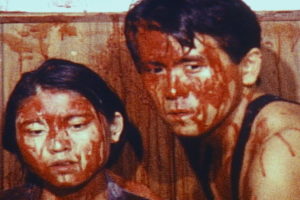
Saying Body Muscle Bodybuilder in Hell utilizes a shoestring budget would be an understatement, being filmed inside a dilapidated property Shinichi Fukazawa’s parents owned, as well as implementing other money-saving tactics during the production. Unfortunately, one of these ideas was to shoot using Super8 film. This has a perceptible, grainy effect throughout the entire film that often resembles snow in the film’s underlit scenes. Nevertheless, this does not detract from the overall quality of the film itself, enhancing the film’s lo-fi visuals instead.
Where Can I Find It?
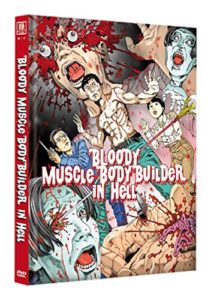
In my opinion, the definitive way to own this piece of media is through the amazing limited release from Midori Impuls. Their limited-run special edition release includes –
- A beautiful hard-backed DVD case with a choice of three different covers, with designs by Graham Humphreys (cover A) and Shintaro Kago (cover B)
- 24-page German booklet with production notes by Shinichi Fukazawa and interviews with Shinichi Fukazawa and Graham Humphrey’s
- An autographed autograph card from director Shinichi Fukazawa (cover A only),
- Interviews
- Video introduction by Thorsten Hanisch and Andrea Sczuka (dasmanifest.com)
- Trailer
Final Thoughts
Bloody Muscle Bodybuilder in Hell is an ode to the cult classics that have come before it, full of the indulgence that made b-movie cult classics popular. The film is an enjoyable mix of gore and comedic energy, efficiently upheld throughout its entire duration. Fully deserving of its status among fans and critics alike, its use of lo-fi practical special effects as well as a cramped, confined set together with minuscule cast all work in the film’s favour, making for a truly entertaining experience. Although not perfect, the film is still a delightful romp to enjoy both alone or with a group of friends.

More Film Reviews
Hotspring Sharkattack (also known as Onsen shâku) is a 2024 Japanese action comedy film written and directed by Morihito Inoue in his feature debut. There have been cases of mysterious… So often the horror genre seeks to hold a mirror up to society’s most profound and insidious anxieties. From concerns surrounding the development of nuclear weapons during the 1950s, as… Khavn De La Cruz, or simply Khavn, is a Filipino director best known for his 2010 crime comedy film Mondomanila. His works never cease to emanate with his knack for… When looking at the origins of sukeban media, the first representation of the genre came in 1967 with Taro Bonten’s Modern Delinquent Girl Stories manga; with the first proper sukeban… “South African enfant terrible filmmaker and artiste-cineaste Manus Oosthuizen meets with Rotten Tomatoes-approved indie film critic Babette Cruickshank in an Echo Park sound studio. With key members of Manus’s crew… One of the crowning glories of the horror film genre is how much can be done with so little. From budget to effects to characters, indie horror films prove time…![Hotspring Sharkattack (2024) Film Review – We’re Going to Need a Bigger Onsen! [Nippon Connection 2025]](https://www.grimoireofhorror.com/wp-content/uploads/2025/05/Hotspring-Sharkattack-cover-365x180.jpg)
Hotspring Sharkattack (2024) Film Review – We’re Going to Need a Bigger Onsen! [Nippon Connection 2025]

Revenge (2017) Film Review – A Subversive Take on a Final Girl

Three Days Of Darkness: Zero (2005) Film Review – Let Darkness Swallow You Whole

Three She-Cats (1966) Film Review – Paving The Way For Delinquent Women Cinema
Razzennest (2022) Film Review – A Unique Experiment in Aural Terror

The Alchemist Cookbook (2016) Film Review – Minimalism Maximized

Hey there, I’m Jim and I’m located in London, UK. I am a Writer and Managing Director here at Grimoire of Horror. A lifelong love of horror and writing has led me down this rabbit hole, allowing me to meet many amazing people and experience some truly original artwork. I specialise in world cinema, manga/graphic novels, and video games but will sometime traverse into the unknown in search of adventure.