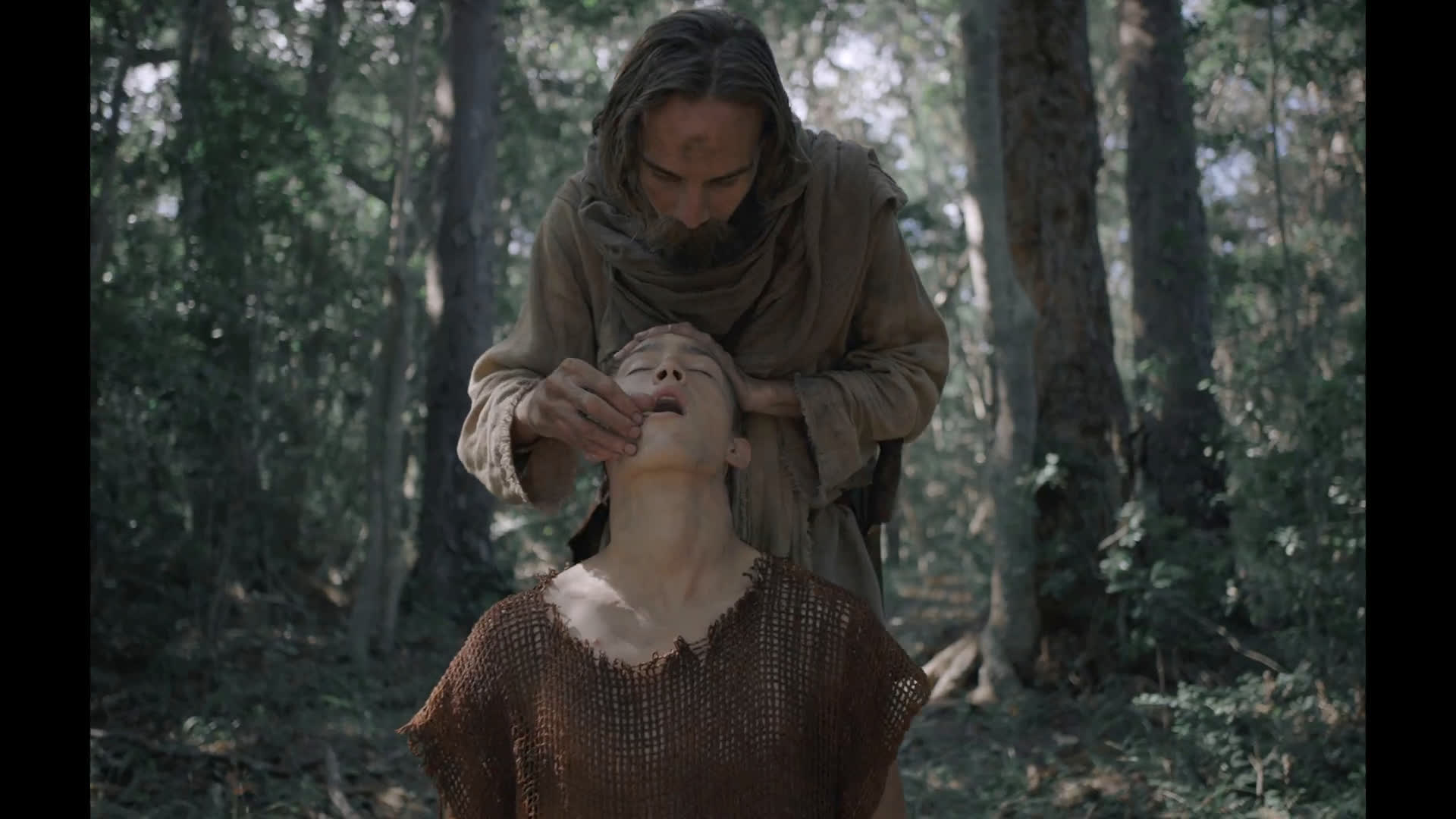




Warning to those with mycophobia – this is not the film for you.
Gaia is a South African ecological horror film, full of mushroom monsters, skin-crawling body horror and raving sermons about the demise of mankind. Switching seamlessly between English and Afrikaans, this is no humorous splatterfest but a dark, sumptuous dive into the horrors of nature.
Our lead, Gabi, is a park ranger in an ancient forest. When a downed drone requires her to leave the safety of her boat to explore in the forest, she’s caught in a man-made trap. Taking the only sensible action and finding refuge in an empty hut, she is found by a father and son – Barend and Stefan – living in the forest who take her in and offering to help her home…eventually.
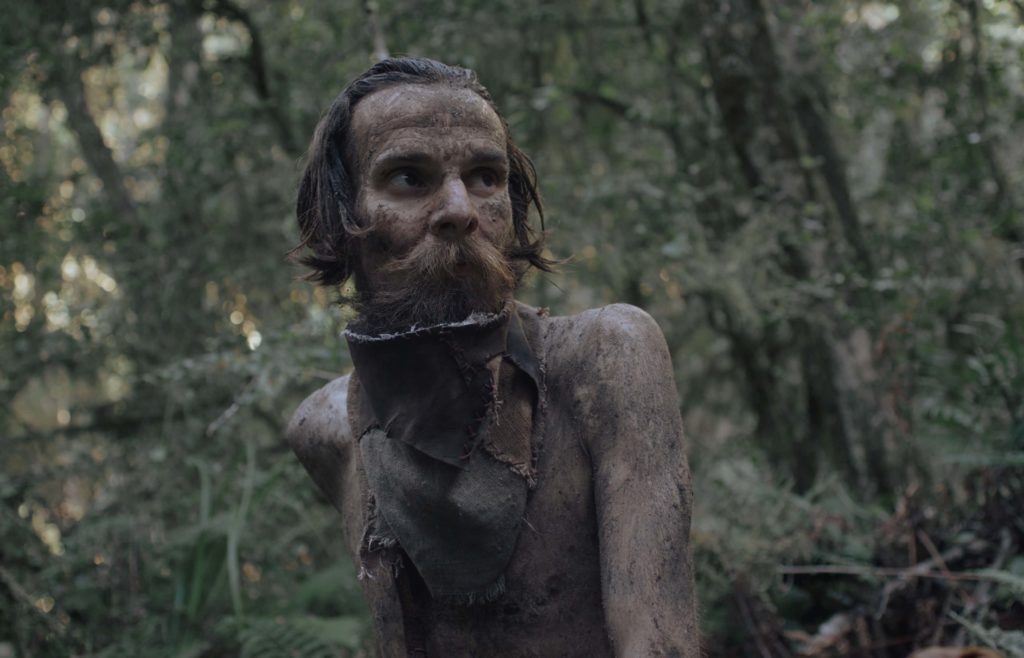
Although kind at first, the religious fervor of the father and seeming simplicity of the son are truly unsettling. Bored and curious, Gabi finds Barend’s writings which liken men to apes and speak of ecological apocalypse. The strange family are living on top of the largest organism in the world, most of which is underground, and regularly pray to it. Fun fact: in real life the biggest organism on earth is also a mushroom (it just happens to be in Oregon)!
Deciding to stay, she becomes an Eve figure to the son’s Adam; teaching him, being kind to him and encouraging him to think and question. She represents to him not just forbidden knowledge but lust, although the film thankfully steers away from the predictable and frankly lazy tendency to include rape as a point of horror, instead making her body both desirable and the source of most of the film’s body horror.
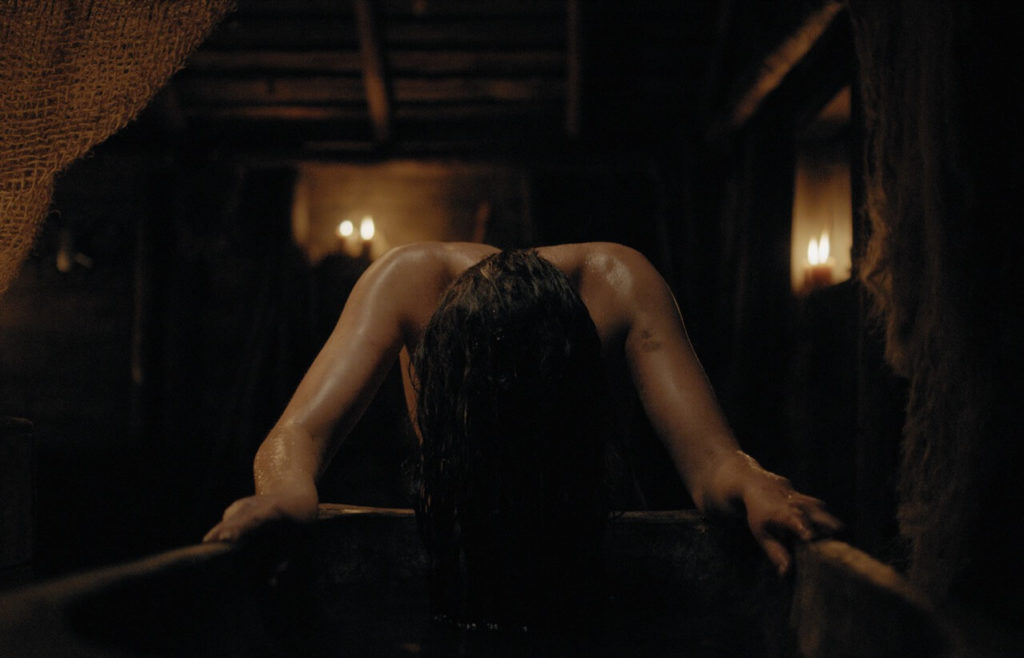
As a lead, Gabi is smart, capable and adaptable. Barring a few mistakes, she acts with the kind of thought-through agency that most horror leads are denied, which only amplifies the horror of her situation. The tension between Gabi and Barend, played out as the rational/religious or human/nature dichotomy, builds beautifully. He is utterly terrifying.
The film is slow, measured and sumptuous, the horror unfolding in darkened corners. It lingers on the unique and disturbing sounds of nature, decay and growth, the spongy sounds of mushrooms between teeth and tongue, the itch of an infection beneath the skin and the plucking of sores.
The cinematography only underlines this with slow panning shots and deep muted colour tones, lingering heavily in the tan fleshy tones that make human and mushroom seem too close for comfort. There’s a slight theme in the filming, wherein the human is split across the screen and the natural is central, whole. The entire film in fact confuses the eyes, forcing the viewer to constantly reexamine and reevaluate what they’re seeing. It’s a very nice touch if you’re into that kind of thing.
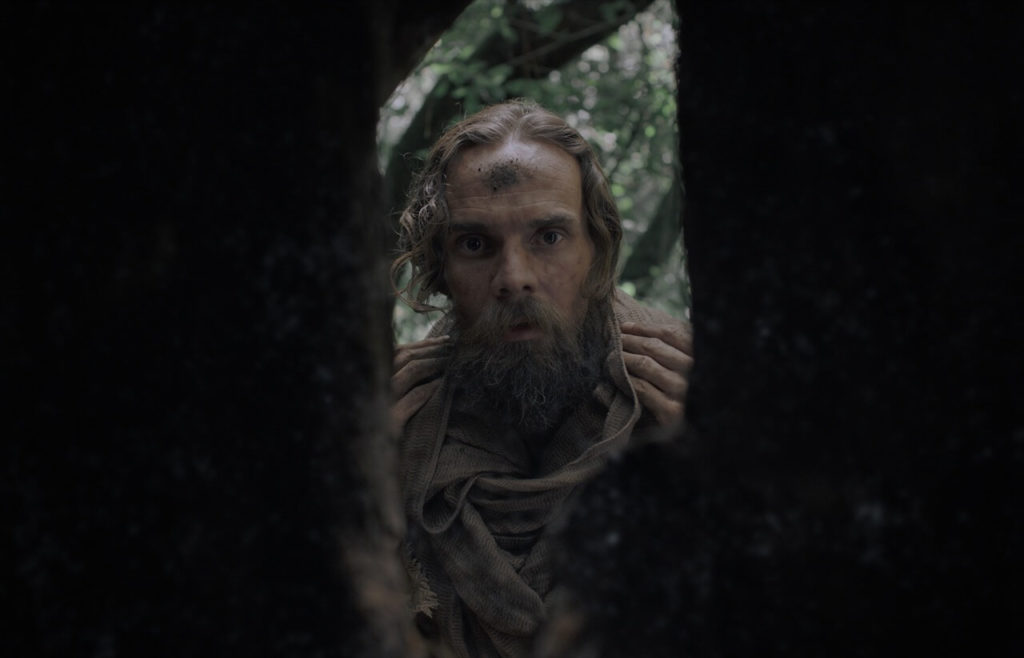
Gaia combines a kind of old testament Christianity with Pagan nature worship that verges on the Lovecraftian. Unspeakable, unknowable horrors that owned the world before the rise of man and will inherit it after we’ve gone; if you’ve ever watched a documentary about mushrooms you’ll know that isn’t far from the truth (and if you haven’t, check out Fantastic Fungi on Netflix).
The monsters themselves look amazing; their concept isn’t unique in horror but it is artfully executed and not overdone. And while “mankind is the real virus” has been done plenty of times, the approach was quite different.
Like the ancient mushroom, the terror of Gaia grows slowly; devouring, subsuming, changing, growing. This film is for the slow burn horror lovers.
Check out the creeping horror of Gaia at this year’s online FrightFest, showing in theatres from 26th to 30th August with digital screenings from 1st to the 5th of September.
More Film Festival Coverage:
Deep Fear is a 2022 French horror film directed by Grégory Beghin, who has made a name for himself as a TV actor. Grégory made his debut behind the camera with the 2020… When the seventh chapter, titled Disinformation rolled in, the narrator and confessor, Dr. Laura Gale started to talk about things “that are not.” She began debunking famous alien encounter stories that had… Director Quinten Dupieux has been building a catalog of films ever since his release of Steak back in 2007. (However, you could argue he defined his image starting all the… One of the more curious selections to be found on the lineup for the 2021 Japan-Filmfest Hamburg (JFFH). Crowded in among the various alluring arthouse features and more straightforward bombastic… Forced to move when her mother gets a new job, a teenager called Sol has to face dangers ranging from power outages, bullies at a new school, the worrying behaviour… I didn’t really have a whole lot going during my high school years. I went to class and did stupid hijinks with my friends, but I mostly just watched movies…
Deep Fear (2022) Film Review – I Did “Nazi” That Coming
The Gulf of Silence (2020) Film Review – No Contact! (Unnamed Footage Festival 666)

Incredible But True (2022) Film Review – Time Travel at its Most Inconvenient
Dosuemon (2020) Film Review – A Passionately Vulgar Dark Comedy
The Night Belongs to Monsters (2021) Film Review – Argentinian Teen Outsider Drama With A Supernatural Edge
Baby Assassins (2021) Film Review – Moe Moe Kyun!

Jenny is a creative copywriter living just outside of Liverpool who loves horror, board games, comics, video games and industrial metal.