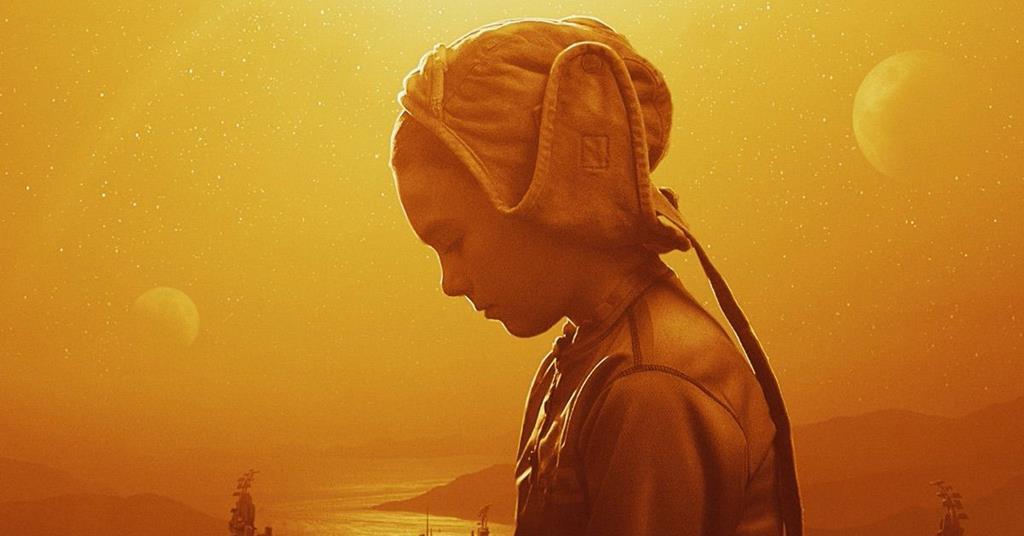
This dystopian sci-fi centers on a family at the very edge of the human frontier: Mars. The mother, father, daughter trio seem to live a Utopian existence until the outside world encroaches on their (literal) bubble. What ensues is the question of who is the enemy, and what is exists beyond their small protected world? The story unfolds through the perspective of Remmy, the young daughter of the settlers, who grows into a women during the course of the movie.
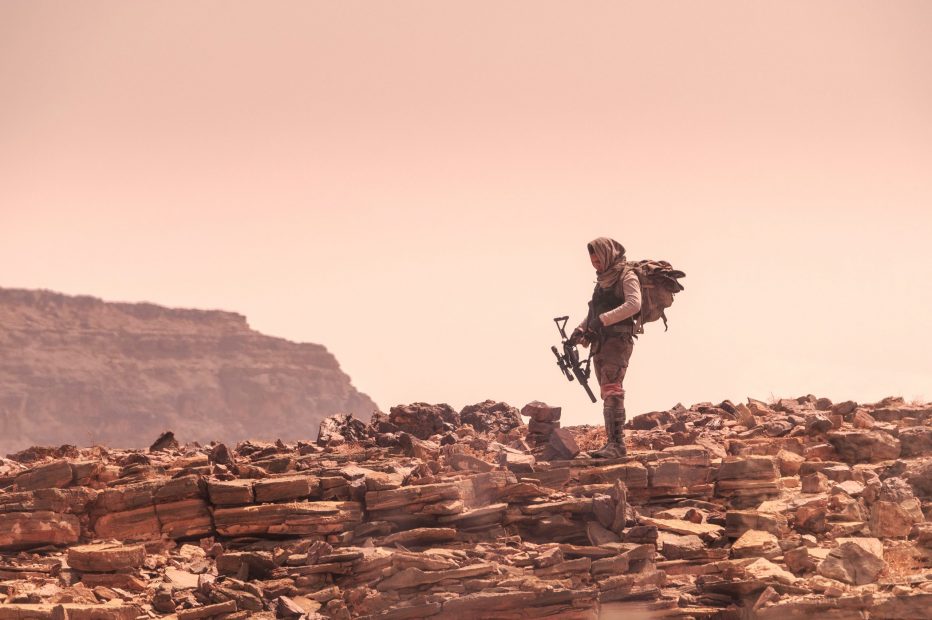
The most incredible feature of this film is the settlement itself; a gorgeous sprawling futuristic compound that feels like the remnants from a forgotten Star Wars film set against a seemingly endless red desert. Settlers only has five named characters, so the house and settlement take on an important role of acting as both a shelter and a cage, filling in tension where dialogue is absent. The cinematography maximizes the setting, with slow-panning shots when characters are stationary, sometimes leaving the viewer admiring the home and daydreaming of living there. In other scenes the camera tracks behind a character as the run through the house, inducing a fear of being cornered or snuck up– as the characters find themselves on occasion.
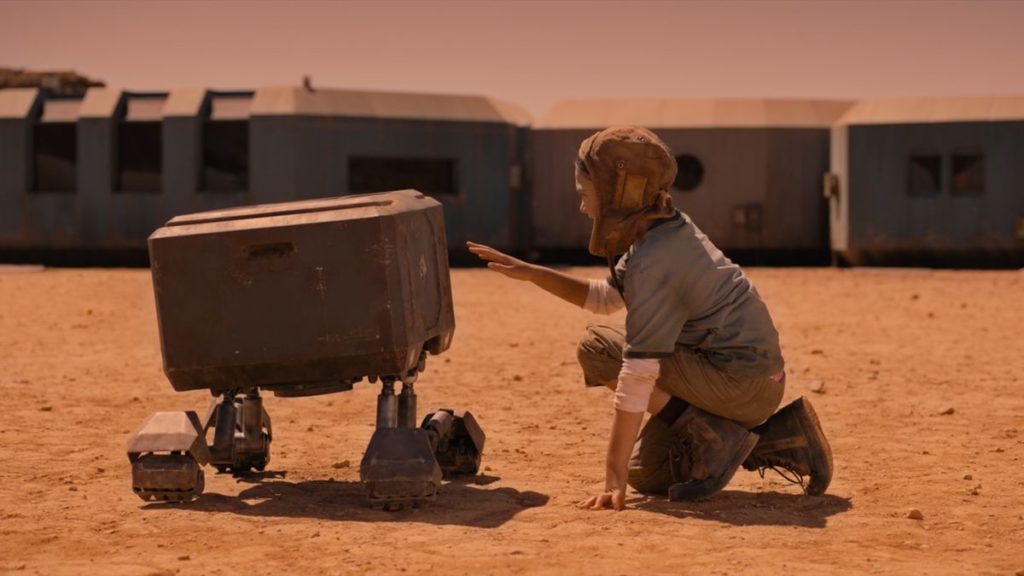
The tech featured in the film is left vague, but interesting, so that we get the science fiction feel without it distracting from the character tension playing out before us. It lacks The Martian -level details of survival, but it’s clear they live comfortably with the aid of futuristic technology. The character Steve is a standout, as a 4-legged and mute worker robot likely built for excavation, but befriends Remmy and thus growing into something more than a worker bot. The effects are so incredible with Steve that it is nearly impossible to tell if he was created with CG or practical effects, and eventually the mind wanders away from the question and easily excepts him as real.
When the outside crashes in on the estate, kicking off the main plot, ominous hints allude to a hellscape on the other side of their world. The question that circulates through much of the film is whether it is safer to stay in the dome with those who have entered, or to risk the outside world. Two different interpretations of the word “survival” clash, the individual vs. the species, where most of the action in the film occurs in short but violent bursts always initiated by one or the other concepts of survival.
The tension and scenes of violence are especially stunning due to the work of the ladies in the film. It is almost impossible to turn away from Sofia Boutella, who plays the mother Isla, as she brings to life all the fears and angers of a character that is given little other than the role of “mother” and “wife.” The intensity in many of the scenes is solely based on her mastery of physical acting and milking every bit of emotion out of sparse dialogue. Young Remmy is played by Brooklyn Prince, the young lead of The Florida Project and one of my favorite films of 2017. Child actors that can pull off Prince’s level of acting are a rare gem to be treasured, and she adds so much frailty but fierce character to the role.
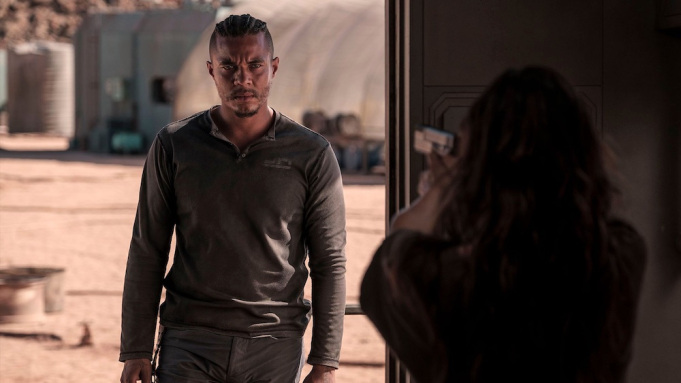
The character Jerry, played by Ismael Cruz Cordova, falls flat for most of the film, with monotone mumbling and wobbling between sociopath lite (TM) and bland step dad. A character that should be either an enigmatic force or a constantly menacing presence just leaves the viewer bored. A beautiful but ultimately boring presence. Many reviewers more esteemed than myself have commented that the movie falls flat, and I believe it is because of Jerry and the failure of his character to put pressure on the plot in a meaningful way. He comes back in spades at the end of the film, which is what won me over, but it wasn’t enough to save it entirely as there was too much lost in character building by the time we get there.
Remmy as a grown woman is played by Nell Tiger Free, who also does a stellar job in the role. Again, the dialogue is so sparse that we are left piecing together the story through subtle interactions, facial expressions, and body language. Free’s eyes alone deserve an award, as those engrossing black orbs say a thousand times more than any dialogue. I was almost ready to quit the film about three-fourths of the way through, then she entered and I was glued to the screen.
The ending, without giving anything away, feels more like a cliffhanger or opening to a sequel than meaningful statement. It’s hackneyed “what happens next is up to you” that left me craving better films like the Netflix exclusive sci-fi Mother, which tackles many of the same themes in a more meaningful way that is heavily laced in well thought out technology. However, I think Settlers is a worthwhile film posing some interesting questions about what we mean when we say “survival” and what that actually looks like.
More Film Reviews
Crabs! (2021) Film Review – A Love Letter to Classic Monster Movies
By all rights Crabs! seems like it ought to be the sort of film that is a complete joke. Nominally it is about a horde of murderous mutated horseshoe crabs…

All 6 Films of Mari Atsumi’s Mollusc Series Reviewed – The Cute Devil
Regarded by many as Japan’s answer to Brigitte Bardot — both for her glamorousness and vaguely European looks (though, she wasn’t actually mixed-race) — Mari Atsumi became one of…
![Strike (2024) Film Review – Now I Have My Very Own Friend From Beyond The Grave [Dead Northern Film Festival]](https://www.grimoireofhorror.com/wp-content/uploads/2024/10/Strike-365x180.jpg)
Strike (2024) Film Review – Now I Have My Very Own Friend From Beyond The Grave [Dead Northern Film Festival]
Strike is a 2024 English supernatural horror short film, written by Hendrik Harms and directed by Mark Patterson. When the lonely and isolated Francine is gifted a case of matches…

Angels Fallen: Warriors of Peace (2024) Film Review – Zamani’s Next Installment in the Angels Fallen Universe
“Haunted by the war in Iraq, a depressed and faithless Gabriel is approached by the mysterious Balthazar, who recruits Gabriel to stop the evil Archangel Michael from raising an army…
The Abandoned (2006) Film Review – Abandon All Hope
The Abandoned is a 2006 horror thriller, written and directed by Nacho Cerdá with additional writing from Karim Hussain and Richard Stanley. Mostly known as a director of shorts and…
30 Days of Night: Dark Days (2010) Film Review – Severely Sucked Dry
Sucking dry its predecessor’s persisting legacy as one of the preeminent vampire movies of the 21st century, 30 Days of Night: Dark Days forces a change of pace and goes…

A study in contrasts, Aubry is a lover of knitting and rescuing strays, but also most likely the one cheering loudest during gory horror scenes.
Someday she’s going to get too excited and accidentally stab herself with a knitting needle.