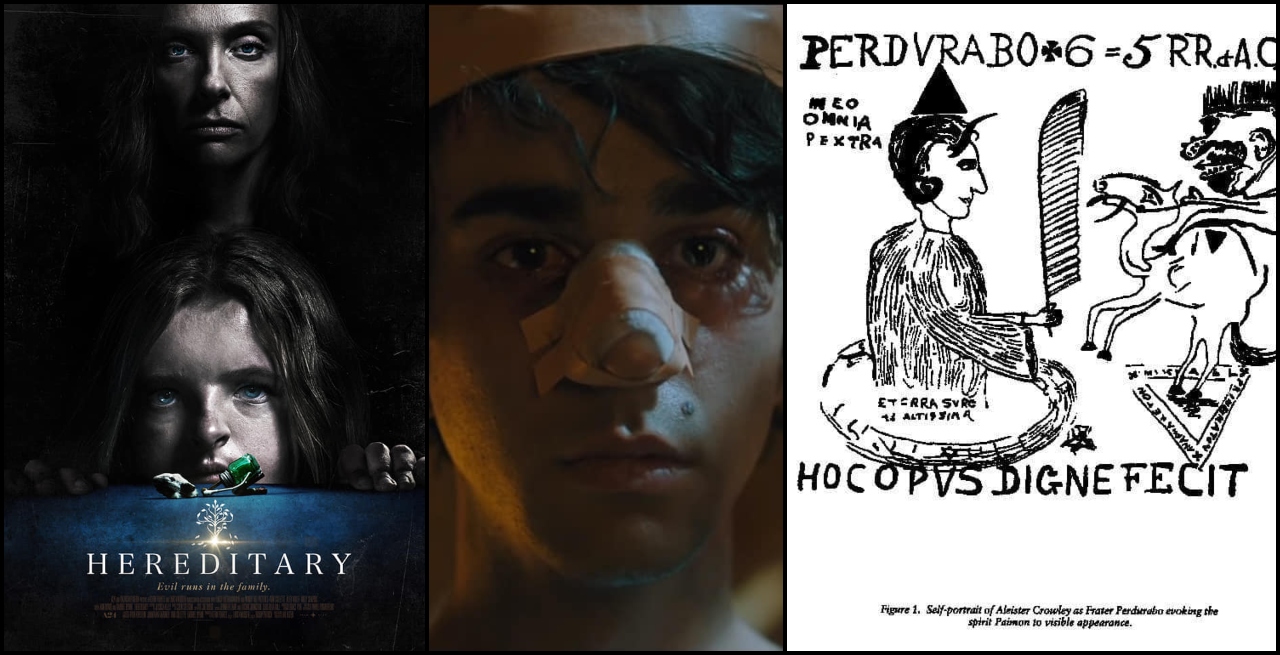
Hereditary shook up the horror community upon its release. The slow-burn torment of being forced to watch a family slowly go mad as tragedies are inflicted upon them, helped to sear the film into viewers’ minds. The ending, with its last-minute reveal of the antagonist, left audiences unsettled, disgusted, and mortified, having been witness to a harrowing blend of body horror, violence, and degradation of the comforting nuclear family unit. But, you might be asking (you do have such an inquisitive mind!), what, exactly, is the bogeyman behind the grim events of the film? Was it actually real? And does it even matter? Well, my curious reader, now is the time to welcome you to this edition of Folklore Friday. My name is Eden, and I’ve summoned you here to talk about the dark figure looming behind the events of everyone’s favorite dysfunctional family film.
[Oh, and there are spoilers ahead, in case you for some reason haven’t seen Hereditary, would be upset at someone telling you how it ends, and yet are still reading this.]

After watching his entire family die in various horrific ways, son Peter finds himself surrounded by cultists who reveal he is now possessed not only by the warped soul of his little sister, but by a demon named Paimon, one of the Princes of Hell. As the cultists chant “Hail Paimon,” Peter stares off into the void, probably also having no clue what’s going on. And honestly, even to those who know their demonology, there’s plenty to be confused about with the portrayal of the so-called “demon.” While Hereditary gets some interesting details right about Paimon, it’s painfully off in other, very predictable ways.
Paimon originated in Mesopotamian mythology as a goddess, and later was turned into a djinni. They are often hermaphroditic, portrayed with both male and female attributes. They preside over the arts and sciences, and thus the purpose of summoning such a being would be for the summoner to gain knowledge in these fields. Hardly the bloodthirsty type, eh? Paimon was famously written about in the grimoire The Lesser Key of Solomon, and later occultist writers would add to their mythos. Other powers ascribed to Paimon are the ability to grant familiars, bestow lordships, reveal the locations of hidden treasures, and one grimoire claims they specifically have the power to control fish. So, summoning Paimon could potentially treat the magician to the greatest all-you-can-eat sushi buffet of their life.
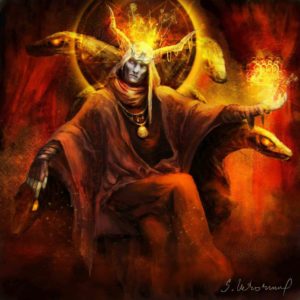
Hereditary does get some interesting points right, though. Paimon’s arrival is said to be presaged by a booming voice that is so loud it cannot be comprehended by human ears. Any summoner must ask Paimon to whisper so that their voice can be understood. The score for Hereditary seemingly takes this into account, as it is full of booming walls of sound. The film also acknowledges Paimon’s hermaphroditic identity, but in an odd way. In the end, both the daughter Charlie and the son Peter are host to Paimon, but throughout the movie, it is insisted that Paimon wants a male host. One has to wonder if the cultists bothered to learn much about Paimon before choosing to worship them. Maybe Peter’s blank stare at the end is actually Paimon wondering at how ill-informed their worshippers are.
Overall, it seems like Ari Aster, the writer/director of Hereditary, only chose Paimon as the Big Bad to avoid the tired trope of having it be the Devil like in so many previous films. Some effort was apparently made at accuracy, but other elements are askew. After all, Paimon was only later demonized by Judeo-Christian-Islamic writers, like so many other Pagan deities. Imagine the Norse God Thor being portrayed in a horror film as a bloodthirsty demon. Unfortunately, while Hereditary’s greatest accomplishment was how it went against the style of most other popular horror films, its greatest downfall is its retention of the ignorant, tropey portrayal of Pagan deities and their followers as monsters. Hopefully Ari Aster educated himself after this. Now, what’s next?
…Midsommar? …Dammit, Ari.
More Reviews
In a career that spanned four decades, prolific novelist Shinji Fujiwara explored a wide range of genres in his work, though is most famed for his 1950s suspense stories. The… I can’t believe that in my review of Fear Street: 1994, I forgot to mention the most important part of a successful slasher film: the sequel. Some slashers don’t always… I love good old-fashioned mockumentaries, especially when they’re done right. Lake Mungo, Ghostwatch, Hell House LLC. and Savageland are just some of my personal favorite mockumentaries—these films manage to create… Since the division of Korea into two separate countries in 1948, North Korea have used its cinema to spread propaganda for their “Juche” or self-reliant ideology to the masses in… Despite being one of Japan’s biggest film studios throughout the late 40s and 50s during the golden age of Japanese cinema, Daiei were struggling by the mid-60s and had to… Eldorado is a 2022 extreme road movie written by Andrea Cavaletto, and directed by Domiziano Christopharo. Not the first time working together, Andrea and Domiziano have collaborated on a number…
Art of Assassination (1969) & The Lady Professional (1971) Film Review – When the Best Man for the Job is a Woman

Fear Street Part Two: 1978 Film Review – If you want Blood, you got it!

Hunting Matthew Nichols (2024) Film Review – A “Blair Witch”-Inspired Slow Burn Mockumentary
Film Insight: Pulgasari (1985) – Kaiju From North Korea

Secrets of a House of Women (1968) Film Review – A Peek Behind the Curtain of Edo’s Red-Light District

Eldorado (2022) Film Review – Roadtrip!

Eden is a Soong-type android learning to pass as human through studies of pop culture, humor, and dark fantasy. Perhaps one day she will learn to love and pronounce “hyoo-mahn” correctly. She was written analyses of music, video games, comics, and film. You can find her other writings on Vocal and WordPress.