




Part 3 – Divine Vengeance
In part 1 and part 2, by examining grindhouse classics Last House on the Left (1972), Thriller: A Cruel Picture (1973), and I Spit on Your Grave (1978), we traced the mortal evolution of the victim in the rape-revenge genre from a mere plot device for male heroism to a human avenger in her own right, forced to fight or die. Now, we examine the supernatural extreme: the victim who returns as an indestructible, mythic force to restore moral order.
This archetype of a revived female spirit seeking vengeance, reborn from the ashes of a tragic and brutal experience, is nearly universal. The women of these stories undergo a swift and painful metamorphosis into spiritual, supernatural beings. In this transition, the woman’s body ceases to be property defined by birth, marriage, or brute force. Instead, she is transformed into a supernatural vessel granted absolute agency, existing beyond the reach of men, a force of nature dispensing cosmic justice.
One of the oldest stories of defilement and retribution by supernatural beings is the Sumerian myth of Inanna (also known as Ishtar) and Shukaletuda. Dating back 4,000 years, the tale tells of Inanna’s rape by Shukaletuda while sleeping. Upon awakening, she unleashed plagues on the land to flush out her rapist. When she finally finds him, his attempts to justify and excuse his behavior further enrages the goddess. Before killing him, she tells him his name will forever be linked with the shame of being a rapist and the cowardice he exhibited.
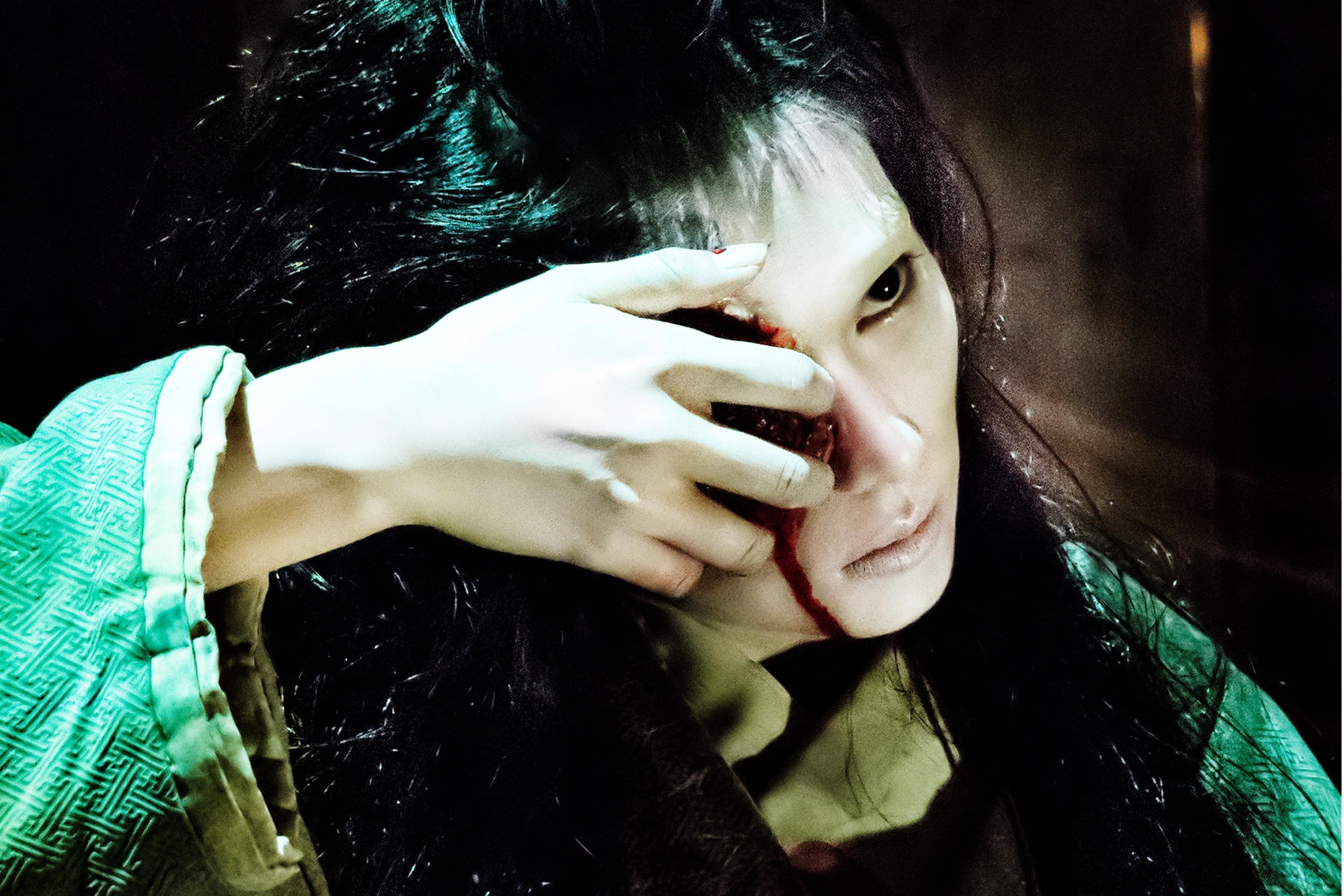
Millennia later, in Greek myths, the Furies (Erinyes) and Medusa emerged as archetypes of this retribution. Spirits from another realm, they punished the transgressors without mercy. Across the globe, similar spirits born from the crucible of violence are just as tireless. There is the South Asian Churel, whose backwards-turned feet signal her total rejection of domestic society as she drains the life force of her victims. In Japan, the ghost-like Onryō, immortalized in the classic story Yosuya Kaidan (1959), sees a murdered wife return as a vengeful spirit to systematically dismantle the sanity of her social-climbing husband, to name a few.
These myths and stories speak for the silenced victims of patriarchal violence. In the featurette Hantu Retribution (included in Severin Films’ All The Haunts Be Ours: A Compendium Of Folk Horror Vol. 2), Australian filmmaker Katrina Irawati Graham describes these spirits as the physical manifestation of trauma: “This is what it looks like when you do this to us… this is how angry we get.”

Traditionally, creatures such as those mentioned above were framed as monsters defined by their enmity towards men. However, modern feminist perspectives reframe their hideous and vile forms not as curses, but as defensive weapons that ensure they can never be touched or violated again and as punishment for transgressors.
Under Indonesian President Suharto’s authoritarian “New Order” regime, the national cinema became a tool of State Ibuism—an ideology that domesticated female identity, reducing women to submissive wives and mothers whose value was measured solely by service to the patriarchal family unit. Popular horror films of the era were cautionary tales of disobedient women transformed into monsters as punishment for their transgressions. However, director Sisworo Gautama Putra’s Sundelbolong (1981) turned these tropes on their head, shifting culpability from women to men. Starring Suzzanna, Indonesia’s “Queen of Horror,” as the reincarnated Alisa, the film offered a terrifying manifestation of female rage.
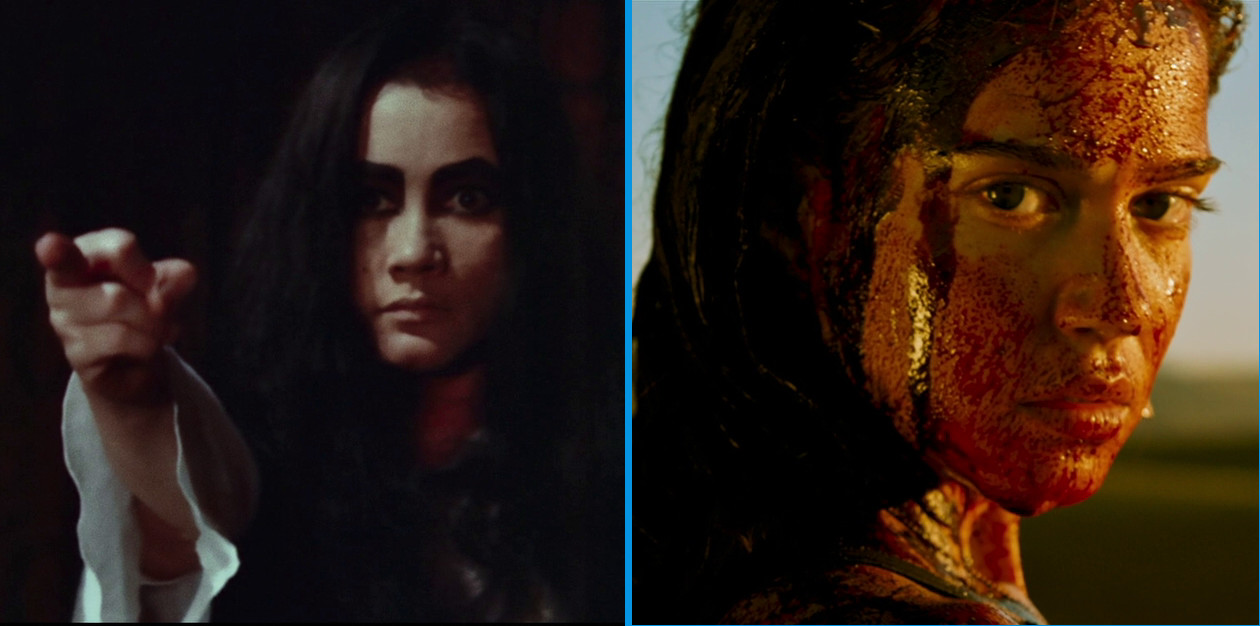
Sundelbolong (a phrase that translates as “prostitute with a hole”) begins at the grave of Alisa, a former sex worker. In a haunting, pre-credit voice-over, she introduces herself as a young woman who once knew happiness but now exists in a dark realm. As the music swells dramatically, she rises into the frame, gaunt and stony-eyed, wearing the Sundel Bolong’s traditional, flowing white gown and long, black hair. In a jarring subversion of the “beautiful ghost” trope, she turns her back to the viewer to reveal the source of her name: a massive, gaping wound rimmed with necrotic flesh and teeming with maggots.
The film proper begins joyously on Alisa and Hendarto’s wedding day. Unfortunately, after Hendarto leaves for work, Alisa encounters Mami, her former madam. Mami sends Rudi and his henchmen to coerce Alisa into returning to sex work. Refusing, they kidnap and brutally rape her. Unlike the graphic depiction of violence that Bo Arne Vibenius, Wes Craven and Meir Zarchi used in their films, Putra discreetly closes the door on the worst of Alisa’s ordeal.
By closing the door, Putra shifts horror from physical violence to institutional failure. Alisa is denied justice in court where the defense attorney weaponizes her past, questioning her character as a ‘good woman.’ Just as humiliating, when she discovers she is pregnant, her doctor denies her abortion, lecturing her on ‘lack of virtue’ rather than providing care or even a modicum of compassion.
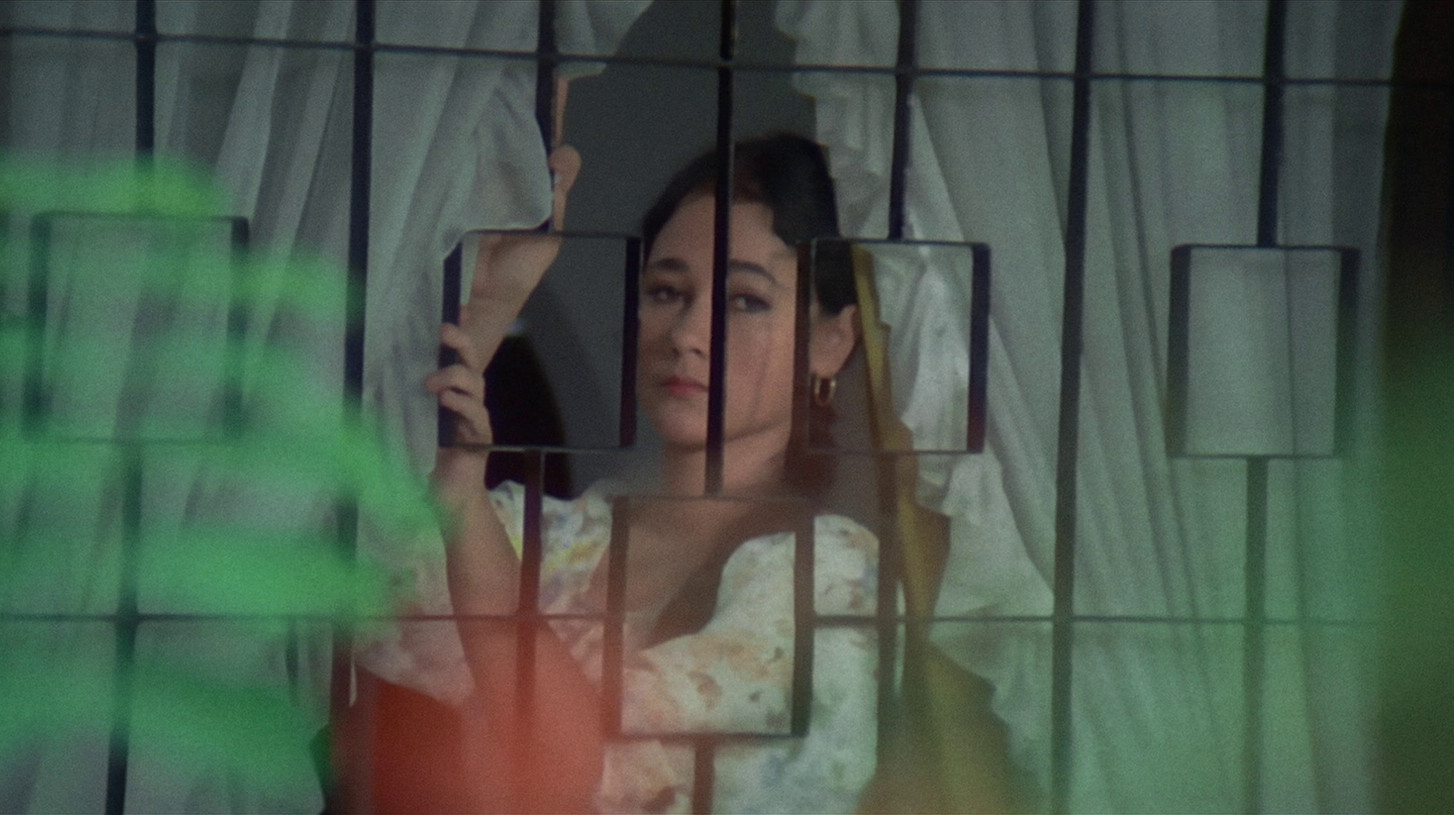
Finding no justice in the courts or succor from medicine, a desperate Alisa suffers a night plagued by visions of deformed infants. The next morning, her housekeeper finds her dead in her bathroom, her bloody fetus between her legs.
Once reborn, the Sundel Bolong targets Alisa’s assailants, weaponizing their lustful yearnings. Throughout the film’s second act, she lures her attackers with promises of seduction into the shadows. But when they reach for her, she reveals the rotting cavity in her back. Faced with their own cruelty literalized, the men recoil in terror—too late. Her revenge is profound irony: men destroyed by the very appetites they used to justify rape.
Unlike many of the films in this series, Sundelbolong offers a definitive resolution to its protagonist’s agency, though one deeply rooted in the cultural confines of its time. The film ends where it began: at Alisa’s grave. In a surprisingly tender and emotional scene, Hendarto and a quorum of men perform ritual prayers, asking Allah to release Alisa’s spirit. As the soundtrack swells with her weeping, Alisa, no longer the Sundel Bolong, vanishes. While she is granted peace, it is a peace mediated and sanctioned by male authority, a final act of domesticating the monstrous spirit back into the spiritual fold. In contrast to the haunting ambiguity of the survivors in Thriller or I Spit on Your Grave, Alisa’s fate is explicitly settled and explicitly contained, ending her rebellion through a sanctioned religious ritual.
While the prayers of men ultimately quiet Alisa’s spirit, Coralie Fargeat’s Jen refuses any such benediction. If Alisa is a spirit seeking a return to the fold, Jen is a woman who burns the fold to the ground.
Historically, the rape-revenge genre has been defined almost exclusively by male directors and writers. The previous instalments of this series explored films spanning from the 1950s to the late 1970s, each produced by male-dominated teams. Writer-director Coralie Fargeat’s Revenge (2017) represents a striking departure from this male-centric canon. In a genre centered on a woman’s journey, Fargeat offers a rare female perspective in both conception and execution—not merely subverting established tropes, but radically reimagining the genre through a female lens.
Revenge directly challenges the victim-blaming that has plagued the genre since its inception. Historically, a survivor’s sexual history was weaponized to discredit her testimony—a grotesque double standard dating back to Levitical law, where assault was only recognized if the victim was a virgin or could prove resistance. Unlike the “pure” victims of The Last House on the Left or even Alisa, who sought redemption by escaping sex work, Jen is unapologetically sexual from the opening frames—the mistress of a married man, neither “maiden” nor “reformed.” Fargeat asserts a vital modern truth: prior consent never negates the right to bodily autonomy. Jen’s sexuality does nothing to diminish the criminality of what follows.
When Jen’s desert getaway with Richard is interrupted by his hunting buddies Stan and Dimitri, the tension begins. During a night of heavy drinking, Jen dances provocatively before the three men. Fargeat intercuts her playfulness with symbols of hyper-masculinity: wrestling on TV, cigar-smoking, and predatory stares. The evening ends with Richard carrying Jen off, framing her as trophy, not partner.
The next day, Stan rapes Jen as Dimitri watches in silent complicity. Richard attempts to ‘manage’ the crisis with a payoff, gaslighting Jen by blaming her beauty for the attack. When she threatens to tell his wife, he pushes her off a cliff. She lands impaled on a dead tree, crucified for their sins.
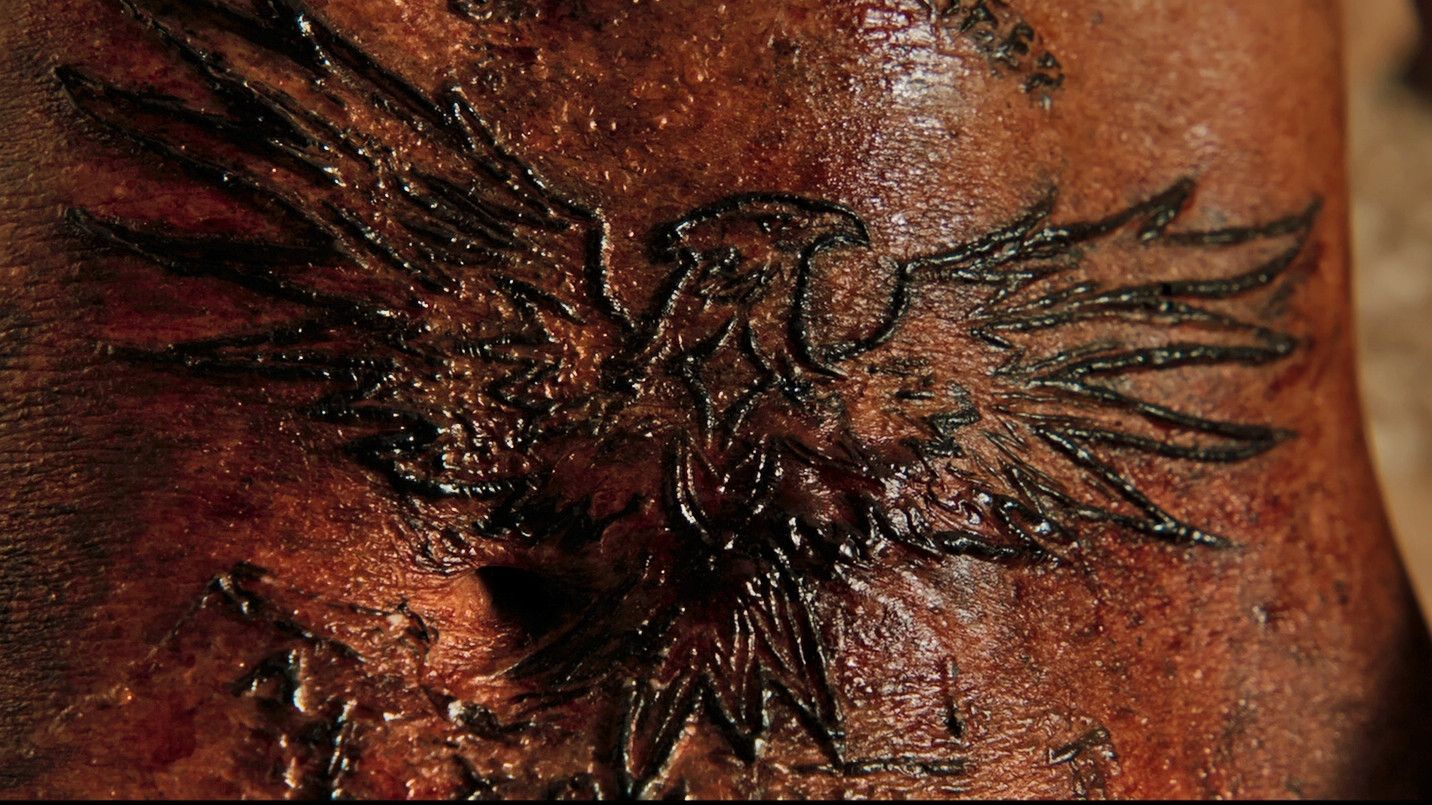
Revenge deconstructs and rebuilds the Phoenix myth. Just like the Phoenix is reborn through fire, fire is the key element to Jen’s rebirth. To free herself from the tree, she sets it ablaze. Later, she cauterizes her wounds with a heated beer can, branding herself with its Phoenix logo. From ‘pretty bird’ to agent of vengeance, she is reborn as an instrument of cosmic justice.
The next morning, upon discovering that Jen’s body is gone, the men set out in pursuit of her, not realizing that they have been replaced as apex predators and are now her prey. One by one, she dispatches them: Dimitri with a knife through the eye that witnessed her defilement, Stan in a brutal confrontation, and finally Richard in a gory battle through the halls of his desert mansion.
The visual motif of blood as purification and transformation has deep roots—from Inanna turning water to blood to punish her rapist 4,000 years ago, to the lurid Technicolor gore of Herschell Gordon Lewis’s Blood Feast (1963), where the goddess Ishtar’s name is invoked (if wildly misrepresented) in a tale of ritual violence. In Revenge, Fargeat understands this ancient lineage, positioning Jen’s blood-soaked finale as part of a 4,000-year-old tradition as a primordial rite.

Born in fire and baptized in the blood of her killers, Jen stands triumphant at the desert’s edge. Unlike Alisa, who is granted final rest, Jen’s fate remains unclear. Will she transcend to another plane, or will she, like Medusa, the Churel, the Pontianak, and the Furies, spend eternity as a fierce force, fighting for the frail victims of patriarchal violence?
From Dinah’s silence in Genesis to Jen’s blood-soaked triumph at the desert’s edge, we have traced an evolution spanning millennia—the slow, painful journey of the rape-revenge narrative from property crime to divine reckoning. But we must ask: how much has truly changed? The victim has evolved from silent plot device to female avenger to supernatural force—yet even these transformations remain, to varying degrees, filtered through the lens of male fantasy. Has the needle really moved since Inanna hunted Shukaletuda, or since Simeon and Levi used Dinah’s rape as a pretext to plunder a neighboring tribe?
The rape-revenge film will continue to evolve as long as the need for these stories persists. Four thousand years after Inanna turned water to blood, we are still telling the same story. The question remains: how many more millennia before we don’t need to?
More film Reviews
It’s that time of year again! Blood in the Snow Film Festival is back for 2024 with a whole host of short, medium, and feature-length films for horror fans to… Cradle of Fear is a 2001 British extreme horror anthology film written and directed by Alex Chandon, and starring Cradle of Filth Frontman, Dani Filth. Cutting his teeth in the… With that title, that font, and that poster, I don’t think there’s any doubt of where this film was going to go. Yes, it is indeed a tongue-in-cheek slasher set in… Meeting your partner’s family for the first time can be a drag, having to find out how well you get along in the family dynamic or learn some truths you… Dreams of Flesh is a 2024 sci-fi horror, written and directed by Davide Pesca with additional writing from Fabrizio Pastura. The film is the third and final installment in the… Hotspring Sharkattack (also known as Onsen shâku) is a 2024 Japanese action comedy film written and directed by Morihito Inoue in his feature debut. There have been cases of mysterious…
Dark Visions Short Films Review – Blood in the Snow Film Festival 2024

Cradle of Fear (2001) Film Review – From Cradle to Grave

Totally Killer (2023) Film Review – All Killer, No Filler in this Comedy-Horror Thriller

Homebound (2021) Film Review – Family Secrets Can be Deadly
Dreams of Flesh (2024) Film Review – VR Therapy
![Hotspring Sharkattack (2024) Film Review – We’re Going to Need a Bigger Onsen! [Nippon Connection 2025]](https://www.grimoireofhorror.com/wp-content/uploads/2025/05/Hotspring-Sharkattack-cover-365x180.jpg)
Hotspring Sharkattack (2024) Film Review – We’re Going to Need a Bigger Onsen! [Nippon Connection 2025]

I am a lifelong lover of horror who delights in the uncanny and occasionally writes about it. My writing has appeared at DIS/MEMBER and in Grim magazine. I am also in charge of programming at WIWLN’s Insomniac Theater, the Internet’s oldest horror movie blog written by me. The best time to reach me is before dawn.