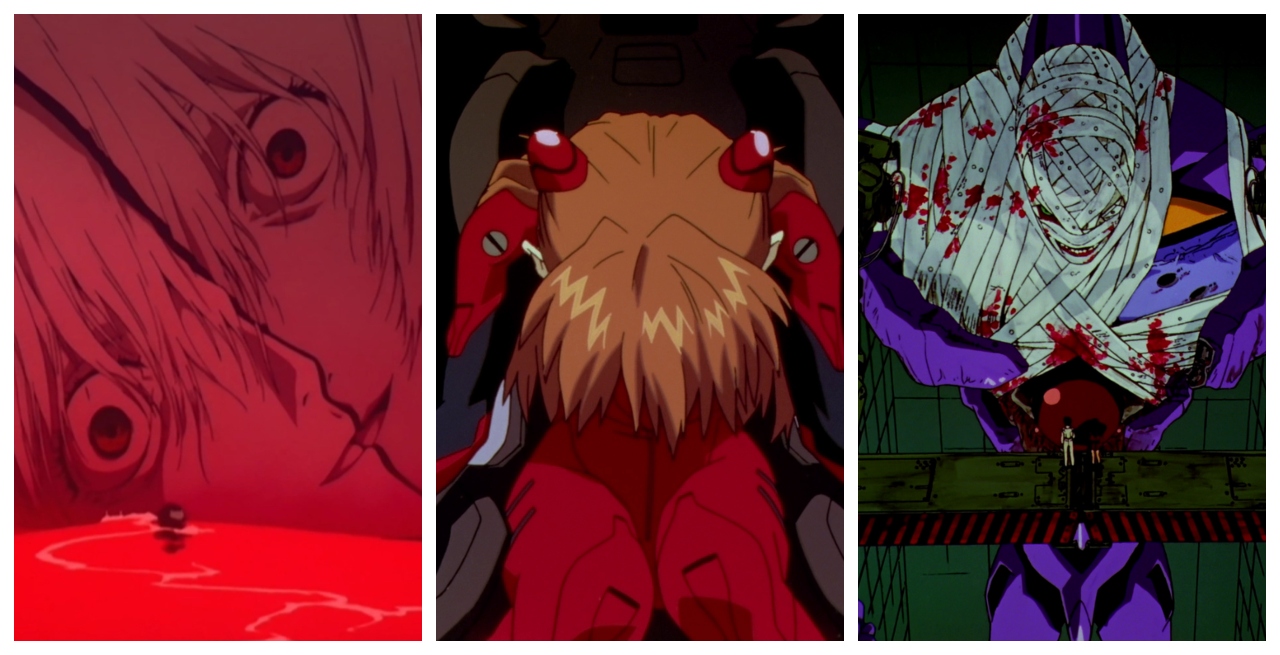




I will be exploring the psychological horror of Neon Genesis Evangelion and the trauma that is aptly exhibited in the series. It is an impressive show that doesn’t minimise the impact of being involved with such extreme scenarios; the damage to any ordinary life at school, the disconnect from friends, and the trauma overriding any stable mindset. Shinji Ikari is a victim who shouldn’t need to adhere to any societal duty as a child – his welfare was sacrificed ruthlessly against his will. Against all the biblical apocalyptic grandeur and extensive mecha conflict, a boy is suffering as an individual amongst all of this.
Psychological horror is understated in certain flicks, especially those concerning war and natural disasters, which might serve as a character study on extreme hardship – how tragedy, conflict, and turmoil affect the psyche of characters adversely. The traumatized survivors of horror franchises are rarely explored, one rare instance being David Green’s Halloween (2018) which encapsulated the lasting effects of overcoming such terror: a paranoid vigilance and neuroticism to no longer have the character as functional to a normal level. The characters are not hardened veterans who’re nonchalant about their experience, they’re terrified of a repeat and forever disturbed by the events; the state of anxiety can also apply to whole societies with a collective consciousness such as that of Neo Tokyo after the Second Impact.
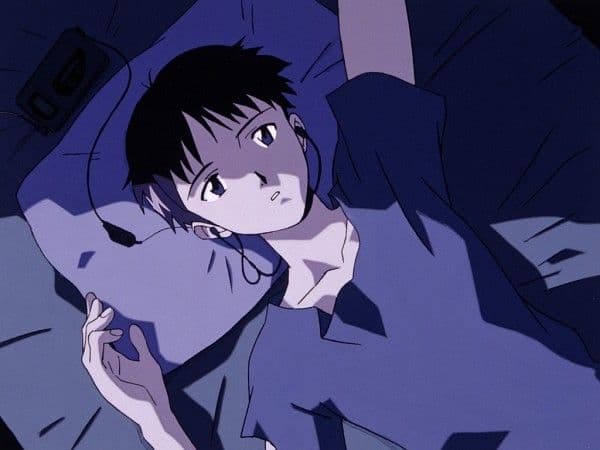
Neon Genesis Evangelion is an anime that’s rife for such trauma to embody psychologically torn characters – humanity is on the brink of apocalyptic calamities and has been ravaged, and remaining populations are on edge in a perpetual fear mirroring the Cold War. People are vulnerable to an existential dread, they have lost much to feel an abandonment of hope and the governments predictably resort to unscrupulously desperate means to starve their fear. Child soldiers are embraced as a ‘necessary evil’ to combat a looming threat– highly destructive ‘Angels’ who arrive sporadically to cause carnage- – to the remnants of civilization. Adolescence is already an age fraught with hormones, instability, and angst – which their biological mecha suits leverage for further power – and their conscription into a war with invading alien kaiju will consequently be devastating to an impressionable psyche.
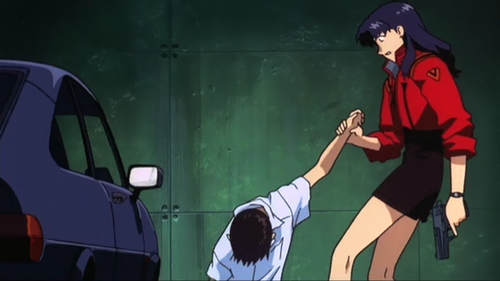
Shinji Ikari is the pilot selected for a biomecha to defend Tokyo-3 and his trusted mentor, Captain Misato Katsuragi, is assigned to manipulate him into accepting such a duty at the callous orders of Shinji’s aloof father. Starting as a casual and cool character, he soon declines mentally once events corrode him. As the protagonist, we witness his confusion, pain and fear as he merely strives to feel validation as common of teenagers. Having lost his mother at an early age, and those around him caring only to pressure him into the frontline of a war, Shinji is uniquely isolated as much as he is neglected – nobody cares for his mental health insofar as he’s their asset. Seeking his father’s validation with cooperating, and satisfying his peers who’re interested in their own safety foremost, Shinji accepts his role at much personal sacrifice to his sanity that’s hard to disconnect from all the violence to follow: accepting mental ruin to simply please those around him.
The war ensuing isn’t simple with the ‘soldiers’ as objects – they are deeply affected and this is portrayed well in the agony between scenes: how they cope with the experiences that are no easy task. PTSD amongst combat veterans is a trope and typically superficially depicted, but Neon Genesis Evangelion explores the subject deeper – why people accept such a terrible fate, their coping mechanisms to manage it, and the reason(s) they continue; anguish is illustrated for all to witness the horror befalling their mind through these experiences. The tragedy of Shinji is that no matter how well-adjusted he is, the environment is set to use him as a tool that’s emotionally disregarded – he will be relentlessly damaged psychologically for an agenda that might be argued as pragmatically imperative for the least suffering to everybody.
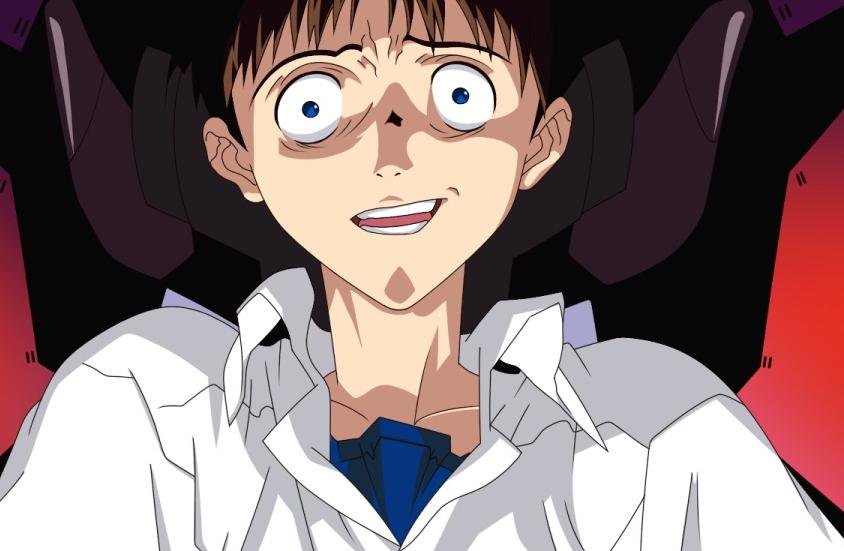
The boy is a face of war, as potent as the debased teenagers in the film Come and See (1985) from Soviet Russia or the recession into metaphorically progressive mental darkness as depicted in Apocalypse Now (1979) – an innocent, casual teenager whose potential is lost in the thralls of conflict. His deconstruction as a normal boy, and destruction as a healthy personality, is a lucid case sample for disaster wrecking people at the most fundamental level.
More Anime Reviews
With his OVA A Kite released in 1998, Yasuomi Umetsu would leave an indelible mark on the world of adult anime. Able to take a rare auteur approach by simultaneously… Crimson Climax is a three-part erotic yuri horror drama based on the Adult visual novel game Hotaruko by Tiger Man Project. The anime was directed by Daiitiya Otosime and Katsuma… Urotsukidoji II: Legend of the Demon Womb is a 1991 adult-oriented sci-fi horror anime film written by Toshio Maeda, Shô Aikawa, and Kôichi Ôhata, and directed by Hideki Takayama. The… Though you won’t see him appear in the cinematic universe anytime soon, many may not be aware that Dracula is a Marvel character. Being the star of his own comic… In the realm of anime, one genre stands out for its ability to transport viewers to otherworldly realms and delve into the unknown—the supernatural genre. From ghostly encounters to battles… Anime opening and ending songs are often the presentations for whatever show you want to watch for the first time. They try to convey the tone and themes that the…
Mezzo DSA (2004) Anime Review – Taking Care of the Danger Business

Crimson Climax (2004) Anime Review – A Dark Tale of Human Sacrifice, BDSM, and Murderous Mannequins

Urotsukidoji II: Legend of the Demon Womb (1991) Anime Review
Dracula: Sovereign of the Damned (1980) Anime Review – Much Ado About Blood Sucking

15 Top Supernatural Anime – Ghost Mortem

Top 10 Deceitful Opening and Ending Songs for Unusually Dark and Disturbing Anime

Some say the countdown begun when the first man spoke, others say it started at the Atomic Age. It’s the Doomsday Clock and we are each a variable to it.
Welcome to Carcosa where Godot lies! Surreality and satire are I.
I put the a(tom)ic into the major bomb. Tom’s the name!