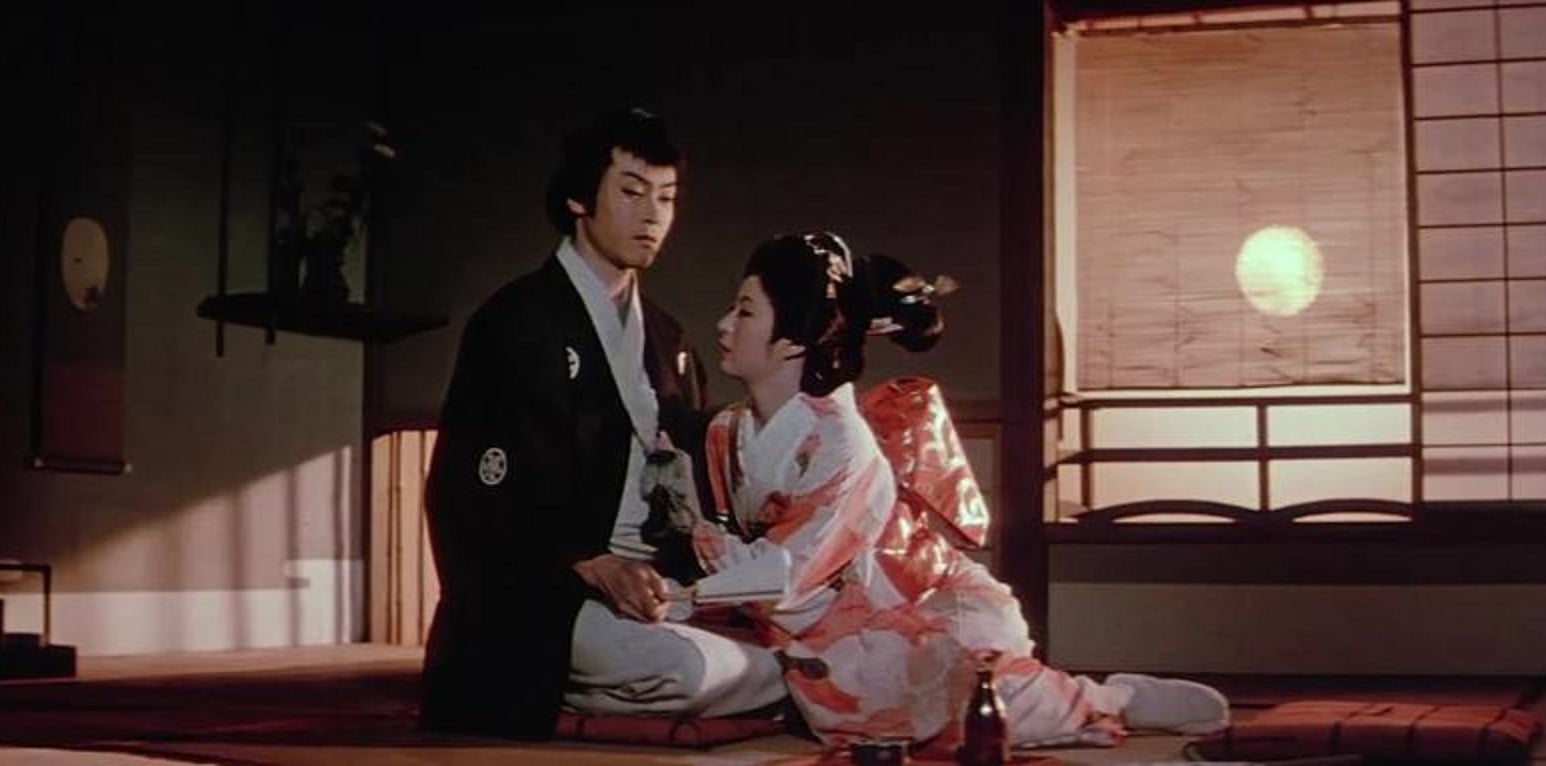




Modern-day J-horror traces its origins back to Japanese folklore and Kabuki plays, The Ghost of Yotsuya can be seen as an intermediate stage in the development of the field itself.
In the movie, our protagonist is a rather short-tempered and gullible young rōnin named Iemon. It is early 19th century Japan and he is living in poverty in the company of his loving wife, Oiwa. Dissatisfied and disappointed, he resolves to murder her in order to re-marry into better opportunities, but little does he know his deceased wife will return as an onryō to haunt him.
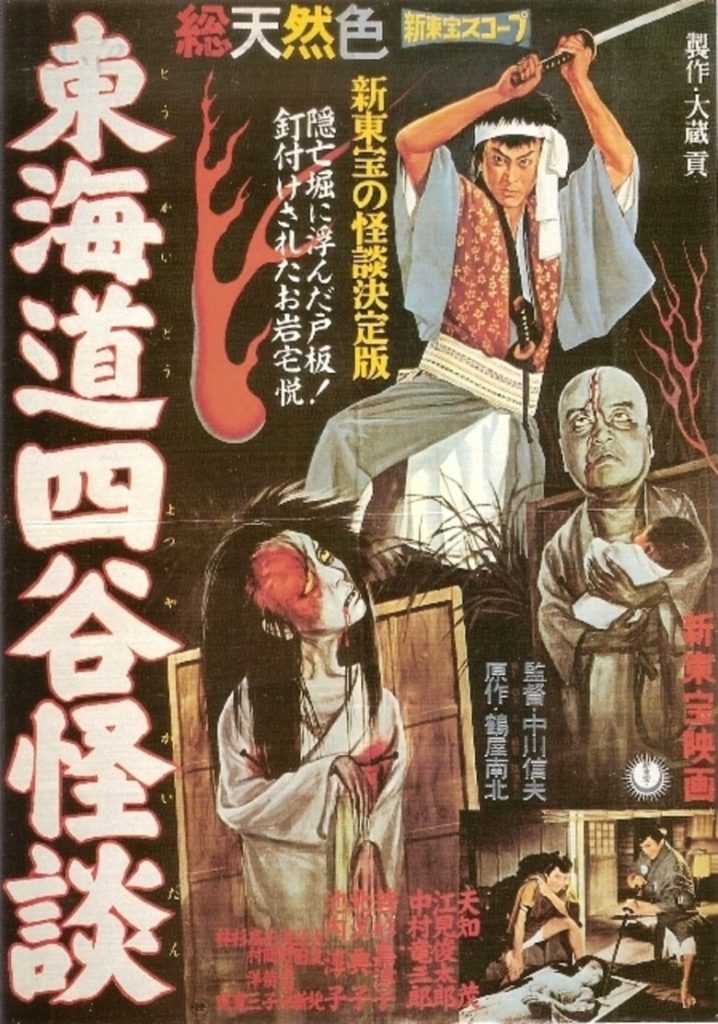
The storyline might be simplistic but it comes with an array of complex characters. Oiwa is a sweet, good-natured soul but she is also naïve, culminating in her unjust downfall. Her sister, Osode, although as good-natured as Oiwa, is more wise of the world, weary and insightful. Similarly, Iemon has a moral compass somewhere, but he is easily manipulated and led astray by his scheming servant, Naosuke, who acts to corrupt him.
The movie is based on a 19th-century Kabuki play known as Yotsuya Kaidan, an extremely popular theater experience in that era. The performances were so influential that Oiwa, the vengeance-seeking ghost of the story, was forever inserted into the cultural history as a salient figure in Japanese folklore. She is depicted as wearing a long, white gown as a burial kimono as an archetype for yūrei in future cinema as a motif. Her face is deformed and her left eye is drooping, both adverse effects of the insidious poisoning from Iemon.
The popularity of the play (and Oiwa as a figure) extended into the age of cinema as well from being firmly rooted in Japanese history. The play boasts of 30 movie adaptations as a lasting legacy proving no matter how society evolves, it will be adapted as respect for the cultural heritage. This version, The Ghost of Yotsuya by filmmaker Nobuo Nakagawa, is considered the definitive version – the most liked and best produced.
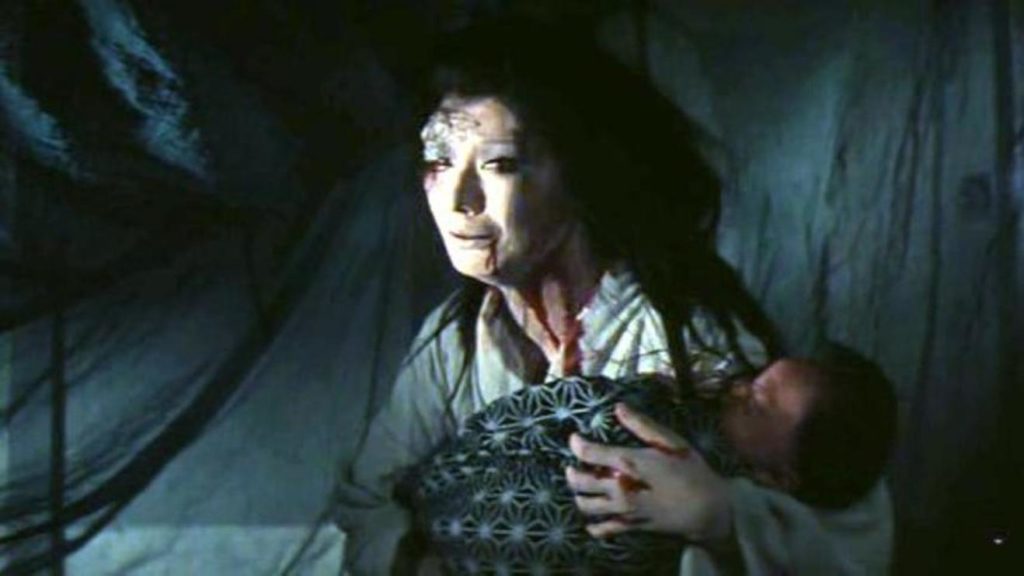
The movie intriguingly does not shy away from its stage origins. The acting, the sets, the make-up, etc., are all decidedly theatrical. I think it was a deliberate choice on the part of the director, a more artificial look as a homage. I found it fascinating as I felt I was getting a glimpse of the Japanese theatre from a bygone era, however! I could be entirely mistaken and those plays may not have corresponded to the setup of this film.
If you like taking a look into the history of J-horror, this is the movie for you. You could have fun comparing Oiwa’s look to Sadako/Samara’s of the Ringu/Ring series and her tragic backstory to that of Kayako’s from Ju-on/Grudge series.
This is a guest article from ‘Movie Meows’
You can follow on Facebook or check out the YouTube channel for more film insights!
More Reviews:
Fright is a 2024 English period horror, written and directed by Warren Dudley. Beginning their career in film in 2005 with the comedy TV movie Come on You Chickens, Warren’s… Bringing the Greek Weird Wave touch to German cinema is Der Bunker director Nikias Chryssos, who in his second feature film does at times leave the impression that he’s working… Kingdom of the Apes is a 2022 Japanese thriller written and directed by Shūgō Fujii. Making his directorial debut with Living Hell (2000), Fujii gained notoriety with his recent mystery… Lake Jesup is a 2024 creature-feature horror comedy written and directed by Michael Houston King. Working in the TV industry as an actor for nearly 30 years, Michael has also… Dark Windows is a 2023 American horror written by Ulrvik Kraft and directed by Alex Herron in his first feature-length film. Three teenagers, who were all involved in the fatal car… My Mother’s Eyes is a 2023 Japanese science fiction psychological thriller, written and directed by Takeshi Kushida. No stranger behind the camera, Kushida is also the creative mind behind the…![Fright (2024) Film Review – It’ll Be Alright on the Fright [Frightfest]](https://www.grimoireofhorror.com/wp-content/uploads/2024/08/Fright-365x180.jpg)
Fright (2024) Film Review – It’ll Be Alright on the Fright [Frightfest]
A Pure Place (2022) Movie Review – Children Of Elysion

Kingdom of the Apes (2022) Film review – A Fable of Japanese Society
![Lake Jesup (2024) Film Review – “CATCHPHRASE!” [Dead Northern Film Festival]](https://www.grimoireofhorror.com/wp-content/uploads/2024/09/Lake-Jesup-2024-cover-365x180.jpg)
Lake Jesup (2024) Film Review – “CATCHPHRASE!” [Dead Northern Film Festival]
Dark Windows (2023) Film Review – Through Rose-Tinted Glasses
![My Mother’s Eyes (2023) Film Review – Beyond Sanity [FrightFest]](https://www.grimoireofhorror.com/wp-content/uploads/2023/07/My-Mothers-Eyes-cover-photo-365x180.jpg)
My Mother’s Eyes (2023) Film Review – Beyond Sanity [FrightFest]