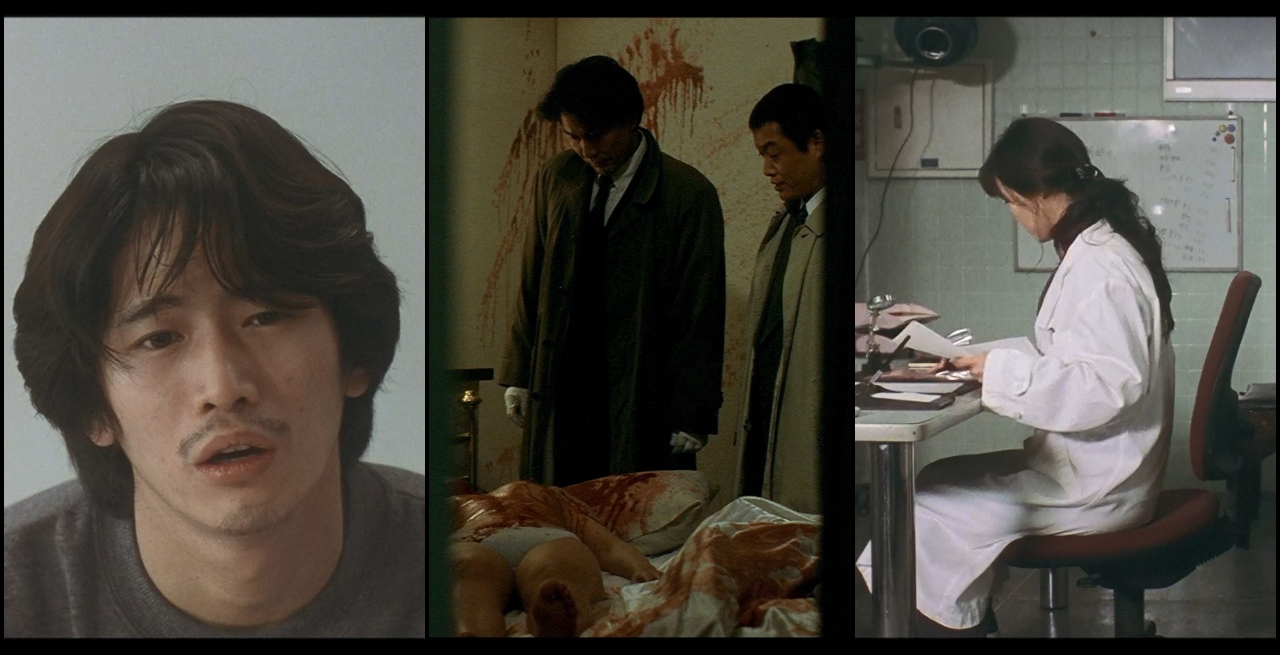
In this short article, I want to write something about Kiyoshi Kurosawa’s Cure (1997). Yet, I do not want to present a common review, but I want to offer a somewhat more poetic piece on the rather scandalous truth of Kiyoshi’s mystery-horror masterpiece.
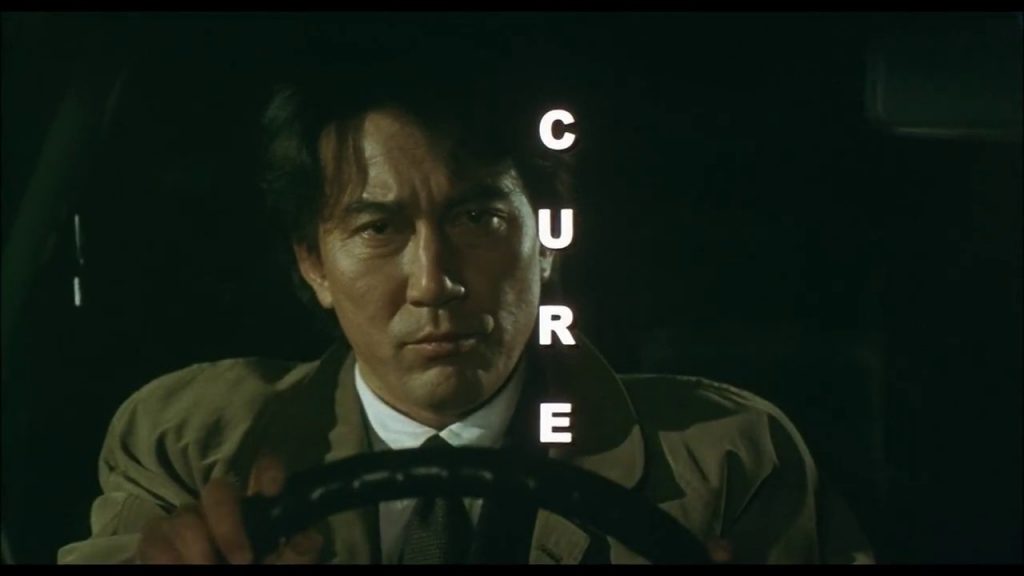
Cure follows Detective Kenichi Takabe (Koji Yakusho) as he is tasked to investigate a string of strangely similar and excessively violent murders. He teams up with Sakuma (Tsuyoshi Ujiki), a psychologist, to try to make sense of these puzzling crimes. After another woman is murdered similarly, Takabe and Sakuma start investigating Mamiya (Masato Hagiwara), a rather strange and mysterious man with mesmeric powers.
In Cure, Kurosawa expertly plays with the notions of truth and lie in his narrative. Do we want to know the truth of our humanity? Can we, once it is revealed, accept it? Or do we try to cover this ugly thing up, locking it up in the deep caverns of our subconscious?
The mesmeric power of Miyama depends on the very deception that marks our conscious life, and depends on a truth that we, as humans, do not want to accept as being our own. There are certain desires, certain thoughts, and certain forms of pleasure that are at odds with our sense of self. Rather than welcoming these dark desires as being our own, we frantically try to imprison them in the musty and forgotten chambers of our mind.
But what kind of desires do we hide from ourselves and from the others we interact with? Nothing other than desires that are destructive, destructive to us and those that surround us. The desire to destroy one’s flesh and the desire to violate the flesh of another human being.
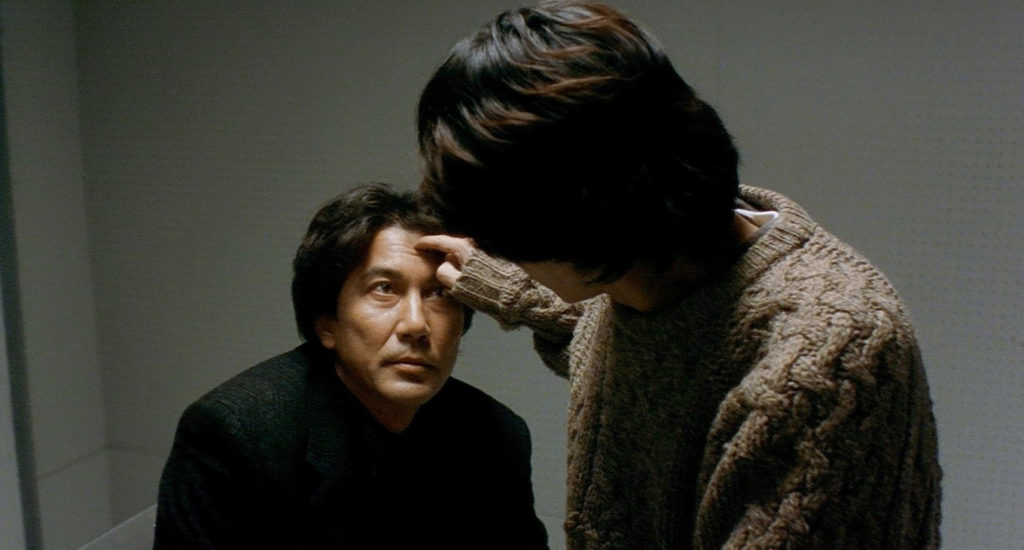
Miyama’s mesmerism preys on people who are unable to come to terms with their violent desires, feasts on those people who are unable to release their violent desires from their subconscious prison and decriminalize them. Miyama preys on those people who are content in living a harmonious lie, a lie where there is no place for the confronting truth of one’s humanity. With his mesmerism, Miyama succeeds in forcing people to act out this truth, he forces them to act under the violent desires they so carefully hide from themselves and others.
Everyone, at least at the level of their desires, is a violator – this and nothing else is the horrifying and uncomfortable truth of Kurosawa’s Cure. Yet, most people refuse to acknowledge it. They reject this truth without realizing that the act of ‘being entirely honest with oneself’ is the only cure, the only defense against Miyama’s mesmerism.
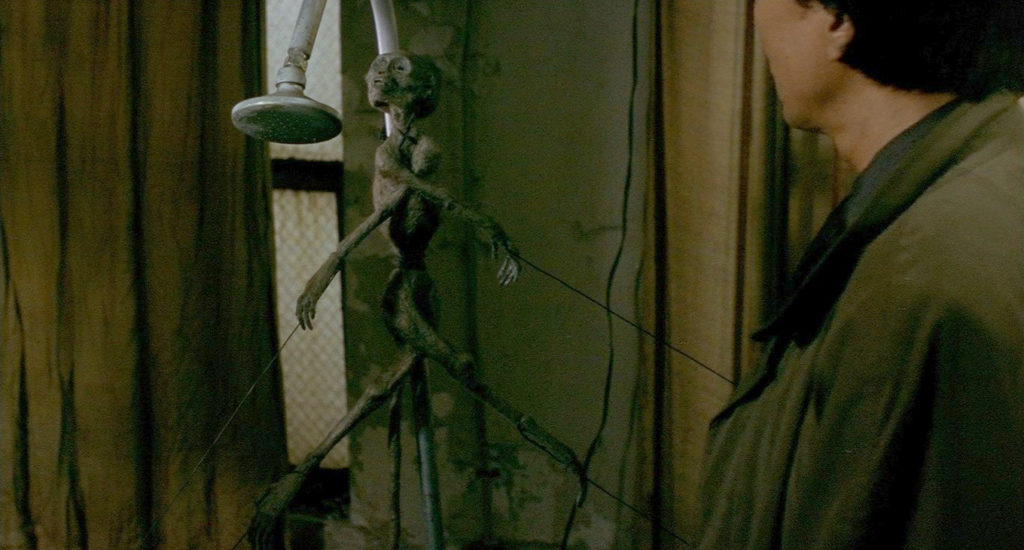
The very reason why Miyama fails to force Takabe to become violent, to become murderous in line with his unconscious desires, is because he accepted the desire to kill his wife (Anna Nakagawa) as being his own. Takabe is immune to Miyama’s mesmeric attacks because his unconscious prisons are empty. After all, there is no imprisoned desire to exploit and hypnotize him with.
Kurosawa’s Cure confronts the audience, in a mesmerizing but rather scandalous way, with the violence that inherently marks the desires that linger in their unconscious – the ending of the narrative reaffirms this rather cryptically. Yet, Kurosawa goes further by revealing the simple yet difficult-to-realize cure to our peaceful deception, to our refusal to acknowledge the aggressive monster that lies beneath our friendly smiles: Honesty with oneself and the ability to accept the horror of our desires.
To read more film analysis from Pieter-Jan you can head over to his official site psycho cinematography
More Film Reviews:
Finding a sense of belonging is built into the core of human existence. In Poser 2021, the debut feature from filmmakers Noah Dixon and Ori Segev, we delve deep into… Prisoners of the Ghostland wastes no time engaging viewers with its opening scene depicting the curious contrast of the stark white interior of a bank with its many patrons donned… Jonathon Glazer’s latest directorial offering, The Zone of Interest (2023) is an understated, yet powerfully urgent warning of how easily humanity can be lost if we are allowed to lose… Blast 2021, or Deflagrations in its cooler sounding, original French title, is a tense thriller focusing on a small company that disarms landmines around the world. After a recent successful… Being mostly an American tradition, fraternities seem to be full of real life horror stories due to the harsh hazing rituals regularly to new pledges. These organisations seem to be… In the tradition of pseudo-local-TV broadcasts like Ghostwatch and WNUF Halloween Special, homegrown horror heads to N.Ireland in Dominic O’Neill’s Haunted Ulster Live. Set in 1998, TV newscaster Gerry Burns…
Poser (2021) Film Review – The Art of Fitting In
Prisoners of the Ghostland (2021) Film Review – East Meets West for a Radioactive Psycho-Western
The Zone of Interest (2023) Film Review – A Masterful and Urgent Warning for the World

Blast (2021) Film Review – An Explosive French Thriller

Hell Night Film Review – A Hybrid of Slashers and Haunted Houses
![Haunted Ulster Live (2023) Film Review – Tune In for Horrors Near You [Unnamed Footage Festival 7]](https://www.grimoireofhorror.com/wp-content/uploads/2024/03/Haunted-Ulster-Live-Title-Card-365x180.jpg)
Haunted Ulster Live (2023) Film Review – Tune In for Horrors Near You [Unnamed Footage Festival 7]