




Paris. London. Milan. Tokyo. Ask anyone what they consider to be the most fashionable place in the world, and chances are high that they’ll say one of these stylish cities. The world of fashion is immortal, effervescent and exciting, but beneath lies a much darker world for those who stumble from their Louboutins and fall too far into the depths of obsession. Mika Ninagawa’s 2012 thriller Helter Skelter explores this world in all its vibrance – and violence.
Adapted from a 2004 manga of the same name, Helter Skelter follows Lilico, a superstar model splashed across the front page of every magazine, billboard and cosmetic package. Men want her, women want to be her and with her perfectly manicured hand, Lilico pulls the strings of all the puppets around her to maintain her image as Japan’s number one. Lilico’s fame and fortune come with a caveat though – a hefty price tag of more than a few pounds of flesh.

Helter Skelter is unbearably stylish, each scene unfurling and blooming like the petals so prominent in Mika Ninagawa’s work as an acclaimed photographer, most famous for her role at the forefront of Japan’s ‘girly photo’ movement. In its native Japanese ‘Onna no ko shashinka’ allowed women a chance to be at the forefront of the male-dominated photography world. Playful and bright, these images of women taken by women allowed both the artist and subject to explore femininity without the pervasive stare of the male gaze. As a photographer, naturally, Ninagawa displays effortless skill in the use of light, shadow, and colour throughout Helter Skelter – and colour abounds. Whether it be through exquisite costuming (bejeweled corsets, plush plumage, and selection of lingerie that puts any Victoria’s Secret model to shame) or psychedelic set design, Helter Skelter is bursting with rich jewel tones and girlish pastels.
And with frequent emblems of femininity scattered throughout (butterflies, flowers, plump red lips), each scene looks like it could be a centrepiece in an issue of the Japanese street fashion magazine FRUiTS. At the middle of every scene is the electrifying Lilico played by former actress and Tokyo bad girl Erika Sawajiri. This magnetic, bratty living doll swings between manipulative seductress and tantrum-prone toddler, the hallmarks of an ego interrupted by fame.
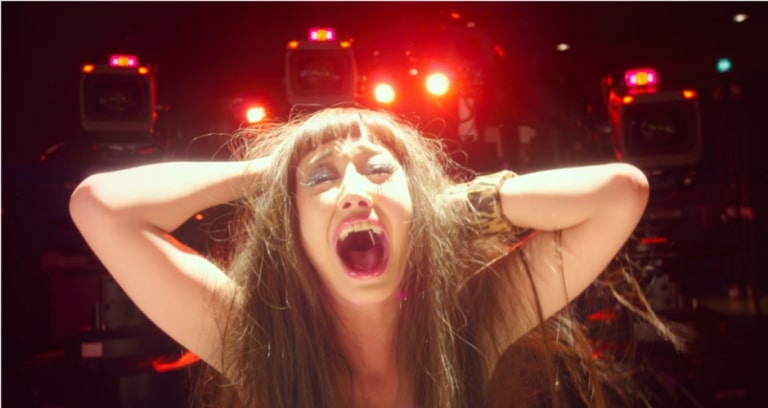
As Lilico spirals to operatic heights of an obsessive, violent need for perfection, the real horror of Helter Skelter becomes apparent. While not necessarily a horror film (you’ll find no jump scares or ghouls within Helter Skelter’s diamante walls) the film serves up scares by raising issues that are very relevant and have potentially devastating consequences. A recent study found that eating disorders are on the rise in Japan, caused in part by the COVID-19 pandemic, but undeniably the constant barrage of perfect, flawless faces has an incredibly harmful impact on young people’s body image. To illustrate this more explicitly, Helter Skelter uses transitional scenes of teen girls comparing themselves to models, lamenting about how fat they consider themselves to be. For Lilico, it is only through an act of self-mutilation, rendering herself ugly and useless (by beauty industry standards) that she is able to finally be free.

Much like Lilico, there are times when Helter Skelter relies solely on its beauty, leaving quite a lot to be desired in terms of plot and falling victim to style over substance. It misses the mark on body horror, failing to make good on its hints of a truly repulsive presentation of the ugliness of beauty, unlike similar films such as Black Swan or The Neon Demon. However, any plot problems quickly fade into irrelevance with each mesmerizing, sparkling moment spent in Lilico’s world as we are privy to her beautiful breakdown. Of all the movies that explore the unforgiving downward spiral that is the pursuit of perfection, Helter Skelter just might be the most chic.

More Film Reviews
There are very few horror movies that linger in the brain well after viewing, like fine wine on the tongue, dragging your thoughts back over and over to replay it… In the anti-consumerist horror comedy Black Friday, a ragtag group of toy store employees try to fight off an infectious horde of customers during the worst day of the year… Psychic Vision: Jaganrei is a 1988 Japanese faux-documentary/supernatural found footage horror film written by Chiaki Konaka and directed by Teruyoshi Ishii. Beginning his career in 1986 with the horror comedy… LandLocked 2021 kicks off with a video recording of a father telling his son that one week after he passes the house will be torn down and everything thrown out…. Director Nia DaCosta’s kind of mostly sequel to the 1992 original revives the Candyman. Say his name five times in the mirror if you dare, as Cabrini Green has dark… Oh, the level of alleged and legitimate prestige Dreamcatcher boasts – directed and co-scripted by Lawrence Kasdan (Body Heat) with the help of William Goldman (Marathon Man) from a novel…
Broadcast Signal Intrusion (2021) Film Review: Descending Into an All-Consuming Obsession

Black Friday (2021) Film Review – Capitalism is Hell
Psychic Vision: Jagenrei (1988) Film Review – It’ll Be Alright on the Night
LandLocked (2021) Film Review – Sometimes When You Stare Into the Past it Stares Back
Candyman (2021) Film Review – Don’t Speak His Name
Revisiting Dreamcatcher: Bros in the Woods on an Oxy Trip

Writer, podcaster and reviewer over at HornBloodFire.
Lover of gore, ghosts and girls getting their own back.