
Hello, my children of the night. This is Eden, here to present you with an examination into something near and dear to my heart: The masterfully sown horror of David Lynch and Mark Frost’s seminal television series, Twin Peaks.
When looking at the vast array of choices from the catalogue of horror media, you will find countless tantalizing flavors: Slasher, ghost story, possession, cosmic horror, etc… And while Twin Peaks covers a remarkable deal of them, it’s difficult to categorize exactly what subgenre of horror it truly embodies. Even though it is mostly thought of as a drama, there’s an unmistakable sense of dread that permeates the series, escalating to sheer terror when its monsters are unleashed. The grinning face of the killer Bob haunts many a nightmare of those who have witnessed it.
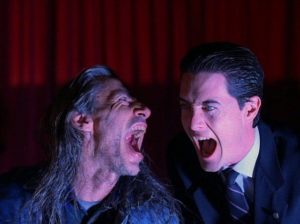
Certainly, the blood-soaked demise of Laura Palmer presents the visceral gore of a slasher film. While the series by and large has focused on atmosphere and the more emotional elements of its story, it does not shy away from brutal violence when it is called for, and the way said violence is slowly built towards and saved for poignant moments makes it all the more jarring and effective. Because of this, we truly know how dangerous these villains are, and just what the consequences of crossing their path are.
A central figure of Twin Peaks, as much as any character, is the ever-looming presence of the woods, and the mysteries it contains. Even the more down-to-earth residents of Twin Peaks are fully aware of its mystic qualities. Indeed, it is called the Ghostwood forest, and it is haunted by many things. The wood itself can contain spirits, such as the piece of wood cradled by the Log Lady. The log speaks to her, and it is suspected that it holds the spirit of her departed husband, who died during a forest fire. Besides the phantoms of unfortunate people who died in the woods, the forest conceals a portal to the Black and White Lodges, through which interdimensional beings frequently pass.
With all these spirits moving through Twin Peaks, it is inevitable that a few might possess a resident or two. The murderous beings Mike and Bob are two such spirits. They occupy various vessels in order to carry out their heinous acts. Even once Mike seemingly repents and vows to cease killing, he continues to dwell in the body of Phillip Gerard, a simple shoe salesman, in order to hunt down his former partner-in-crime, Bob. It is even suggested that the fauna of Twin Peaks, particularly the owls, are used as vessels for the spirits of the Lodges.
However, the one subgenre of horror that, for me, proliferates Twin Peaks, is cosmic horror. There may not be a Cthulhu lurking in the duck pond or sprawling reptoid cities hiding beneath the town, but the fear of the unknown permeates the narrative. The Buddhist dichotomy of Fear vs. Love manifests in many ways, most notably in the idea that fear feeds the mysterious entities lurking behind the veil, while love is a way of combating them. Thus, not only are we made to fear the unknown, but know that that fear is in turn feeding the unknown. The presence of incomprehensible forces like “Judy” or the agents of the White Lodge is almost Lovecraftian in nature: Their motives are unknowable to mere mortals, and we only see the effects of their obscure actions. Just as Lovecraft’s Azathoth is an entity that dreams the universe into existence, and its waking would herald the end of the universe as we know it, Twin Peaks asks us “Who is the dreamer?”, a question which is, of course, unanswered, and perhaps unanswerable by minds such as ours. Perhaps Twin Peaks’ monstrous deity called Judy is a being akin to Azathoth; a dreamer, in whose dream the world and characters of the series exist.

As expected from a series by such unconventional creators as Mark Frost and David Lynch, Twin Peaks is a story that defies strict categorization. It has riveting drama, soul-rending tragedy, swooning romance, and bizarre humor. But far greater than all these things is the pervasive and multi-faceted horror that it displays, and one of the reasons we feel compelled to follow the narrative is to see how the frightening forces will affect our beloved characters and their picturesque home. Here’s to unconventional horror.
More Reviews:
Fear Street Part Three: 1666 Film Review – Even the Strongest Curse Can be Broken
Film trilogies are a tricky business. With the exception of Lord of the Rings and Star Wars, most trilogies don’t set out planning to tell a singular story across three…
After Blue (Dirty Paradise) Film Review – An Erotic, Sci-fi, Coming of Age Tale
“My name is Roxy, but the village girls call me toxic” After explaining how womankind found themselves alone in the land known as ‘After Blue’, we meet Roxy whose introduction…
Broadcast Signal Intrusion (2021) Film Review: Descending Into an All-Consuming Obsession
There are very few horror movies that linger in the brain well after viewing, like fine wine on the tongue, dragging your thoughts back over and over to replay it…
Agony (2020) Film Review – A Macabre Slice of Gothic Horror
Harkening back to the golden era of Italian cinema, Agony features giallo starlet Asia Argento and the iconic Franco Nero. Billed as an homage to Italian giallo cinema and led…
Doris Wishman’s Indecent Desires (1968), and the Horror of Male Obsession
Why are horror and exploitation films so popular? Why do fans willingly submit themselves to the gruelling, torturous experiences that these genres provide? The simple answer is it feels good…
SHC: Freak Accident (2022) Short Film Review – I’m Burning Up!
We previously had the chance to check out Thomas Burke’s short film Camping Fun, a quick dive into a small cult that showed that Burke had the knack to channel…

Eden is a Soong-type android learning to pass as human through studies of pop culture, humor, and dark fantasy. Perhaps one day she will learn to love and pronounce “hyoo-mahn” correctly. She was written analyses of music, video games, comics, and film. You can find her other writings on Vocal and WordPress.