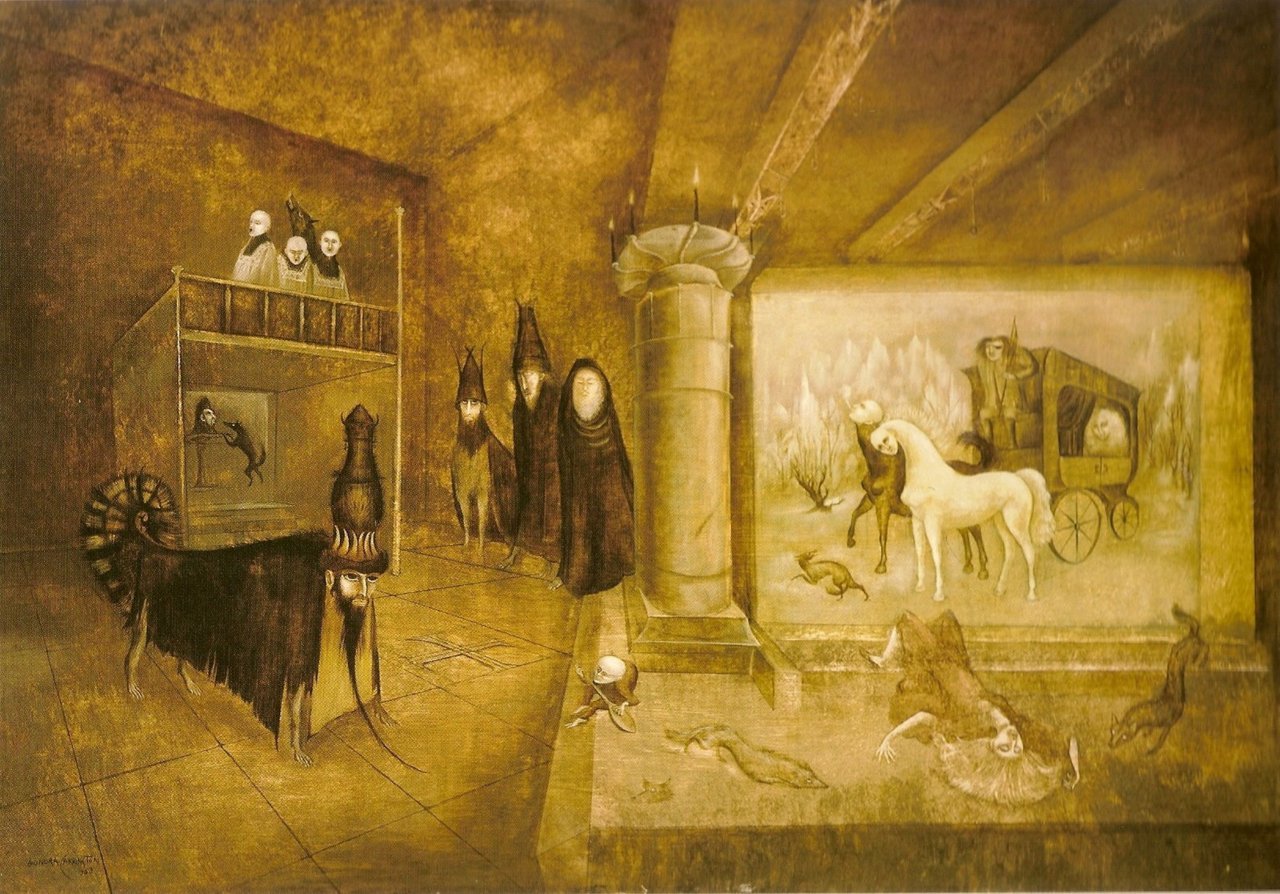
Surrealist art can transport us in ways other art cannot. Madness, darkness, awe, and beauty are all found within the style. Painters such as Salvador Dali, Rene Magritte, Joan Miro, and M. C. Escher have all gone on to infamy, but there is a bevy of artists who contributed to the Surrealist Movement in its heyday yet are sadly overlooked today. One of these pioneers is Leonora Carrington, a British artist whose life was one of turmoil and tragedy, but who constantly found revitalization through her remarkable art. Let us take a trip, back across time and into other, more strange worlds, and tread through the surrealist wonderlands in the art of Leonora Carrington.
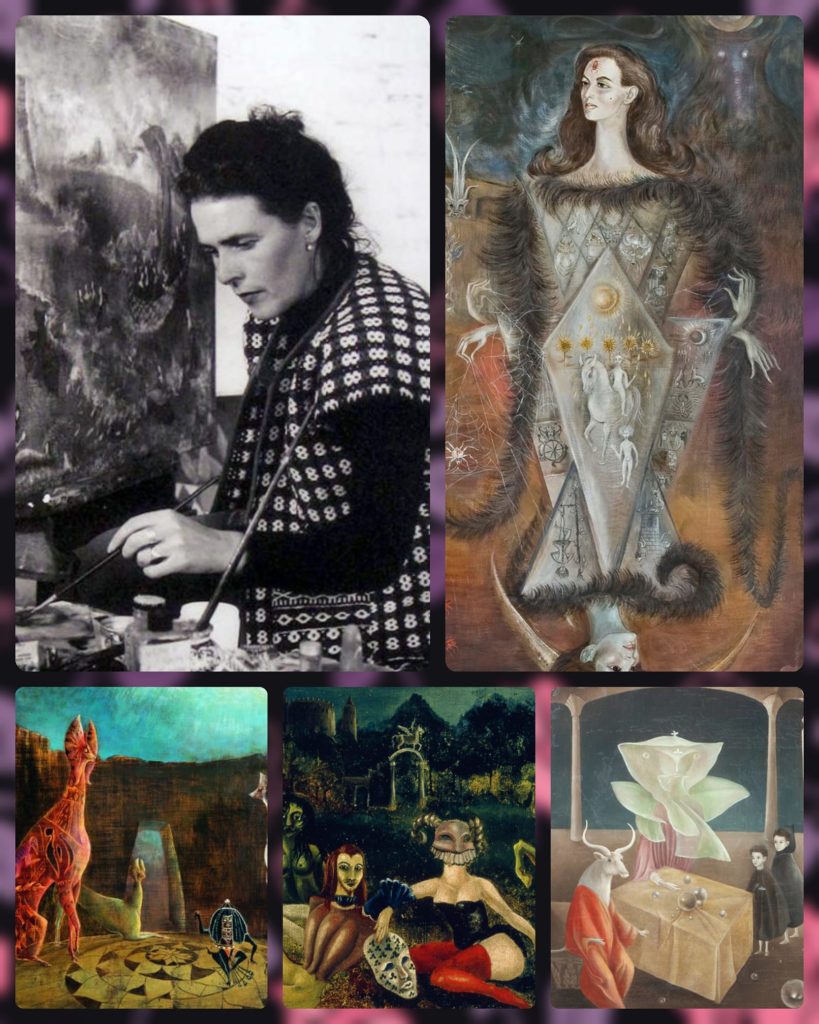
Born in 1917 in the United Kingdom, Carrington was always a strange girl. She would conceive of far off alien worlds, and draw pictures of the weird creatures that inhabited them. Her father wished she would be more conventional, failing to understand her creativity. Instead of participating in the usual “ladylike” occupations of the time, she daydreamed and read weird fiction by the likes of Aldous Huxley. She soon found a new home within the budding surrealist movement, bonding in particular with Leonor Fini, who became her collaborator and confidant, and Max Ernst, whom she fell instantly in love with.
However, these bonds were soon shaken with the rise of the Nazi party, who declared surrealism to be “degenerate art,” and thus targeted the artists. Max Ernst was taken to a concentration camp, and Carrington suffered a breakdown and was institutionalized in an insane asylum. While being transferred to another facility, Carrington orchestrated her escape.
In Portugal, a diplomat friend of Pablo Picasso agreed to marry Carrington to grant her immunity, and the pair fled to Mexico. There, Carrington found new life. Her art flourished, and she became a beloved figure of the community. She also bonded with fellow surrealists Frida Kahlo and Remedios Varo. She was an outspoken feminist, firmly believing that all persons should be equal and free in body and mind. She never returned to her native UK, and never again saw her former friends and collaborators.
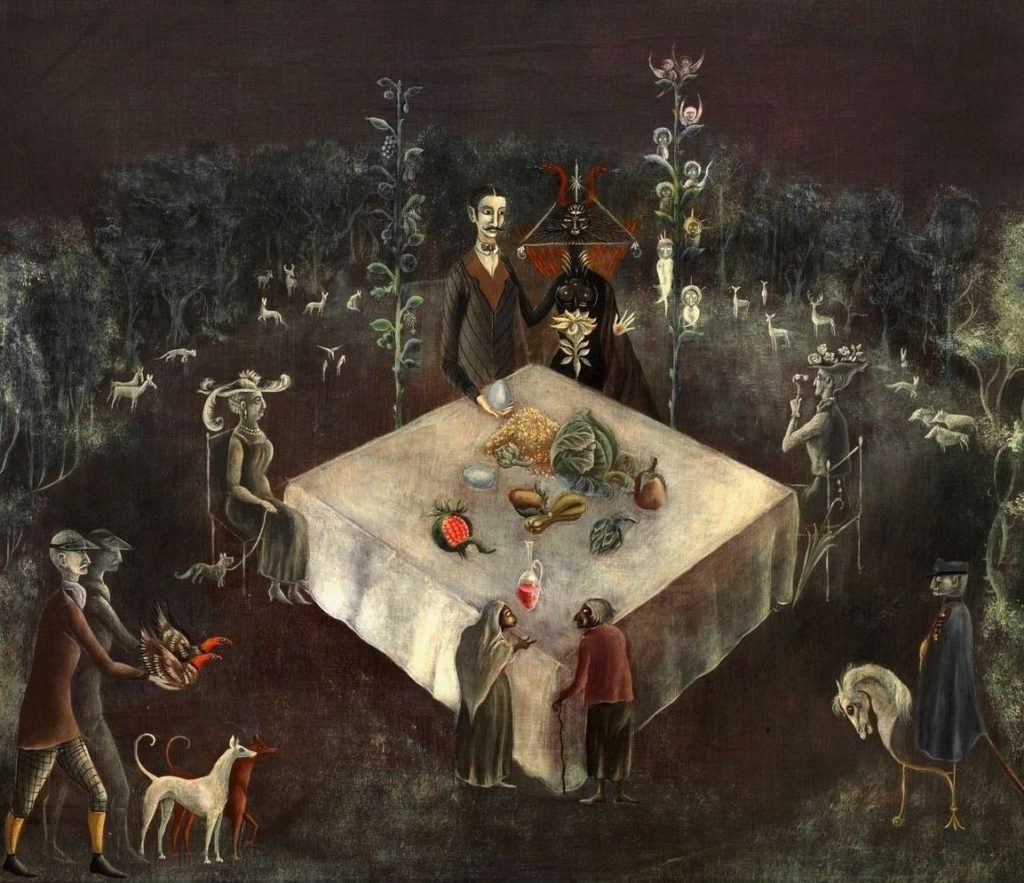
Carrington’s paintings are her psyche made visual, her mind explored with paint and canvas, so unabashedly her yet speaking profoundly to the deep recesses of our own subconscious. Her strong individuality, a proud otherness, is obvious in the way she exclusively painted fantastical creatures and vaguely humanoid entities. This was the world she belonged to, the one she dwelt in within her mind. The mystical quality of her thoughts, her refusal to be tethered to the dull reality that those in the establishment subscribe to, manifests in the amorphous backgrounds and otherworldly architecture.
There is magic and darkness there, but undoubtedly, a freedom. Carrington truly belonged to another plane of existence, and her story is and inspiring one of perseverance. When she passed in 2011, after a long and fruitful life, she left us these windows into the fantastic realms she saw, giving us the opportunity to free our own minds by exploring the wondrous dreamscapes upon the canvasses.
More Reviews:
Sorority Babes in the Slimeball Bowl-O-Rama (1988) Film Review – An Imp Named Slickback
Sorority Babes in the Slimeball Bowl-O-Rama (also known as The Imp in the UK) is a 1988 American B-movie horror comedy written by Sergi Hasenecz, directed by David DeCoteau, and…

Mad Heidi (2022) Film Review – A Loving Look at the Discarded Exploitation Films of the 1970s
“Yodel me this!” – Heidi Long before home media and even longer before video streaming, the only way to see original movies was to go to the theater. Most theaters…

Candyman (2021) Film Review – Don’t Speak His Name
Director Nia DaCosta’s kind of mostly sequel to the 1992 original revives the Candyman. Say his name five times in the mirror if you dare, as Cabrini Green has dark…

Deathsport (1978) Film Review – Blood, Boobs, and Bangs
Deathsport is a 1978 sci-fi action drama, directed by Nicholas Niciphor, with additional shots directed by Allan Arkush, and produced by Roger Corman. The film is a somewhat spiritual successor…
![The Coffee Table (2022) Film Review- A Careless Family Affair [Fantastic Fest]](https://www.grimoireofhorror.com/wp-content/uploads/2023/09/The-Coffee-Table-cover-365x180.jpg)
The Coffee Table (2022) Film Review- A Careless Family Affair [Fantastic Fest]
The Coffee Table, from the mind of emerging international director Caye Casas, stands out as a genuinely unnerving and intellectually stimulating horror film in recent memory. Serving as a cautionary…

The Reckoning Review (2020) – Neil Marshall’s Return to Horror
RevBarely a year after Neil Marshall’s first big-budget Hollywood feature, Hellboy (2019), failed to earn him a box office success, he has returned to his horror roots with the much…

Eden is a Soong-type android learning to pass as human through studies of pop culture, humor, and dark fantasy. Perhaps one day she will learn to love and pronounce “hyoo-mahn” correctly. She was written analyses of music, video games, comics, and film. You can find her other writings on Vocal and WordPress.