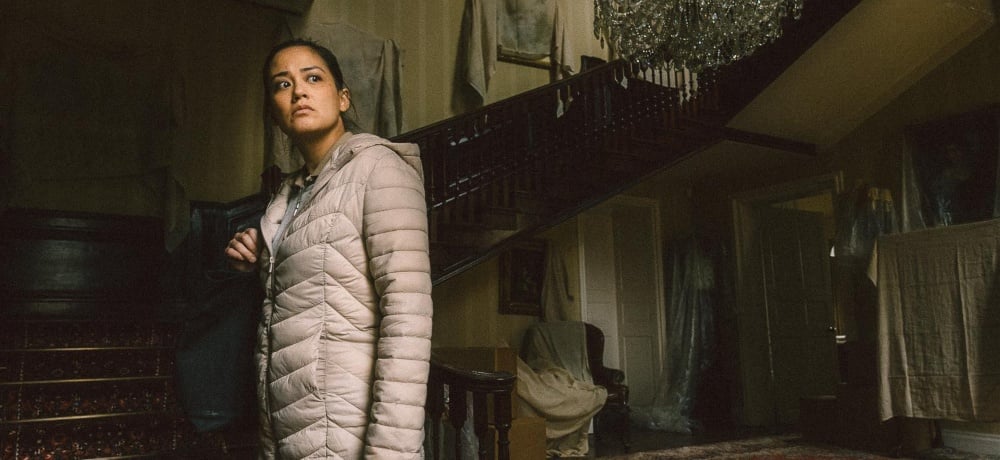




Raging Grace outlines the exploitation and fetishisation of undocumented immigrants whilst simultaneously celebrating distinctive Filipino traditions and cultural heritage. Paris Zarcilla’s incisive directorial debut follows single mother Joy as she struggles to work two underpaid jobs to provide for her daughter Grace.
The heart of Raging Grace lies in Maxene Eigenmann’s nuanced portrayal of Joy. From the offset it’s clear that Joy is a dedicated mother, however, she is caught in the quagmire of oppressive socio-economic immigration systems. Joy’s desperation to provide a safe, consistent life for her daughter leads her to accept a job that seems almost too good to be true. Instead of following her roaring gut instinct to turn down the job, Joy begins waiting hand and foot on Katherine who subjects her to a slew of condescending passive aggression. Amidst the simmering micro-aggressions, Joy also has to grapple with caring for Mr. Garrett, the terminally ill uncle of Katherine, with vulnerability and respect. Joy’s job is to ensure the cleanliness of the manor, and the safety of Mr. Garrett as he spends his remaining time unable to communicate due to his deteriorating condition.
Instantly the film deftly establishes a sense of dread and foreboding and this is only built upon as the secrets that linger in the manor threaten to out themselves. There is a hint of supernatural soliciting, however, this isn’t fully developed within the plot and the film decides to focus instead on the horrors of man, both literally and metaphorically. One can’t help but wonder if the real horror lies with the secrets of the house, or with the degradation and oppression Joy faces as an undocumented Filipino woman.

The first act of the film is able to create a multi-faceted portrayal of the two main characters (Joy and Grace), as we see the plot unfold largely from Joy’s perspective. Flashbacks to her traumatic past are weaved throughout the film, creating intrigue and understanding as to Joy’s situation in the present time. However, the film isn’t quite able to support the strong start to the finish line, with the plot becoming a little frenetic and convoluted towards the end; the strengths waver slightly as it transitions from its deliberate setup to a more action-oriented second half. The pacing becomes brisker, and while this change injects urgency into the narrative, it also compromises some of the emotional depth established earlier. The genre elements introduced in the latter half, while serving as a gripping plot device, occasionally overshadow the film’s socio-political message.
What Raging Grace is able to evoke successfully is a sense of melancholy and foreboding, this is largely in part due to the colour palette and sound. Zarcilla’s directorial prowess shines through in his ability to create an atmosphere that oscillates between tension and empathy. The visuals are crafted with a keen eye, capturing both the beauty and the harshness of the immigrant’s environment. The film’s subdued colour palette and meticulous attention to detail underscore the protagonist’s sense of being suspended between her past and an uncertain future. Joy feels unfamiliar and incongruous in the surroundings of the large, opulent houses she cleans and is silenced by the micro-aggressions she faces. The intense and stark sound choices of discordant piano chords being employed during tense moments help to emphasise Joy’s emotional turmoil and the physical threats that she and Grace face.
It’s easy to see why Raging Grace received many well-deserved accolades, including the Thunderbird Rising Award for Best Debut at SXSW 23′. The salient political message that is the lifestream and beating heart of the film is an important one to explore, and the expertly crafted aesthetics of the film help to emphasise the horrors within. Raging Grace is an accomplished and impressive directorial debut and the film remains a compelling testament to the enduring spirit of those who navigate a world that often seeks to both uplift and suppress them. Raging Grace stands as a resonant call for empathy, understanding, and meaningful change within the societal structures that shape our lives whilst giving a myriad of scares along the way.

We watched Raging Grace (2023) at FrightFest 2023

More Film Festival Coverage
There aren’t a lot of production studios left that are devoted to horror. The two big ones that come to mind for me are Sam Raimi’s Ghosthouse Pictures and Blumhouse…. It feels like there is constant chatter online about the decline of the horror genre. Yet, for every hollow remake and safe studio engineered big-budget vehicle, there is a wealth… New Religion is a 2022 Japanese surrealist horror, written and directed by Keishi Kondo in his feature-length debut. Kenshi is also known as the writer/director/cinematographer behind the drama short See… The anthology film is almost as old as the industry itself. Perhaps the earliest example is D.W. Griffith’s Intolerance (1916), the director’s petulant response to wholly justified accusations of racism…. Fishing doesn’t have the best reputation in fiction. Going off literature and film and Dick Cheney, one gets the impression it’s boring, it’s vaguely cruel, and it mostly serves as… Missing Child Videotape is a 2024 Japanese supernatural horror film written and directed by Ryota Kondo with additional writing from Suzuyuki Kaneko. Known for directing the short films Akai tegata…
Bingo Hell (2021) Film Review – You Win, You Die!
Coming Home in the Dark (2021) Film Review – A Night Drive Straight into Hell
New Religion (2022) Film Review – The Degradation of Society

Midnight Peepshow (2022) Film Review | Down the Rabbit-Hole…
Sweetie, You Won’t Believe It Movie Review – Fantasia Festival 2021
![Missing Child Videotape (2024) Film Review – Deafening Silence [Nippon Connection 2025]](https://www.grimoireofhorror.com/wp-content/uploads/2025/05/Missing-Child-Videotape-Cover-cover-365x180.jpg)
Missing Child Videotape (2024) Film Review – Deafening Silence [Nippon Connection 2025]