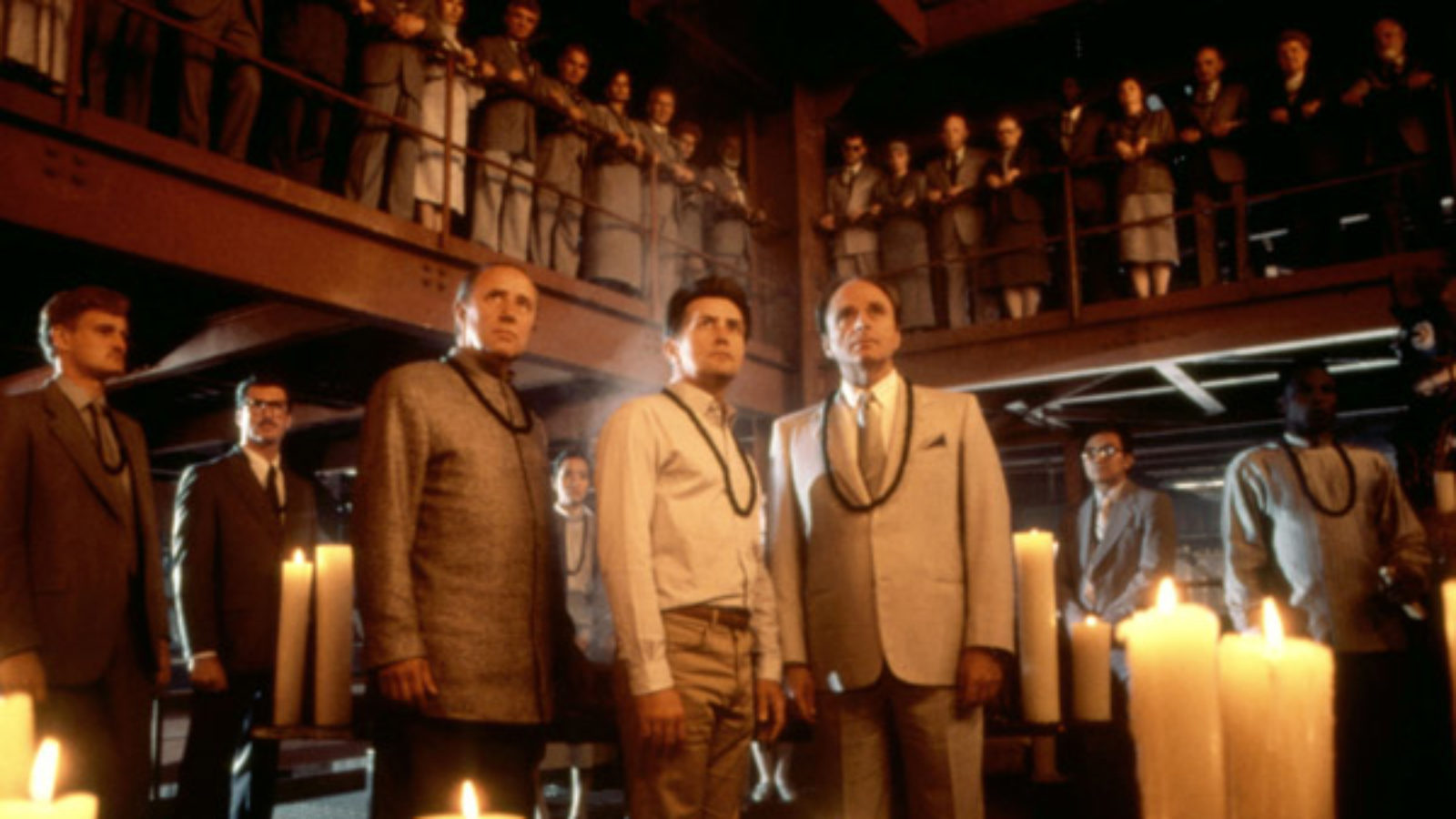
At the start of John Schlesinger’s 1987 horror film The Believers, police psychiatrist Cal Jamison (Martin Sheen) is having a quiet morning with his wife and child. Within minutes, a malfunctioning coffee maker electrocutes his wife, boiling her insides as she stands tremoring from the shocks. It has nothing to do with the rest of the film, it’s just a pre-opening stinger that also doubles as a pretty clear insight of what you’re in for: this film is gratuitous, fairly shameless and exploitative.
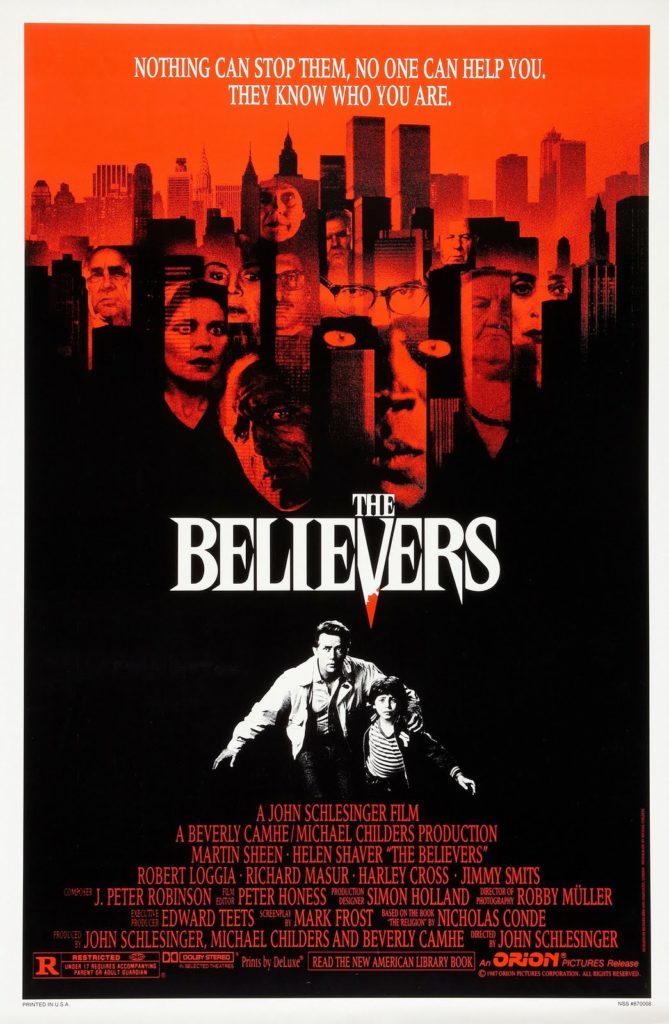
A year later, Jamison has relocated to New York City with his son, where a series of brutal child murders are plaguing the city. After a chance encounter with a paranoid, Cuban detective (Jimmy Smits), it becomes apparent that an ancient Caribbean religion with promises of great wealth has appealed to city’s elite, and no less than a Donald Trumpian construction magnate (Harris Yulin) is at the center of it.
Like Marathon Man and Midnight Cowboy, The Believers is interested less in the supernatural and more in the very human elements. They’re still there, as real as Dustin Hoffman’s method acting, but they’re not without a pretty heavy dose of camp. A scene in which Sheen’s friend spills some coffee creamer is heightened to absurdity when it sends Sheen into flashbacks of his wife’s untimely end. This would work if The Believers had a sense of humour, but it doesn’t.
There was a string of religious horror dating back from The Exorcist and its imitators, but the 80s brought about another, more human malignant threat: Yuppies. Reagan’s American “voodoo economics” takes on a very literal meaning when it becomes clear that the wealthy went all in on an evil, Caribbean cult (who hides its Satanic influence within the very normal practice of Santeria).
There’s no shortage of horror that came under fire for negative portrayals of religion and religious followings. From Silent Night, Deadly Night sparking protests for its murderous Santa to recent accusations against The Witches remake, there’s always a religious group ready to start a picket line.

But The Believers, based on Nicholas Conde’s novel The Religion, seemed to take on a group without any understanding of the actual practices of Santeria. I’m surely as ignorant as most in the topic, as I am any other Caribbean practices, but I’m fairly certain there’s no pact with the devil that allows boils to burst out with spiders.
Some of what Schlesinger brings to the film works quite well, with Sheen, Robert Loggia and a particular game turn from Richard Masur grounding the more ridiculous aspects with some very real performances. But ultimately, at it’s core is a borderline racist message. Horror never has to adhere to any realities, but it’s always preferred when it sidesteps unnecessary controversy.
Removed from Santeria, The Believers has other problems. Some performances ring hollow, and the climax, as it is, feels unfinished. The final coda feels insignificant, like an add-on from production notes.
Still, there is something appealing about the idea of the wealthy sacrificing children’s blood in order to get ahead. In recent years, with the rise of the 1 per cent in the U.S. and the near-erasure of the middle class, it only hits closer to home today as it did under Reagan.
It’s just a shame it’s buried under a clumsy film that only deals in broad-strokes and excess.
This article was originally written by Kenny Hedges for Grimoire of Horror.
More Reviews:

Cube (2021) Film Review – Japan Beat Hollywood to the Punch
The term “remake” is often met with blatant vitriol and is usually accompanied by assertions that Hollywood is either running out of ideas or is cashing in on the audience’s…
![Unnamed Footage Festival Short Films Collection (2024) – Short but Sweet [Unnamed Footage Festival 7]](https://www.grimoireofhorror.com/wp-content/uploads/2024/03/Untitled-design-28-365x180.jpg)
Unnamed Footage Festival Short Films Collection (2024) – Short but Sweet [Unnamed Footage Festival 7]
At this year’s Unnamed Footage Festival, the lineup of short found footage films promises to immerse audiences in thrilling and chilling narratives captured through unconventional lenses. From eerie home videos…

Cult of VHS (2022) Documentary Review: Love and Obsolete Media
In our modern times, with seemingly endless movie selections available at the touch of a button and in high definition quality, it seems crazy that anyone would anyone choose to…

Top Hate, Top Lust, Top Heavy: Severin Films Presents RUSS MEYER’S BOSOMANIA!
To me, the greatest American rock and roll band will always be The Cramps. Led by singer Lux Interior and guitarist Poison Ivy Rorschach, draped in vintage Frederick’s of Hollywood…
Legend Of The Mountain (1979) Film Review – Triumphant execution of a typical Folktale-ish Narrative
Shih Chun is Ho Yun-Qing, an intelligent student who fails his imperial examination and, after failing to find a respectable job well, decides to become a manuscript copyist. His minimal…
Fear Street Part Three: 1666 Film Review – Even the Strongest Curse Can be Broken
Film trilogies are a tricky business. With the exception of Lord of the Rings and Star Wars, most trilogies don’t set out planning to tell a singular story across three…