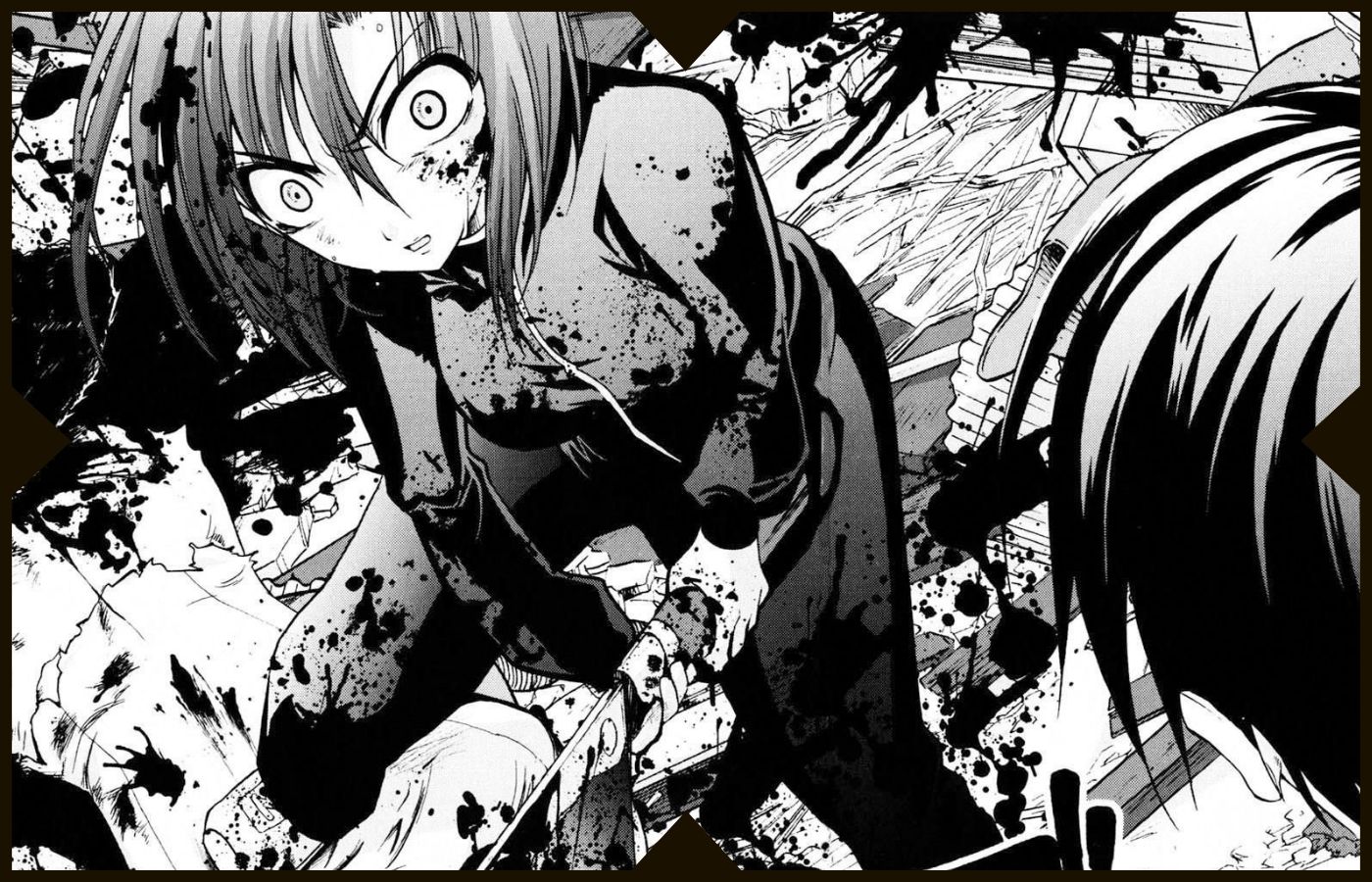
Higurashi When They Cry, or Higurashi no Naku Koro ni in Japanese, is an sprawling franchise of Ryukishi 07 – starting with the amateurish visual novel series in 2002 only initially selling fifteen copies, produced by ’07th Expansion’ and subsequently adapted onto practically every platform to amass exceptional sales. The series encompasses two live film, a 2006 anime including feature films, live television series, four light novels from the original creator, drama CDs and multiple manga – a breadth that’s still expanding to this day with the 2020 anime remake.
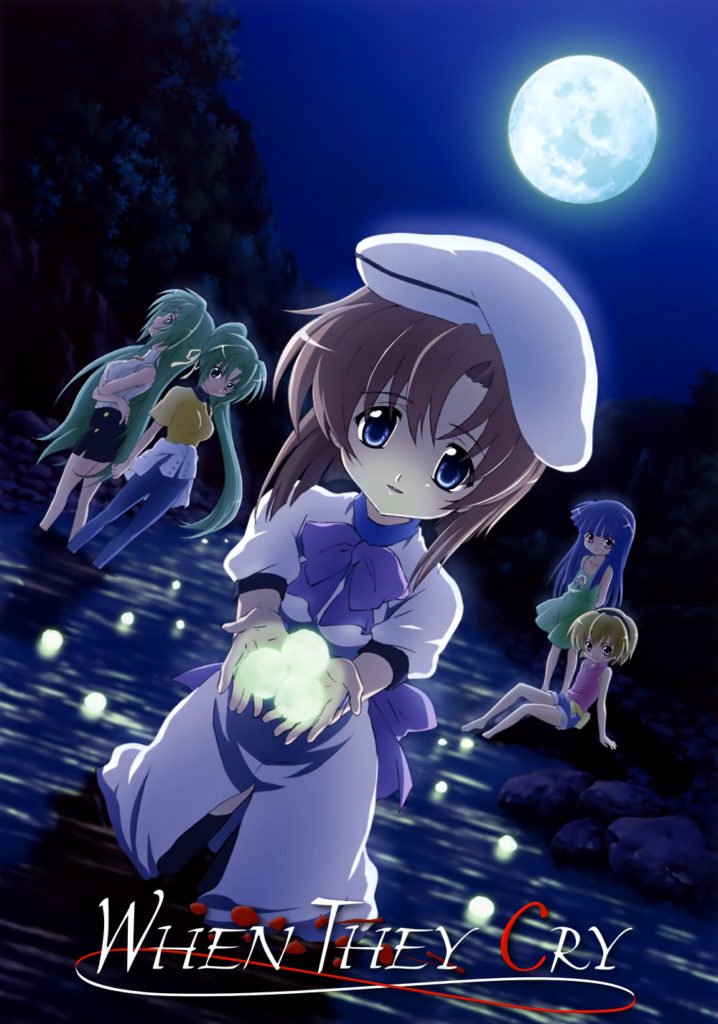
Over time, the style style has matured and each plot point has developed significantly – it has become cultivated carefully from a meek canon into a profound lore. The visual novel was originally one of raw focus on the narrative as an innovative ‘sound novel’- scene (extracted from real locations) and audio were the key highlights to the experience, player choice was minimal to have the experience itself as the foremost direction.
The series has a myriad of timelines to unveil the mysteries underlying the traditional village of Hinamizawa – based on ‘Shirakawa village’ as a World Heritage Site in real life – and follows a clique at the local school as they become embroiled into disturbing events to a point some become berserk with a paranoid rage. This is attributed to a local condition known as ‘Hinamizawa Syndrome’ resembling a contagious paranoid schizophrenia. Keiichi Maebara, who becomes close to every other student as a charming fellow, has recently relocated to the town and he is our main protagonist as he explores the mysteries alongside us as the reader/viewer – unsolved murders, creepy antics and disturbing legends all showcase this town as far from ordinary or tranquil.
Occasionally splitting to other perspectives, with exploring backstories or others’ action during events, the series is engrossing for how much we become intimate with the town and all the inhabitants – accompanied with a dread to any care that their fate is insecure. Hinamizawa as a village is strongly traditional town with reverence to the local deity of Oyashiro, a family shrine as central to life in the village and respect for ancestral customs with festivals – all serving a folk horror that’s strong for atmospheric horror from culture as much as the narrative is for psychological intensity.

Although at first an adorable premise with playful interactions from endearing friendships and joyful school life, this is solely a setup for the brutal contrast as the violent undertones overtake their lives – there’s a foreboding darkness underneath the pleasant fabric of ordinary life. The series is intriguing, tense and intricate to an extent the originally amateur art style is deceptive of the depth – very much the reason for enduring popularity. Over time, with renditions and revisions, the series has been perfected in the setup of an idyllic town, endearing characters and traditional customs with a vibrant social life – it consolidated a real immersion to the setting of a rural lifestyle soon twisted into various horrors.
The series is complex from being divided into four independent, main timelines as ‘Question’ arcs and these each have a corresponding ‘Answer’ arc as ‘Kai’ to address mysteries/curiosities of these. The main narrative timelines are Onikakushi-hen (Spirited Away), Watanagashi-hen (Cotton Drifting Chapter), Tatarigoroshi-hen (Curse Killing Chapter) and Himatsubushi-hen (Time Killing Chapter). There are also three extra, bonus chapters released in three series which may provide an alternate perspective alongside further details- Rei, Matsuri and Kizuna.
More Anime Reviews:

Urotsukidoji II: Legend of the Demon Womb (1991) Anime Review
Urotsukidoji II: Legend of the Demon Womb is a 1991 adult-oriented sci-fi horror anime film written by Toshio Maeda, Shô Aikawa, and Kôichi Ôhata, and directed by Hideki Takayama. The…

Satoshi Kon: The Illusionist (2021) Film Review: A Short Life with Immeasurable Impact
I had the great fortune of viewing the documentary Satoshi Kon: The Illusionist (2021) at this year’s Nightstream horror film festival. As a longtime fan of his work it turned out…
Natsume’s Book of Friends (2008) Anime Review – A Wholesome Horror
It is an undeniable fact that some horror fans also can be huge softies. We enjoy our healthy dose of gore, scares, and violence, but we are not dead inside….
![[April Fools] Shrek (2001) Anime Review: Abandon Hope All Ye Who Watch the Ogre](https://www.grimoireofhorror.com/wp-content/uploads/2022/03/BeFunky-collage-365x180.jpg)
[April Fools] Shrek (2001) Anime Review: Abandon Hope All Ye Who Watch the Ogre
Every generation has a movie or TV show that collectively traumatized it. Whether it was Tommy Lee Wallace’s It adaptation, The Texas Chainsaw Massacre, or Cory in The House, we…

Top 7 Yandere Anime Characters That Are Not Yuno Gasai
Sometimes love makes you crazy, and sometimes makes you want to stab someone right in the middle of their chest. Just as the Japanese term defines it, a “yandere” is…

Higurashi no Naku Koro ni Gou (2021) Review: A Deep Dive into Time Loops of Discomfort
With the latest Higurashi series wrapped up as of just last week, it’s time for a spoiler-filled review for the fans that want to dissect the heart (and other organs)…

Some say the countdown begun when the first man spoke, others say it started at the Atomic Age. It’s the Doomsday Clock and we are each a variable to it.
Welcome to Carcosa where Godot lies! Surreality and satire are I.
I put the a(tom)ic into the major bomb. Tom’s the name!