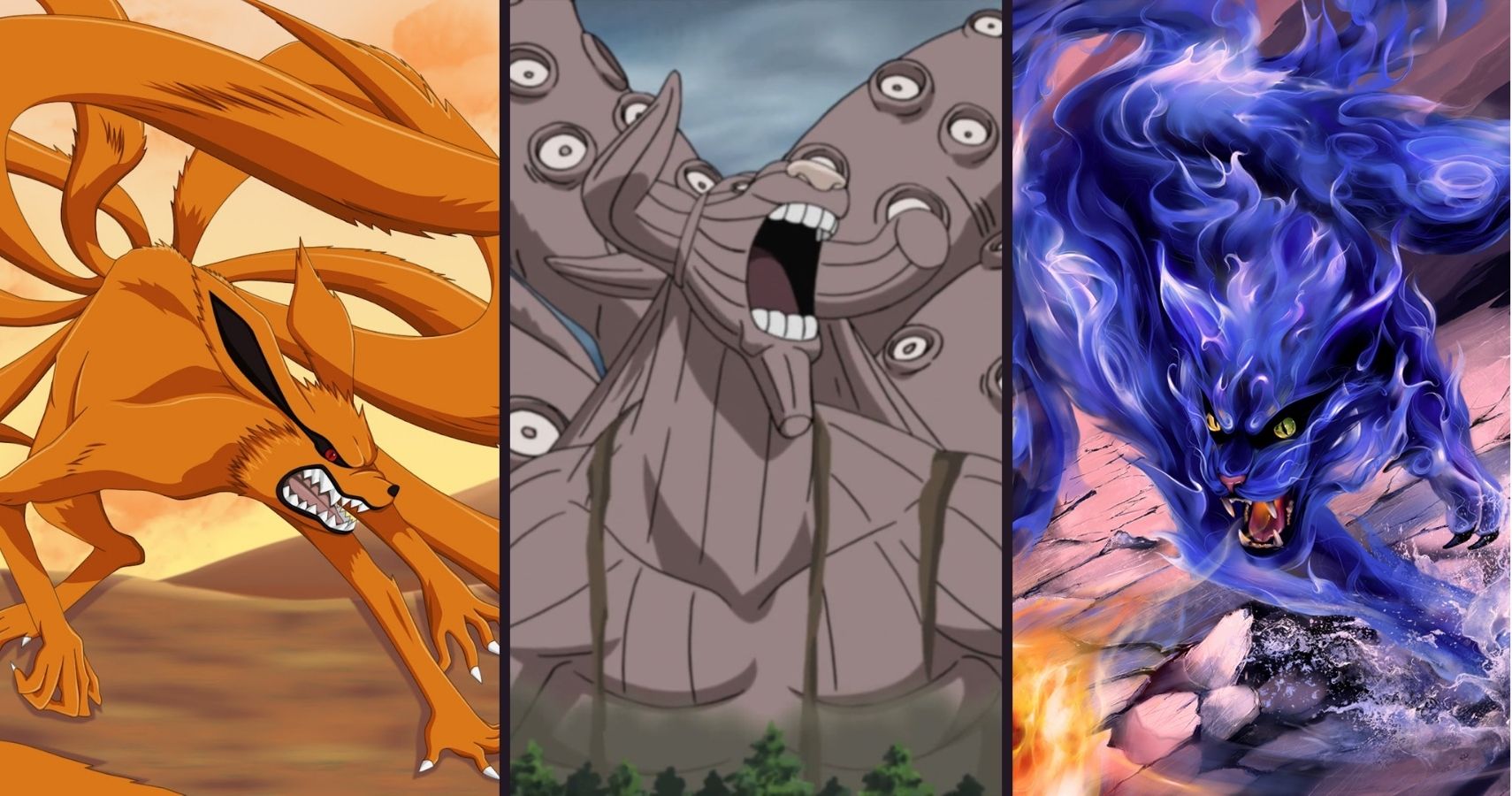




It’s safe to say that, for most, Naruto was their first exposure to Japanese media and culture. With its larger-than-life fight scenes, solid story arcs and beautiful artwork, it has definitely made its mark on popular culture throughout the world.
One thing that I have always enjoyed about Naruto was the Bijuu, or the Tailed Beasts, titanic living life forms of chakra created by the Sage of the Six Paths out of the chakra from the Ten-Tails. The tailed beasts were originally created not only to prevent the Ten-Tails’ resurrection but also to maintain and balance peace. Because of their immense power, the tailed beasts were sought out by humans to be used as weapons in times of war.
The Concept of the Bijuu is somewhat based on Japanese mythology. The creator of the manga, Masashi Kishimoto, uses names with different kanji, but with the same pronunciation to run parallel to the myths and make them unique. I will explore unique instances of mythology appearing throughout Naruto.
Juubi

Juubi (十尾), the Ten-tails, is a reference to Ame-no-hitotsu-no-kami, the Shinto god of iron-working and blacksmiths, Datara and Diadarabotchi. The former for its ability to forge living things out of metal and the latter for its giant size. The Ten-Tails is brown in colour and titanic in size; one of its hands is larger than any of the tailed beasts. While the beast possesses multiple forms, common attributes include a single eye, which takes up most of its head, and spiky protrusions growing out of its back in a shape reminiscent of a conch shell.
Kyuubi
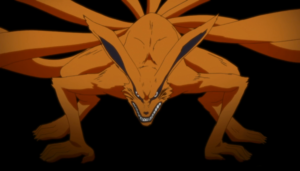
Kyuubi: 九喇嘛 (クラマ; Kurama), the Nine-tails, is a reference to the kitsune in Japanese mythology. The name Kurama is more then likely named after the mountain of the same name. Mount Kurama is said to be the home to the Tengu god Sojobo and most importantly, the location where the technique Reiki was learned. Reiki is the art of using chakra (universal energy) to heal others. This ties into Naruto’s life-giving energy ability he gains after tapping into the Nine-tails’ chakra.
Hachibi
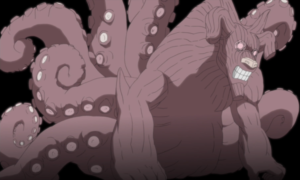
Hachibi: 牛鬼 (ぎゆうき; Gyuuki), the Eight-tails, is based off the Ushi-Oni, a sea creature commonly seen with an ox head and the body of an insect. These beasts are said to be incredibly cruel and savage, with toxic poison-like breath and a taste for humans. The name Gyuuki, meaning cow demon, is another pronunciation of Ushi-Oni.
Nanabi/Shichibi
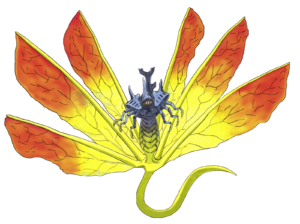
Nanabi/Shichibi: 重明 (ちようめい; Choumei), the Seven-tails, is most likely based off the rhinoceros beetle, one of the strongest creatures on the planet in relation to its own size. The name could be a reference to Kamo no Chomei, a 12th-century poet who secluded himself from society, took Buddhist vows, and became a hermit living outside the capital. Chomei is most famous for his writings about nature and the natural events he had witnessed.
Rokubi
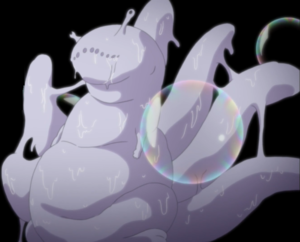
Rokubi: 犀犬 (さいけん; Saiken) the Six-tails, is based on the turban-shell snail demon, Sazae Oni. Sazae Oni are monstrous and deadly creatures. They are powerful shape-shifters, often taking the form of beautiful women in order to lure seamen into trouble.
Gobi
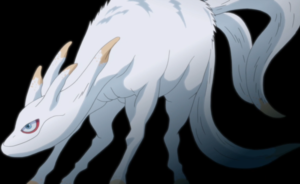
Gobi: 穆王 (こくおう; Kokuou), the Five-tails, Kokuou literally means “respectful king”. This name probably comes from the name of the 10th-century BC Chinese King Mu of Zhou. He’s famous for the legend surrounding his visit to the sacred Kunlun Mountains, where he visits the goddess Xi Wangmu, (literally meaning: Queen Mother of the West) so he can eat from her peaches of immortality. There is also an account of the King being shown a human-shaped automaton — a completely artificial, fully functional robot with internal organs and all. This might tie into the Jinchuriki Han’s appearance and abilities.
Yonbi
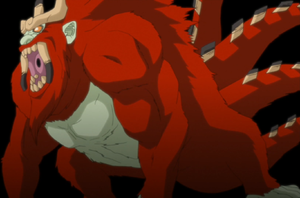
Yonbi: 孫悟空 (そんごくう; Son Gokuu), the Four-tails, is a reference to the Satori; strange, intelligent ape-men found in the mountains of Gifu. They are roughly the size of a man and appear to be larger versions of the native monkey found in the region. They are known to eat humans on occasion. The name Son Gokuu is obviously a reference to the Monkey King in the 16th-century novel Journey to the West, as well as Dragonball.
Sanbi
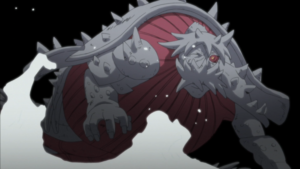
Sanbi: 磯撫 (いそぶ; Isobu), the Three-tails, a combination of the Suppon no Yurei, the vengeful spirits of softshell Turtle, that attack those who have harmed them; and the Isonade, mysterious, shark-like creatures that are known searching rocky coastline searching for boats to scuttle and fisherman to eat.
Nibi

Nibi: 又旅 (またたび; Matatabi), the Two-tails, is a reference to the forked cat demon, Nekomata. When a Nekomata transforms into a Yokai, its tail splits down the center to form two identical tails. These monster cats are likely to be seen walking through towns and cities on their hind legs, speaking the human tongue. The name Matatabi comes from the Silver Vine, a plant herb similar to Catnip used medicinally for cats.
Ichibi
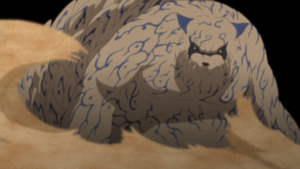
Ichibi: 守鶴 (しゆかく; Shukaku), the One-tail, is a reference to the shapeshifting raccoon demon, Tanuki. Tanuki are the creation of Toriyama Sekien, an 18th-century scholar, for his book Hyakki tsurezure bukuro. A tale of a shrine priest being a tanuki in disguise ties into how the One-tail was corrupted by a Hidden Sand priest.

Masashi Kishimoto’s basis for these monsters are deeply seeded in mythology. Ultimately, he managed to create his own awesome, distinct creatures that are all memorable in their own right.
More Anime Reviews:
Happy Sugar Life is an incredibly unique viewing experience. At first, it’s easy to write it off as merely a Higurashi copy: yet another cute, slice of life story hiding… Mermaid Forest is a 1991 anime OVA adapted from Rumiko Takahashi’s manga Mermaid Saga, published from 1984 to 1994. Directed by Takaya Mizutani and produced by Pierrot, the anime was… In 2015, someone posted on 4chan asking a simple question: “What’s the most ***** up thing you have seen on the Deep Web?” Skipping all the explanations why this question… A Kite (or simply Kite to Western audiences) is a 1998 OVA anime, written and directed by Yasuomi Umetsu. Originally released as two separate episodes on VHS, all subsequent DVD… It is an undeniable fact that some horror fans also can be huge softies. We enjoy our healthy dose of gore, scares, and violence, but we are not dead inside…. Even after all these years, Serial Experiments Lain remains a cult-classic anime for many. With only 13 episodes and a ton of unanswered questions, fans still want something more of…
Happy Sugar Life (2018) Anime Review- Bittersweet Love
Mermaid Forest (1991) Anime Review – Murmaider
Urban Mysteries: The Search for Saki Sanobashi AKA Go for a Punch
Kite (1998) Anime Review – Film Noir Action
Natsume’s Book of Friends (2008) Anime Review – A Wholesome Horror
Serial Experiments Lain (1998) Video Game Review – Welcome Back to the Wired

Hey there, I’m Jim and I’m located in London, UK. I am a Writer and Managing Director here at Grimoire of Horror. A lifelong love of horror and writing has led me down this rabbit hole, allowing me to meet many amazing people and experience some truly original artwork. I specialise in world cinema, manga/graphic novels, and video games but will sometime traverse into the unknown in search of adventure.