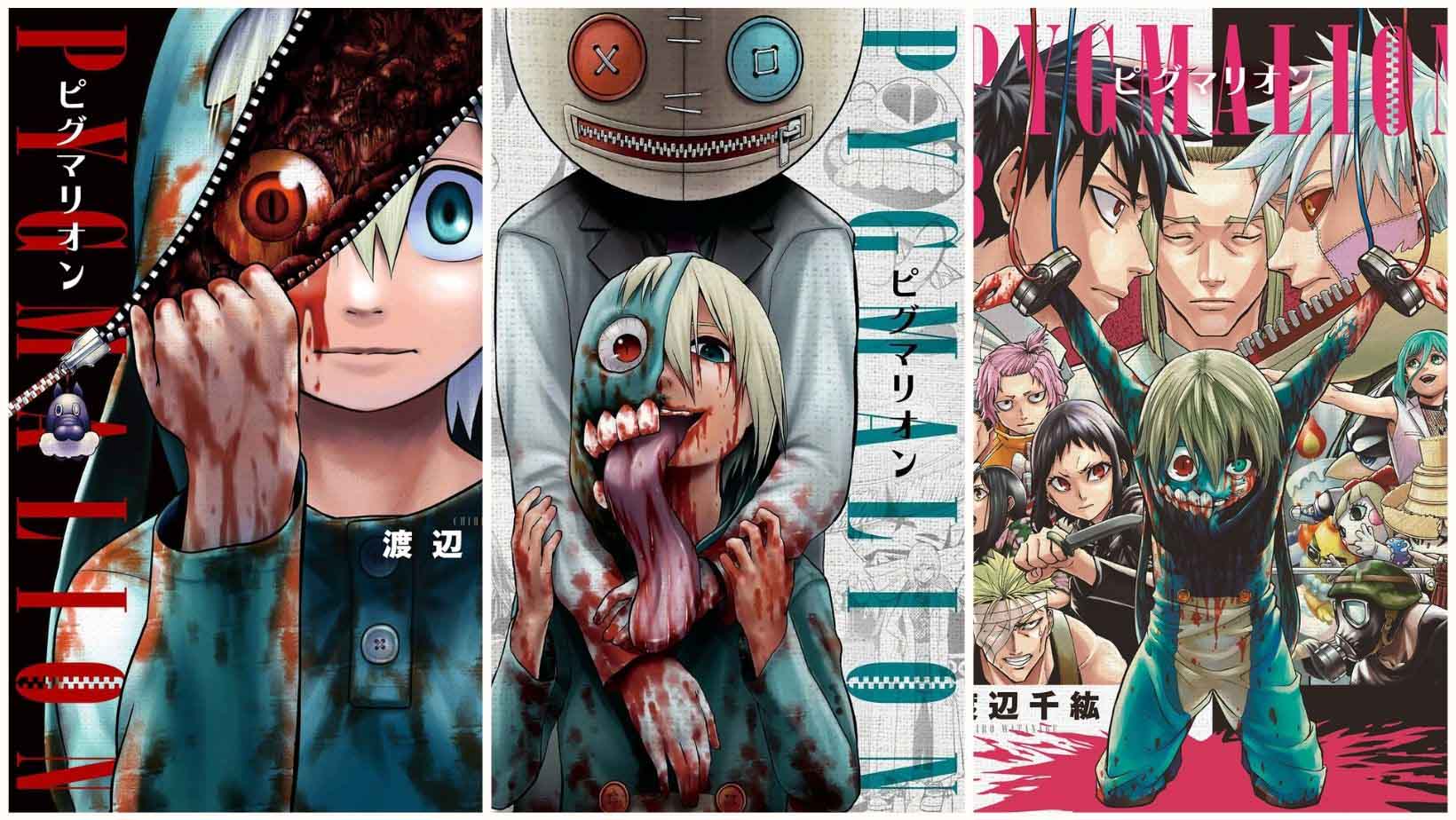





Pygmalion is a gory horror manga consisting of three volumes released in 2015 and concluding in 2017, written and illustrated by Chihiro Watanabe. Watanabe is known as the creator of the short manga Akurei Tsukai (2006), Tsumi no Hanataba (2009), and Haburi (2018).
“At the National Local Mascot Festival, children all across Japan can meet their favourite local mascots. But as the festival gets underway, it becomes clear that what’s inside these costumes aren’t people – they’re something much darker, with a taste for human flesh. Amid the chaos spreading through the entire country, Keigo Ayahara, his little brother Makoto, and his friend Ako must now fight for their survival and their humanity.”
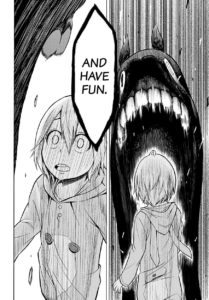
Starting at a breakneck pace, the story’s veritable chaos kicks of within the first dozen pages, featuring a heavy emphasis on gruesome body horror that prevails throughout the relatively short run. Despite the rapid pacing, these first dozen pages are utilised well to establish the story’s characters decisively and their overarching backgrounds efficiently, allowing the impeccably visualised carnage to take centre stage throughout. Pygmalion rarely shies away from this violent content, and eagerly embraces graphic depictions of anthropophagy at the hands of these monstrous mascots in a relentless tempo.
Although successfully incorporating a coherent introduction, this short story has excessive information dumped on the reader inorganically at points – resulting in a contrived feeling not best for a natural flow. An emphasis on delivering a fully clarified story comes at the price of extended dialogue to complete all details – their lengthy retorts consequently lasting pages. Surely prolonging the story beyond its fugitive three-volume run would avoid the problem – information being delivered at a slower and more methodical pace.
The main basis of the story is derived from the ancient Greek myth bearing the same name, a grand sculptor and king of Cyprus who falls in love with an ivory statue of the perfect woman he created. After praying at the altar of Aphrodite, the statue is brought to life by the goddess as the King and his creation both live happily ever after. Regardless of this basis, the manga flips the perspective of this mythology and instead focuses on the fate of the sculptor’s artwork itself as an emotive symbol, being thrust into an unavoidable relationship to which her feelings and opinions matter not – essentially becoming a slave. The flip in objectivity is an interesting take on the myth, being implemented well as a basis for an unscrupulous display of body horror in a fresh take.
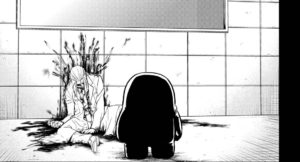
On the other hand, the story falls into similar tropes found throughout Shonen manga, with an unsuspecting protagonist intrinsically interlinked to the plot from a young age. Unfortunately, this causes certain key parts of the story to be slightly predictable in their reveal, lacking the shocking uncloaking of information intended by the author. This shortcoming is difficult to blame on the story itself; the over-saturation of the Shonen genre following a similar general formula becoming difficult to avoid said tropes.
When it comes to visceral visuals, Pygmalion certainly delivers in an impeccably cathartic manner. Along with an interesting, albeit predictable story, this manga is a fine representation of the body horror genre. At only 3 volumes, is an entertaining way to spend an afternoon revelling in some over-the-top violence.
More in Manga
“Daisuke Ichiba is not a manga artist, he is a drawer of beautiful women!” There are few Japanese underground creators that can hold sway over a select few and never… Fancy a retro anime review about a kawaii magical girl with an absence of clothes but an excess of psychic killing powers!? Of course y’do! Can you guess what show… True crime has become a popular sub-genre that has reached a wide audience of those looking for shock or to better understand the lowest depths of humanity. However, the genre… Gaia is a strikingly gorgeous and demented release from new mangaka Asagi Yaenaga, who is transitioning from their expressive and violent art pieces into the realm of narrative storytelling. The… I am always on the lookout for more extreme and challenging horror manga as a fan of work that pushes those boundaries of what is acceptable as entertainment. That said,… Ken Niimura is a Spanish-Japanese artist who employs a simplified, endearing style to share three stories in this volume of the taboo. Taking inspiration from the Japanese tales he heard…
KSKHH (2021) Manga Review – Oh What Beautiful Filth!
Anime Retrospective: Elfen Lied
God’s Child Manga Review – Nishioka Kyoudai Create a Serial Killer
Gaia (2022) Manga Review – A Deviously Dark Debut Horror Manga
Fear Infection (Kyoufu Kansen) Manga Review – Visions of Childhood Terrors
Never Open It: The Taboo Trilogy Manga Review – Japanese Folklore Re-Envisioned

Hey there, I’m Jim and I’m located in London, UK. I am a Writer and Managing Director here at Grimoire of Horror. A lifelong love of horror and writing has led me down this rabbit hole, allowing me to meet many amazing people and experience some truly original artwork. I specialise in world cinema, manga/graphic novels, and video games but will sometime traverse into the unknown in search of adventure.