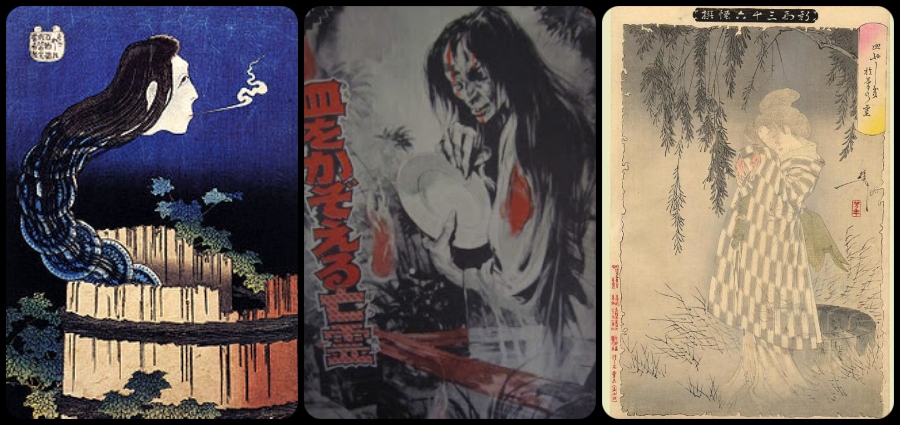





Banchō Sarayashiki, translated to ‘The Dish Mansion at Banchō’, has a strong legacy in Japan as a kaidan (Japanese ghost story) since 1741, it has been adapted in various ways (e.g. manga, novella, television series) and depicted in the ever-enduring ukiyo-e. A bunraku play titled ‘Banchō Sarayashiki’ was performed at the Toyotakeza theatre in the 17th century, with kabuki versions following the success at likes of the Naka no Shibai theatre in Osaka, and these traditional practices solder the tale into national heritage. The tale features ‘Okiku’, who has become a folkloric icon as an onryō, associated to haunted wells where her body was dumped as a victim of an unfair and manipulated accusation – the well a clear connection to the disposal in Ringu as a trope.
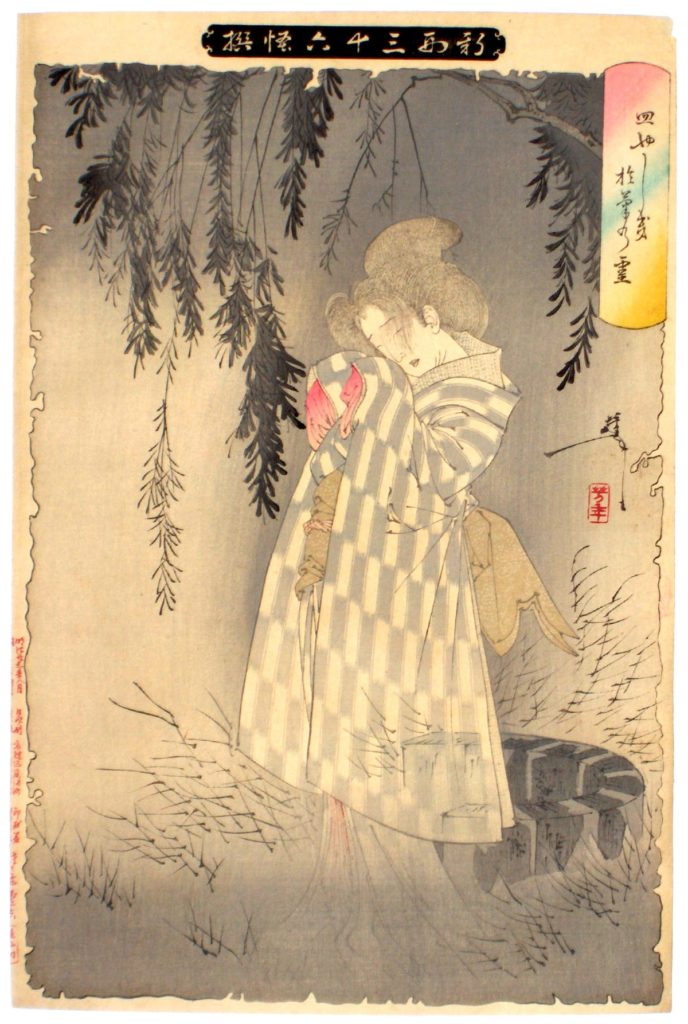
The original tale recounts a beautiful maid, Okiku, serving as the maid to the samurai Aoyama Tessan whose interest in her is relentless – he’s enamoured with her stunning looks and takes every chance to court her. As she rejects him politely to conserve her modesty, Aoyama is frustrated at being spurned and hatches a devious scheme – he will hide one of the ten Delft plates she’s responsible for overseeing as immensely valuable heirlooms – a serious oversight of her duty deserving even her execution. Okiku notices there are only nine plates and counts for ten obsessively, guilty, and shocked at her error to lose the tenth – there are only 9.
Her master, Aoyama, discovers the scene and offers her clemency in exchange for her submitting as her lover- a proposal completely against her dignity he is atrociously trying to manipulate. She refuses firmly and the the samurai flies into a rage – he throws her into a well as a supposed punishment for losing the plate. After this dreadful event, the yurei of Okiku would crawl from the well every night to haunt Aoyama and count to nine softly until letting a horrendous shriek represent the tenth missing plate that spelled her doom.
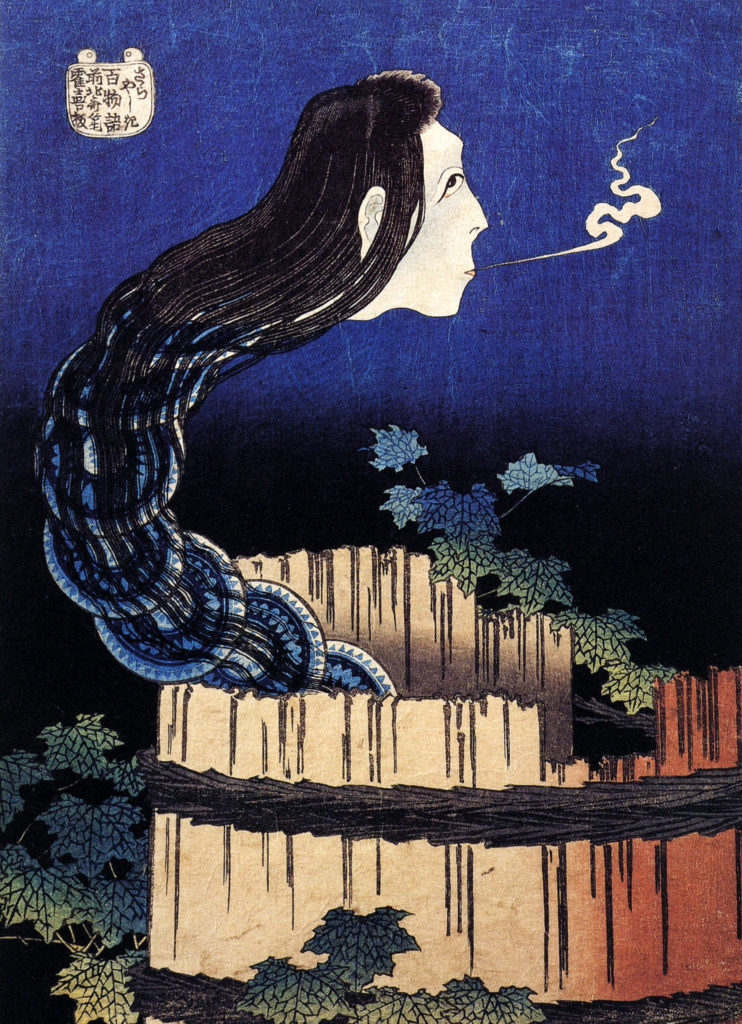
The subsequent outcome to this tale is contended and there’s no definitive ending – some depict an exorcism with screaming the tenth in tune with her, while others portray her merely disappearing once the missing plate is discovered. The plot has other variants, too, changing all drastically as in the Edo and Harima versions, both much more intricate in the level of details whereas they’ve developed into a much deeper narrative. Banchō Sarayashiki is a tragic tale of an inappropriately pursued woman who suffers manipulations to coerce her fate until an unjust death as a consequence of nothing she did – she is very much a rightful vengeful spirit to Japanese lore, a vexed spirit whose rage of injustice channels her into an onryō.
More Folklore and Urban Legends
The smiley face murders exist as a modern urban legend, a way to explain the mysterious drowning deaths of college/university-age men. This comes from a multitude of cases where near… There’s a funny kind of serendipity when you’re a fan commentator on popular entertainment, where you can sometimes just barely miss a critical piece of information that hits a smidge… Sitting at the southeastern corner of Asia lies the Philippines, which like any other Asian country such as Japan or Thailand, has its own fair share of cinematic horrors. Filipino… The Okiku Doll is a haunted object presently stored at the Mannenji Temple and originating in Hokkaido, Japan as a possession of a daughter, Okiku, from the Suzuki family. The…
Smiley Face Killers (2020) Review – College and University Bros Beware!

The Great Yokai War – Guardians (2021) Film Review – Miike Returns to the Beloved Series

Most Memorable Monsters of Pinoy Cinema
Japanese Urban Legend of The Okiku Doll

Some say the countdown begun when the first man spoke, others say it started at the Atomic Age. It’s the Doomsday Clock and we are each a variable to it.
Welcome to Carcosa where Godot lies! Surreality and satire are I.
I put the a(tom)ic into the major bomb. Tom’s the name!