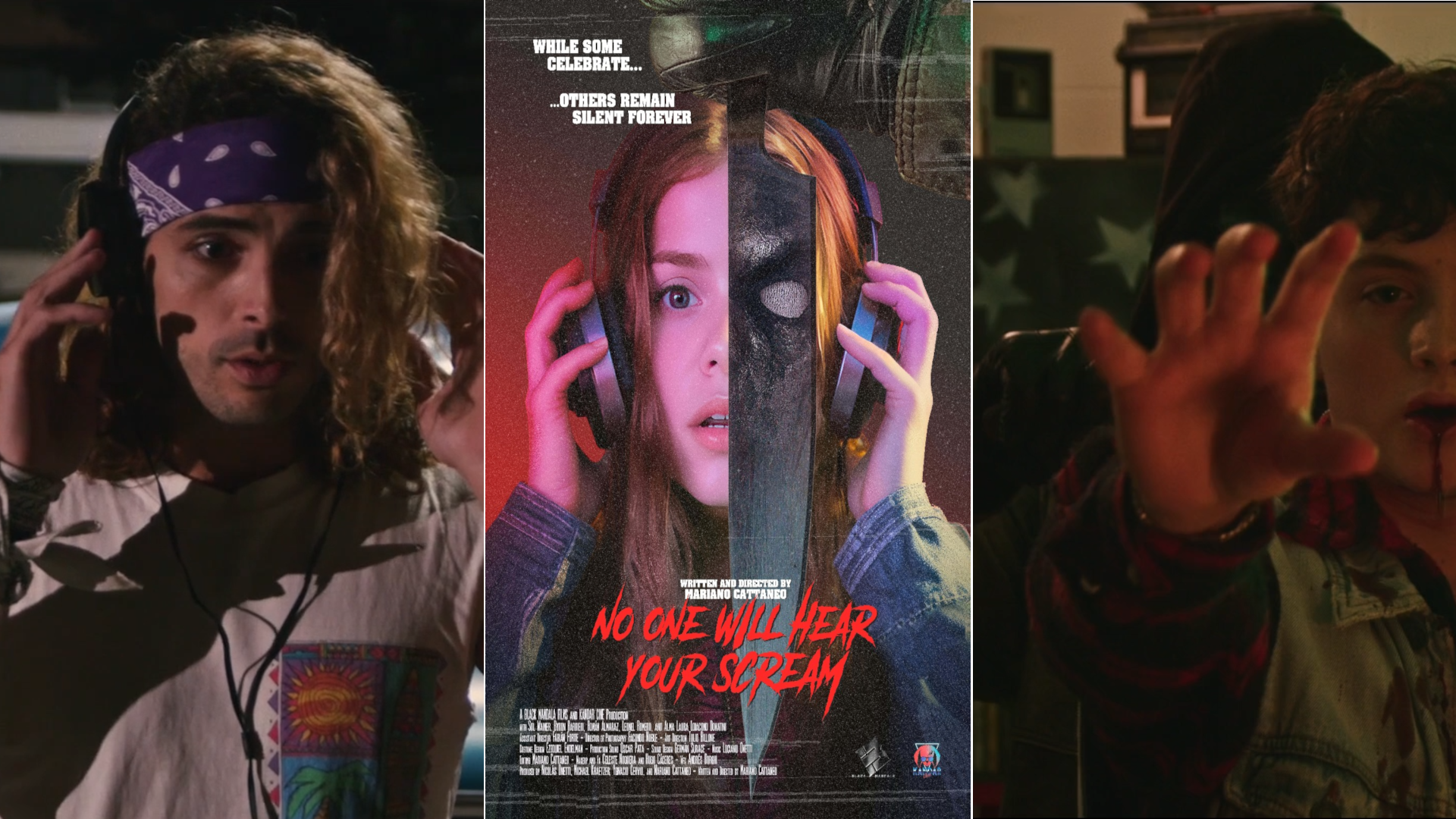





It is 1990, and the residents of Bernal, Argentina, are riveted by the FIFA World Cup games while a killer prowls the streets. As the competition on the pitch increases, so does the bloody body count. Record store clerk Micaela (Sol Wainer) finds herself ensnared in the killer’s web of violence while the citizens of Bernal turn their backs on the danger to watch the games in Mariano Cattaneo’s terrifying No One Will Hear Your Scream (2025).
Opening with a montage of Bernal preparing for the games, unaware that a killer has already claimed several victims: businesses close with handmade signs appearing on the doors and in windows, announcing the store will reopen after the match, phones are taken off the hook, and the town draped in the blue and white of the national kit. While the citizens are busy watching their national pastime, hometown team pride flying high, the killer takes a victim. The violence amidst the anticipatory fervor mocks the illusory safety of the suburb’s homes with their concrete walls and spiked fences, turning the town into the killer’s charnel house.
This shocking, pre-credits scene opens a larger conversation: This atmosphere of dread is not unique to this film. South America has become a powerhouse for horror that demands the viewer look at what lies beneath the skin of society. Films like Cemetery of Lost Souls (Brazil, 2020) and The Last Matinee (Uruguay, 2020), along with Guatemala’s La Llorona (2019), all masterfully exhume the ghosts of the continent’s trauma. The early 1990s in Argentina, in particular, was a period of profound instability: as the brittle mask of military dictatorship gave way to a volatile, transitional democracy, the culture became haunted by the unresolved trauma of the “disappeared.” For the residents of Bernal, this is the specter that lurks in the shadows while they are distracted by the spectacle on their television screens.
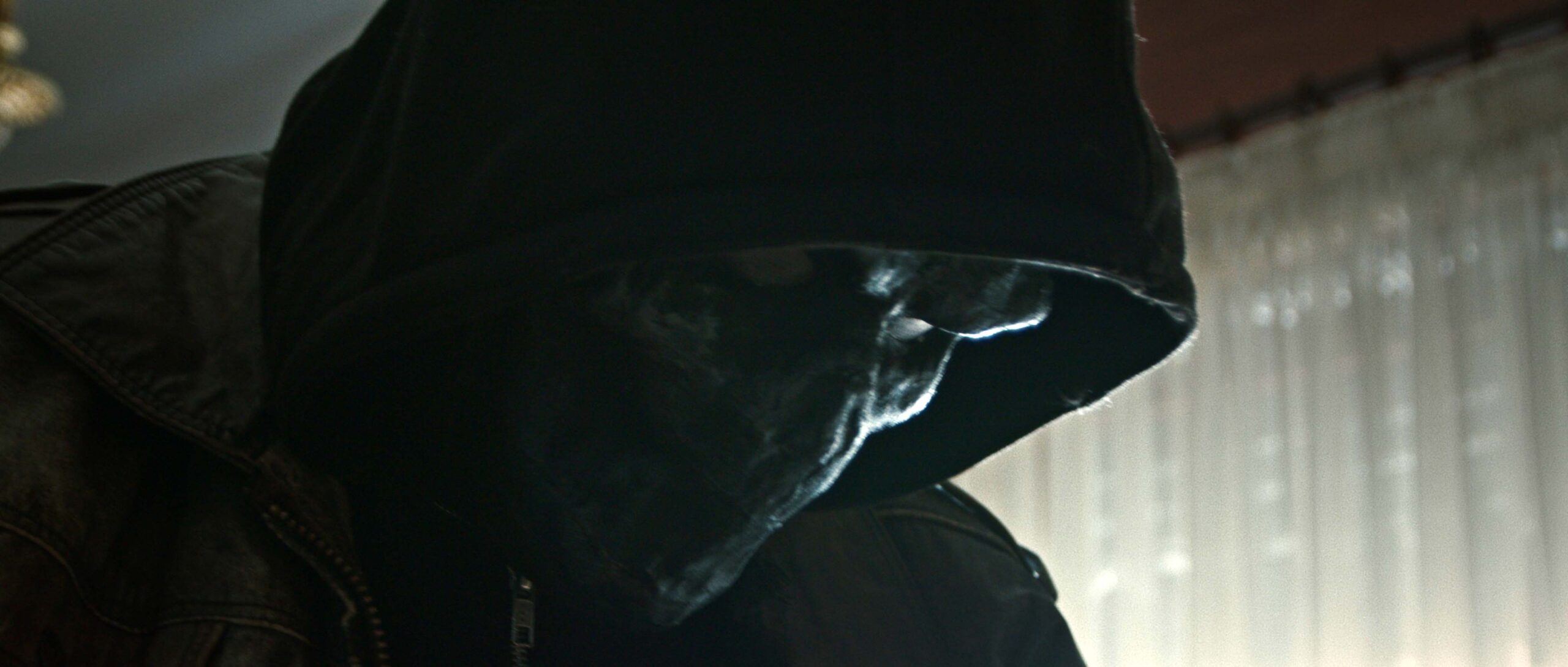
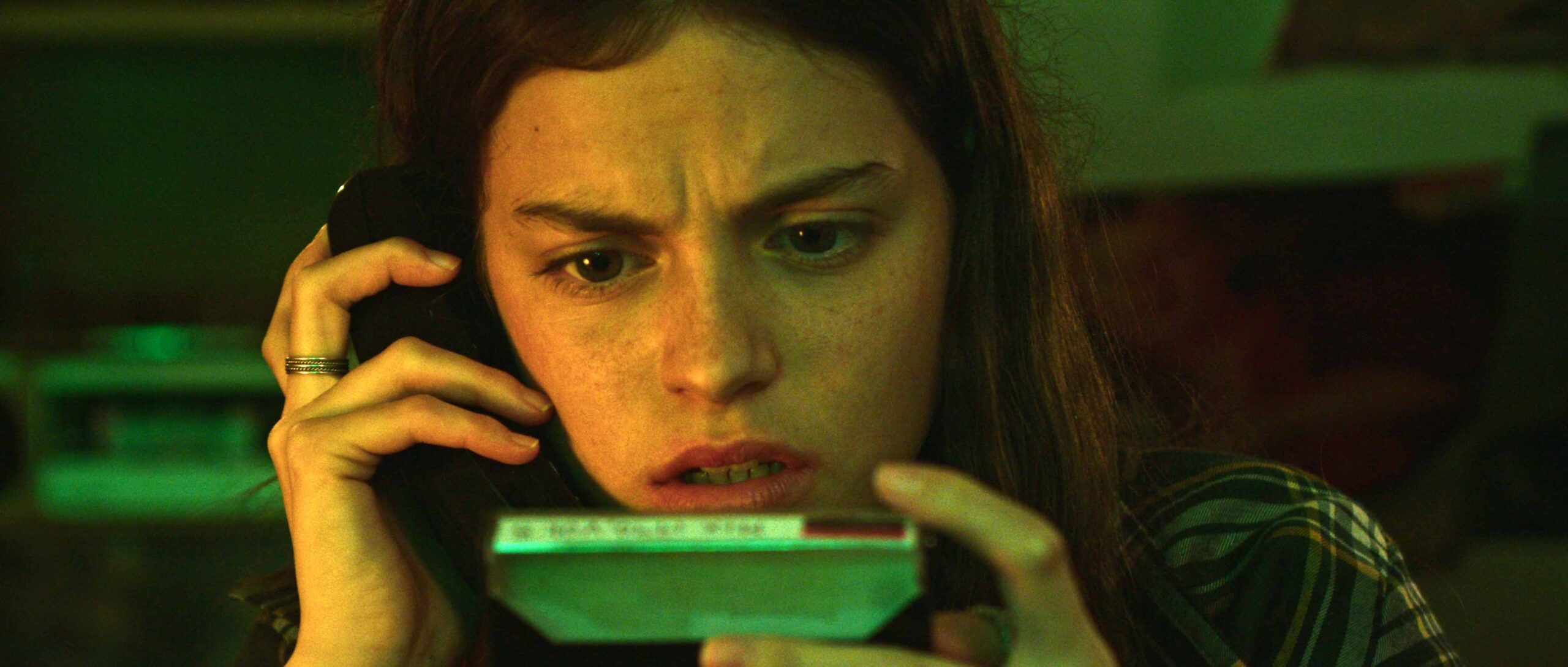
In short, the slasher genre is a perfect medium to speak to the culture of fear these liminal government changes created. What better metaphor for a life where seemingly anyone could join the desaparecidos than a killer who moves through Bernal with total impunity, leaving only a bloody trail behind? Micaela discovers that the killer is using the mixtapes she sells to choose their victims. She is drawn inexorably into the mystery while her best friend, Tomás (Byron Barbieri), constantly urges her to leave it alone, denying there is even any connection between the killings.
Together, these two characters embody society’s fractured reaction to the uncertainty of the era. Micaela, a compelling subversion of the traditional final girl trope, acts as a powerful moral compass. She actively challenges the pervasive apathy of her peers, urging those who remain indifferent to the escalating violence to stand in solidarity and confront the sinister web of murders in which they are all ensnared.
This dynamic between the two protagonists serves as the emotional and philosophical anchor. While Micaela represents the courageous, albeit dangerous, impulse to seek truth in the face of systemic erasure, Tomás embodies the pragmatic, internalized survival instinct that allowed many to endure the volatility of the period. By positioning their friendship as the central conflict, Cattaneo elevates the film beyond typical slasher tropes, transforming a hunt for a serial killer into a profound meditation on the psychological cost of living through historical transition. Their diverging paths highlight the agonizing ambiguity of the 1990s, forcing the audience to grapple with the realization that, in an environment of rampant uncertainty, both resistance and complicity carry a heavy, irrevocable price.
No One Will Hear Your Scream utilizes Argentina’s participation in the 1990 FIFA World Cup as a parallel narrative, emphasizing the contrast between national celebration and individual terror. Writer-director Cattaneo repeatedly spotlights how the town of Bernal essentially shuts down to watch the matches—the very moments when the killings occur. This is underscored by the recurring irony of newspaper headlines bearing the slogan ‘Argentina, otra vez en carrera’ (Argentina, in the race again), highlighting the narrative’s hopeless pessimism. Just as the citizens are distracted from their nation’s economic decay, they are persuaded to turn a blind eye to the violence unfolding in their midst. It is, quite literally, bread and circuses.
Cattaneo captures the atmosphere of 1990s Argentina with remarkable precision, grounding the film in the era’s distinct cultural landscape. Through meticulous production design—from the ubiquity of acid-washed denim and hair-band heavy metal fashion to a fascination with foreign technology and music—the film authentically portrays a generation of youth attempting to forge their own identity against the backdrop of global trends popularized by MTV.
Instead of showering the audience with a montage of violence, Cattaneo’s tight script focuses on Micaela’s attempts to find the identity of the killer. The onscreen kills are ingenious, stylish, and brutal, soaked in the blood of the victims. Cattaneo doesn’t dwell on excessive violence but allows the victim’s humanity to shine through the assaults as eyes and mouths widen in the dawning comprehension of their fate.
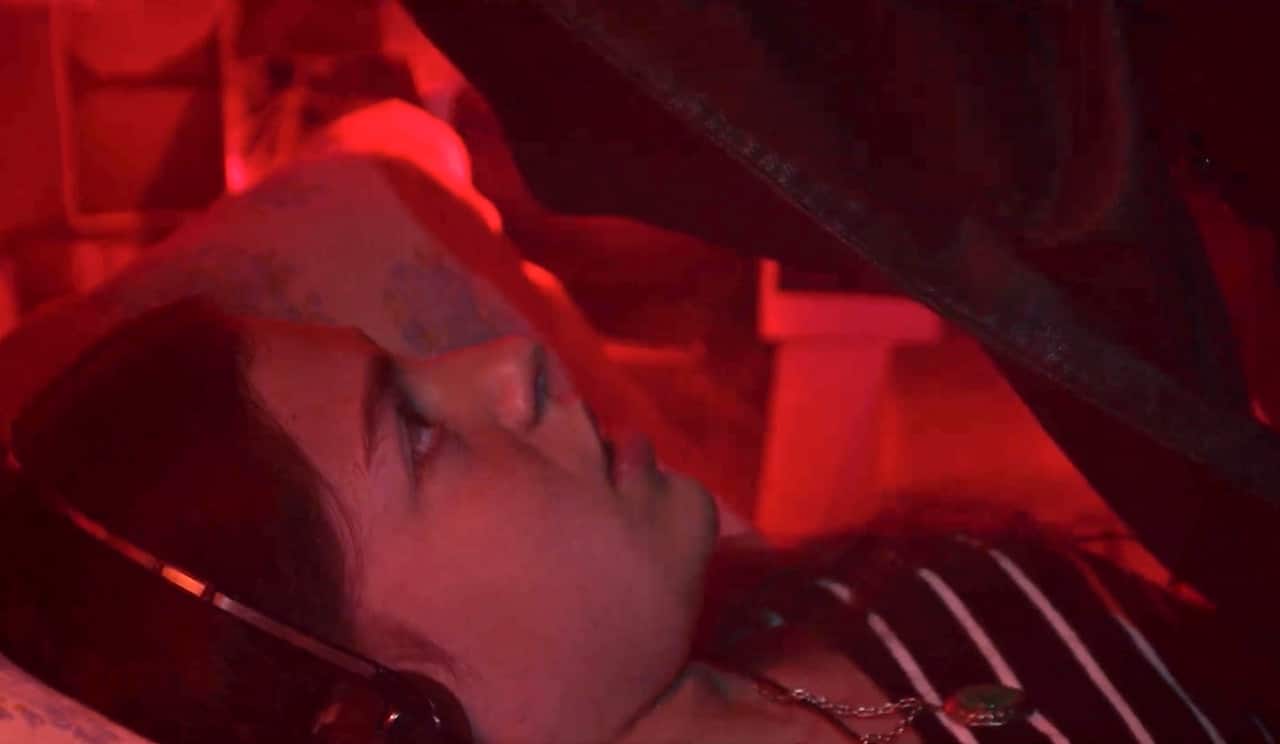
Micaela is unique among final girls. She becomes an amateur detective who happens to be operating inside a slasher film. Instead of waiting for the final confrontation, she enacts a serious investigation into the killings, interviewing survivors, chasing down leads, and piecing together the connection between the victims and the mixtapes she sold them. In the film’s final moments, she grabs a knife and chases after the retreating killer. Her sleuthing gives No One Will Hear Your Scream a welcome procedural texture, grounding the horror in Micaela’s rational mind even as the body count climbs around her.
Just as Micaela and the audience believe the mystery is solved, Cattaneo pulls the rug out with a genuinely shocking reversal that reframes everything that came before. It is the kind of plot turn that rewards the audience’s investment in the film’s central relationship and lands with considerably more emotional weight than the genre typically demands.
All these elements, the story rooted in Argentina’s 1990 political unrest, the look of the time, the cleverly shot violence, and Micaela’s sleuthing, coupled with a period-specific synth score, made No One Will Hear Your Scream a rewarding watch on many levels. The movie is another example of South and Central America’s multi-level genre films, signalling the continent’s rising status as a purveyor of thought-provoking and exciting films.
No One Will Hear Your Scream (2025) is available to stream on Tubi.
More Film Reviews
Khavn De La Cruz, or simply Khavn, is a Filipino director best known for his 2010 crime comedy film Mondomanila. His works never cease to emanate with his knack for… Tetromaniac: 61 – Scorecard Killer is a 2023 Italian extreme horror, written and directed by Domiziano Cristopharo and Poison Rouge. Domiziano is known as the writer and director of such… When Norman Graysmith is invited into the home of an aspiring serial killer, Aidan Mendle to be exact, he believes he has the subject for a career-defining documentary. However, the… In 1934, vaudevillian Will Hammer (real name William Hinds) diversified into the film industry. Hammer Productions Limited joined forces with Spanish entrepreneur Enrique Carreras to create Exclusive Films Limited, before… Junk Head is a 2017 Japanese stop-motion animation film written and directed by Takahide Hori. The film is based on Hori’s first short film, Junk Head 1 (2013), a project… Art the clown brutally slashed his way onto our screens in 2016, in Damien Leone’s gruesome hearkening back to the splatter-filled, SFX-loving classic films of the 70s and 80s that…
Three Days Of Darkness: Zero (2005) Film Review – Let Darkness Swallow You Whole
Tetromaniac: 61 – Scorecard Killer (2023) Film Review

When The Screaming Starts (2021) Film Review – Killer Comedy
Frankenstein and the Monster from Hell (1974) Film Review | Hammer Horror
Junk Head (2017) Film Review – Superb Stop-Motion Cinema

Terrifier 2 (2022) Film Review – Disgusting and Depraved, Just How We Like It

I am a lifelong lover of horror who delights in the uncanny and occasionally writes about it. My writing has appeared at DIS/MEMBER and in Grim magazine. I am also in charge of programming at WIWLN’s Insomniac Theater, the Internet’s oldest horror movie blog written by me. The best time to reach me is before dawn.