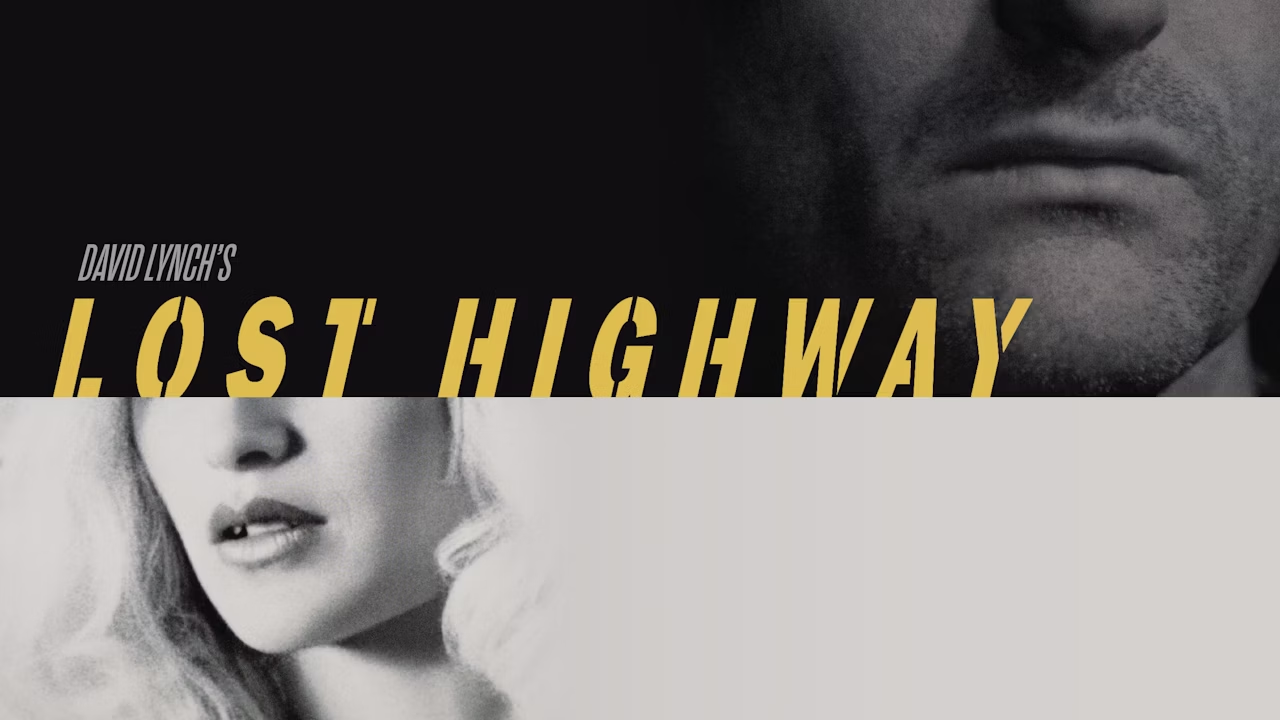





A lot has been said in the last week or so about the legend and legacy of David Lynch. The man was a unique visionary who saw the world, time and people in a way that changed the way we could all see them – and one of the most mind-melting of his films is Lost Highway.
This neo-noir psychological thriller with strong surrealist influences is far from Lynch’s most bizarre film, but it still benefits from a few watches. Bill Pullman plays Fred Madison, a jazz saxophonist in a viscerally uncomfortable marriage with his beautiful wife Renee (the incredible Patricia Arquette) in their stylishly sterile LA home. Every word they say to each other is tense, and they tend to sit as far apart as possible. Their lovemaking is theoretically beautiful, softly lit, and with passionate music, but it’s ultimately unfulfilling and emasculating.
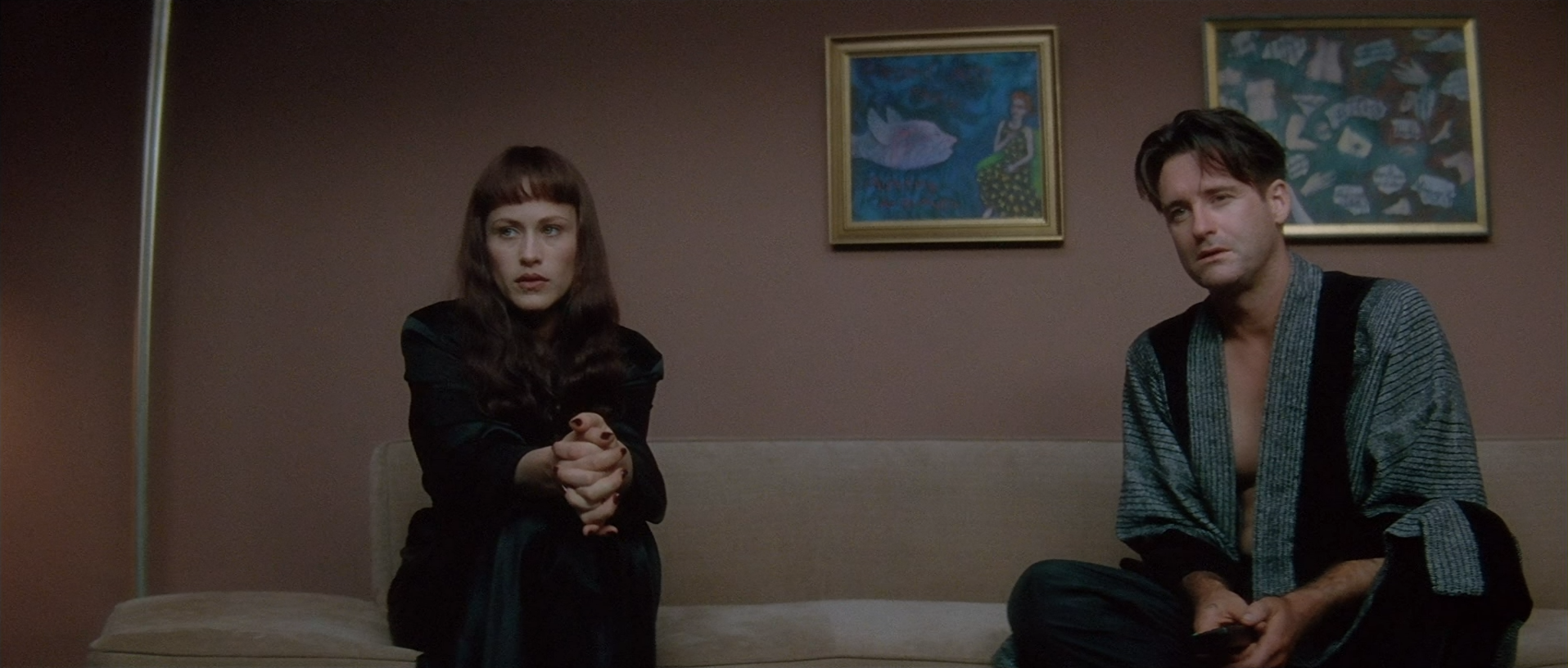
At the very beginning of the film, Fred answers the intercom to the simple statement, “Dick Laurent is dead.” Shortly after, the couple starts receiving videotapes of their own home, grainy but nondescript footage. Madison himself is a fan of cameras, explaining a few times that he likes to remember things his own way, rather than the way they happened – this simple statement is a key to unlocking most of the film’s second half.
The tapes don’t stop with the outside of their home, but even invade it, filming the pair as they sleep. A rattled couple heads to the party of Renee’s friend Andy, where she immediately gets drunk and tries to get rid of Fred. As she does, he bumps into a mysterious man with powdered white skin and an intense expression on his face, who asks, “We’ve met before, haven’t we?”
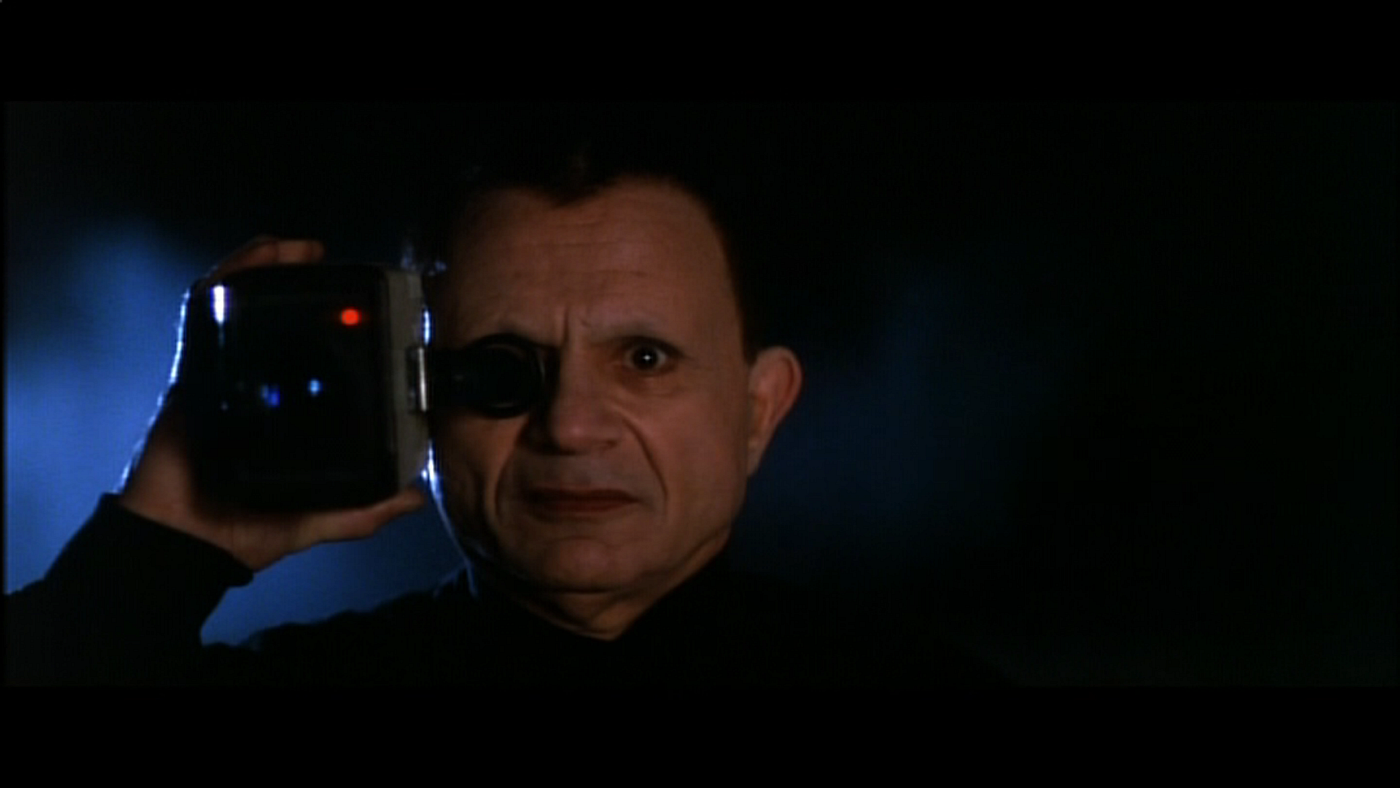
Introverted nightmare aside, Fred tries to brush off the creepy Mystery Man, who claims they’ve met before at Fred’s house before uttering the terrifying phrase “I’m there right now.” Sure enough, when he calls the house, that same man’s voice answers with blood-curdling calm, “I told you I was here.”
The final tape is received, clearly showing a dead Renee in their bedroom, and Fred is arrested. As Fred sits in his cell awaiting the death penalty, he looks up to see curtains parting to reveal another world, moving backward, where the Mystery Man waits. The lights dim, and we see a road at night, finally pulling up to a young man. Back in his cell, Fred appears to be having a violent fit – it’s speculated that this is the moment he’s being executed by electric chair.
In the second half of the film, we have an entirely new protagonist, Pete. At first, it appears to be a completely different film, but soon Pete bumps into a familiar face – it’s Renee, now a bombshell blonde called Alice, the girlfriend of gangster Mr Eddy. Alice is light and cheerful, the yin to Renee’s yang, a damsel to be saved.
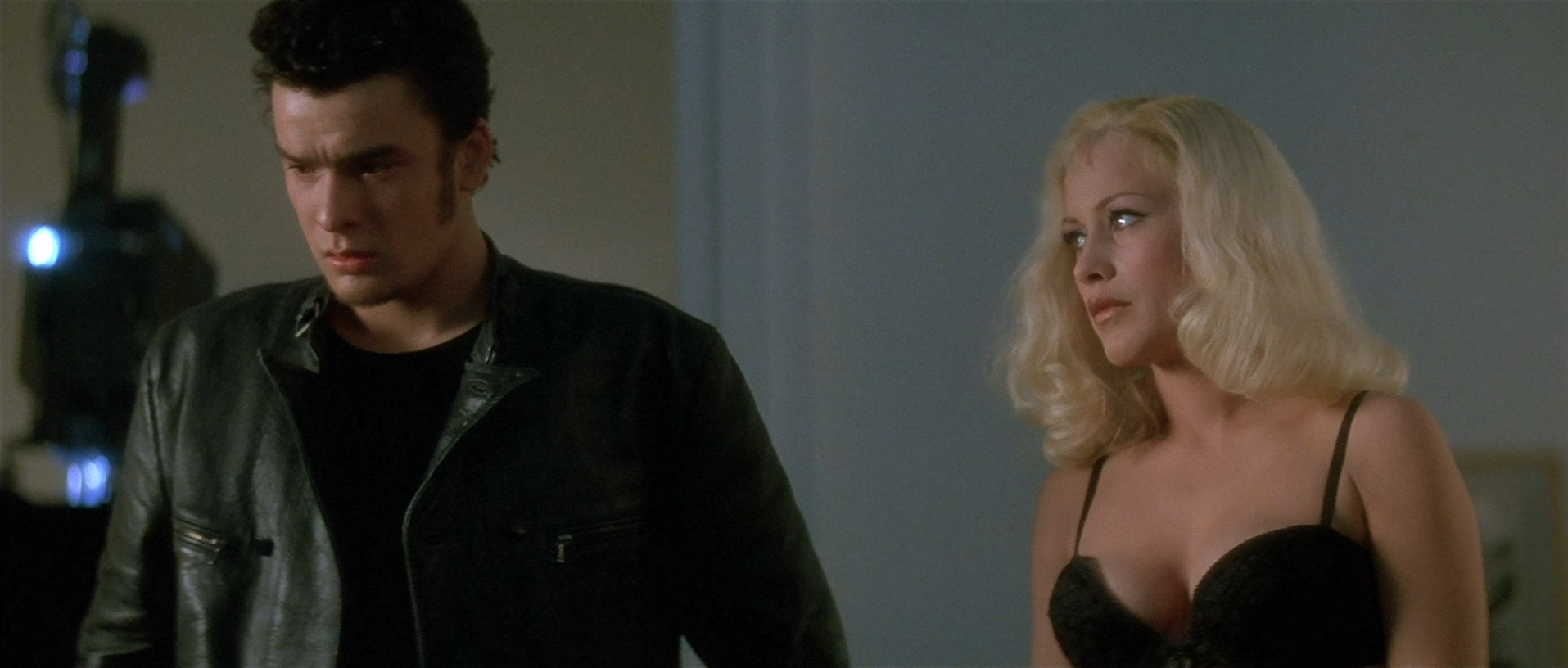
As Pete becomes entangled with Alice, Fred’s life seeps more and more into Pete’s. Their motel room romance puts them both in danger, and in an attempt to run away together, a man dies. She switches on Pete almost immediately, now a cool, calm femme fatale, correcting Pete “You. You killed him.”
One of the finest images of this film shows the lingerie-clad Alice stealing the jewellery from a very dead Andy – yes, that Andy – while a projection runs a seemingly endless porn sequence starring Alice. Pete’s nose begins to bleed, his mental state deteriorates and his world starts looking like a metal club at two in the morning. As Rammstein blares and psychedelic flame burns, a large video projection of a naked Alice mocks Pete, the crueler twin to Renee’s gentle but devastating pat on the shoulder.
They run away to the desert together to get help and end up making passionate love in the dunes. “I want you”, he says over and over. “You’ll never have me,” she answers, leaving him in the dust. This triggers his transformation back to Fred Madison, who comes face to face – and occasionally camcorder – with the Mystery Man who furiously demands “Who the fuck are you?”.

Suddenly, we’re in the Lost Highway Hotel, and Renee’s leaving a naked Mr Eddy asleep in bed – Fred watches on from another room, waiting until she leaves to violently assault the gangster and kidnap him while the Mystery Man watches. Together, they kill him in the desert. Back in LA, Fred walks up to his own home’s intercom, presses the intercom, and calmly says “Dick Laurent is dead.”
Expect sporadic moments of violence, frequent pornographic sequences, cameos from Henry Rollins, Marilyn Manson, Twiggy Ramirez, and Gary Busey, plus an incredible soundtrack featuring the likes of Rammstein, Nine Inch Nails, and Lou Reed, brought together with Angelo Badalamenti’s ominous sounds. It’s bookended by the same haunting David Bowie song, and filled with themes of guilt, jealousy, identity, and masculine pride.
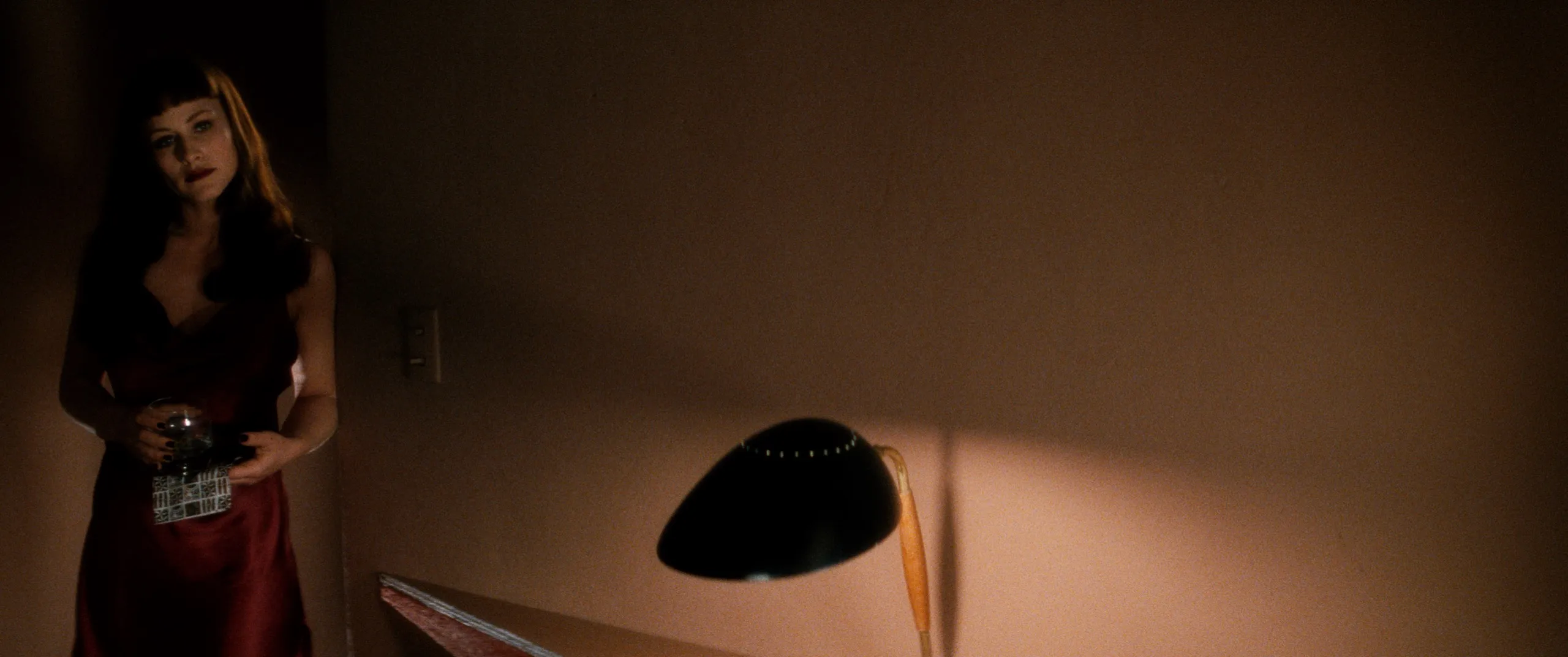
You may also be interested to know that Lost Highway is a cited inspiration for the legendary horror game Silent Hill 2. Both feature a wife-murdering protagonist punishing himself subconsciously for his crimes, at least, if you believe the general consensus of the film’s meaning, because of course David Lynch would never give us an easy answer!
While Lost Highway has more of a narrative structure than some of his other films, I’d also argue that it’s the most horror of them all in both idea – that of being trapped in a Möbius strip of guilt – and in execution. Backed by an incredible soundtrack that builds in intensity as the story continues, Lost Highway might not make sense the first time, but it’s always one hell of a journey.
More Film Reviews
Malignant (2021) Film Review: Expect the Unexpected
***As a disclaimer, there are mild spoilers in this review, but I have tried to keep them to a minimum.*** Paralyzed by fear from shocking visions, a woman’s torment worsens…

She Kills (2016) Film Review – Right in the Dick
She Kills is a 2016 American action horror film, written and directed by Ron Bonk. Boasting a huge filmography as an executive producer, Ron is known as the proprietor of…
![Else (2024) Film Review – Dissolving into the Infinite Unknown [Fantastic Fest]](https://www.grimoireofhorror.com/wp-content/uploads/2024/09/Else-cover-365x180.jpg)
Else (2024) Film Review – Dissolving into the Infinite Unknown [Fantastic Fest]
Anx and Cass are on opposite ends of the scale when it comes to personality. Anx is overly cautious while Cass grabs life by the balls and makes the most…
The Moor (2023) Film Review – Cronin’s Atmospheric Horror is a Must Watch
In today’s world of flashy graphics and CGI, audiences have become immune to fantastical horror, pushing some writers to create content to test our boundaries with the extreme. In The…

Crumb Catcher (2023) Film Review – Believing Your Own Bulls*** is Half the Battle
Weddings can be stressful; add in a drunken blowjob for the groom from a vindictive stranger and an obnoxious employee overstepping social boundaries, and, for couple Shane and Leah, it…
Kanto Woman Infamy (1969) Film Review – Surviving in a Man’s World of Vice and Dishonour
Despite being one of Japan’s biggest film studios throughout the late 40s and 50s during the golden age of Japanese cinema, Daiei were struggling by the mid-60s and had to…

Jenny is a creative copywriter living just outside of Liverpool who loves horror, board games, comics, video games and industrial metal.