




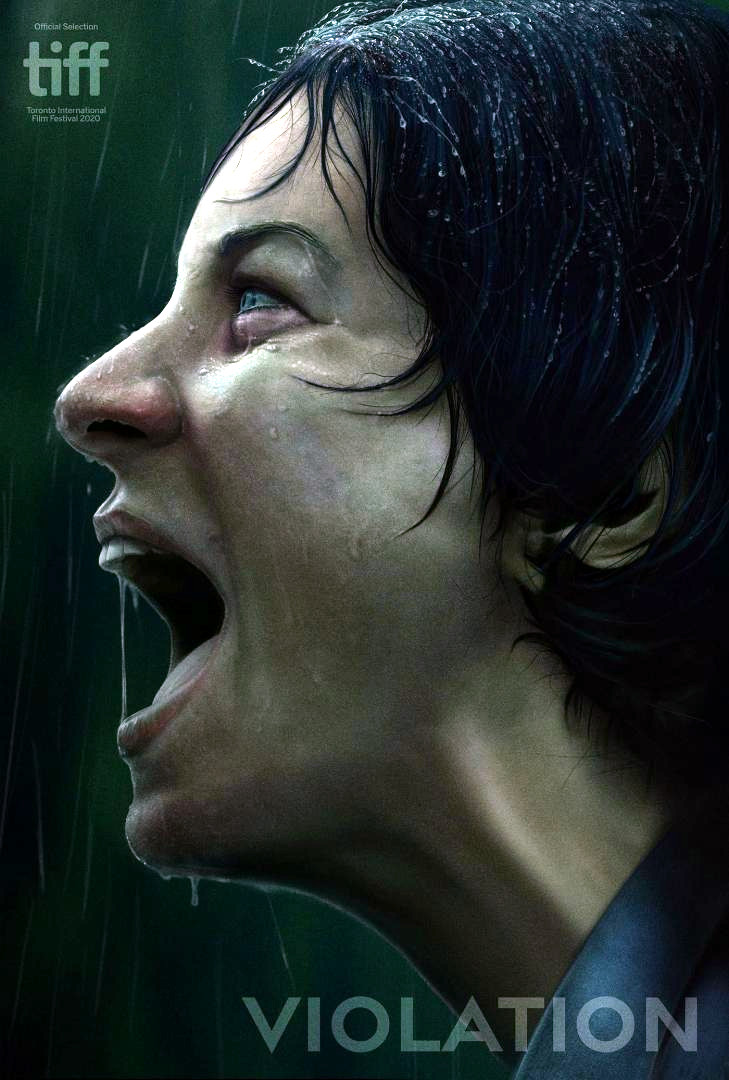
On the surface, co-writers and directors Madeline Fewer-Sims and Dusty Mancinelli’s 2020 thriller Violation is a story of obsession, jealousy, and reconciliation. It is also a genre-defying movie that inverts common tropes to take audiences out of their comfort zones and deep into abject territory. To present this deeply disturbing and ambiguous tale told from the perspective of an extremely unreliable narrator, Fewer-Sims and Mancinelli employed a multi-layered technique to provide guideposts for the audience to follow, but with no clear destination to arrive at.
Violation takes its time, carefully revealing itself over the course of three distinct episodes, told in an overlapping, non-linear style. After a warning about the graphic nature of the movie, the movie begins with Miriam (Madeleine Sims-Fewer) and her husband Caleb (Obi Abilli) on their way to visit her sister Greta (Anna Maquire) and her husband Dylan (Jesse LaVercombe) at their cabin on a lake. Initially, there is plenty of affable, good-natured banter during the reunion, but Miriam reacts awkwardly when teased about being over-protective of Greta.
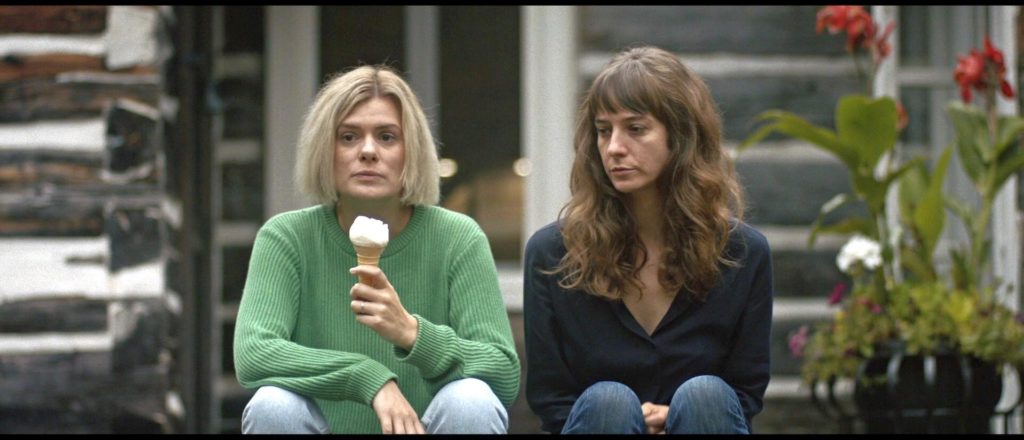
In the next section, from the final third of the film, Miriam returns alone to the lake house to help Greta prepare for her in-laws’ family reunion. When Greta complains about Dylan’s absence and how he would make her seem to be the one at fault for being upset, Miriam accuses him of taking advantage of her. Unwilling to get into it with her, Greta reveals it was Dylan who wanted the sisters to reconcile, not her. She angrily accuses Miriam of seeing herself as “saint who gets tricked into doing bad things” and never taking responsibility for sabotaging her life to make herself seem important.
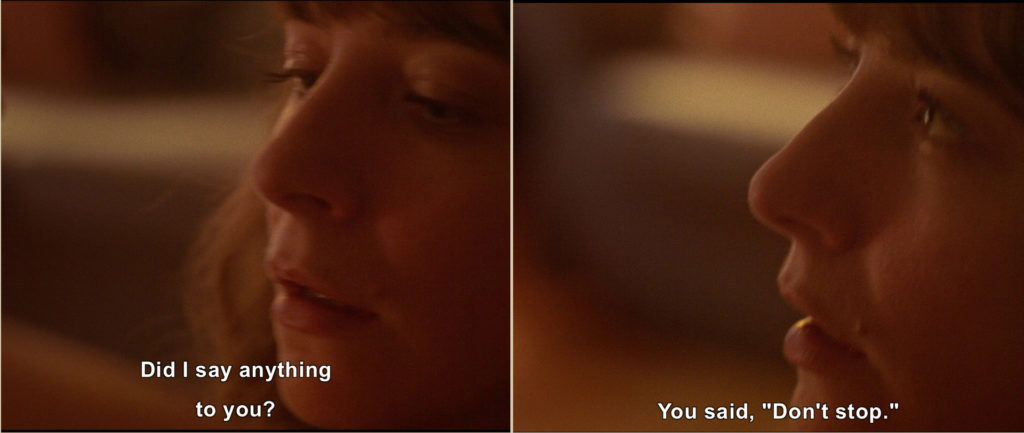
The connecting portion between the first and last chapters begins with Miriam and Dylan meeting for what appears to be a clandestine, illicit rendezvous. The audience learns they had sex when Miriam and Caleb arrived at the lake house. After a few drinks, she undresses Dylan, making him describe their previous encounter. As he talks, she blindfolds him and asks him if she said anything while he was touching her. He tells her she said, “Don’t stop.” As the movie continues and revisits each of these episodes, more, darker details come to light, but Sims-Fewer and Mancinelli give nothing away, insisting the viewers reach their own conclusions.
While Miriam is a very flawed character, the flaws live in her personality, not in her presentation. Madeleine Sims-Fewer does an excellent job bringing the extremely complicated Miriam to the screen. She expertly navigates through Miriam’s wide range of affects, from being extremely personable to coldly calculating and self-serving. Equally excellent co-stars Anna Maguire as sister Greta and Jesse LaVercombe as brother-in-law Dylan deliver subtle but effective supporting performances. LaVercombe especially proves himself to be fearless. The graphic nature of his role in the middle chapter takes Violation to a level of realism that few movies dare to go.
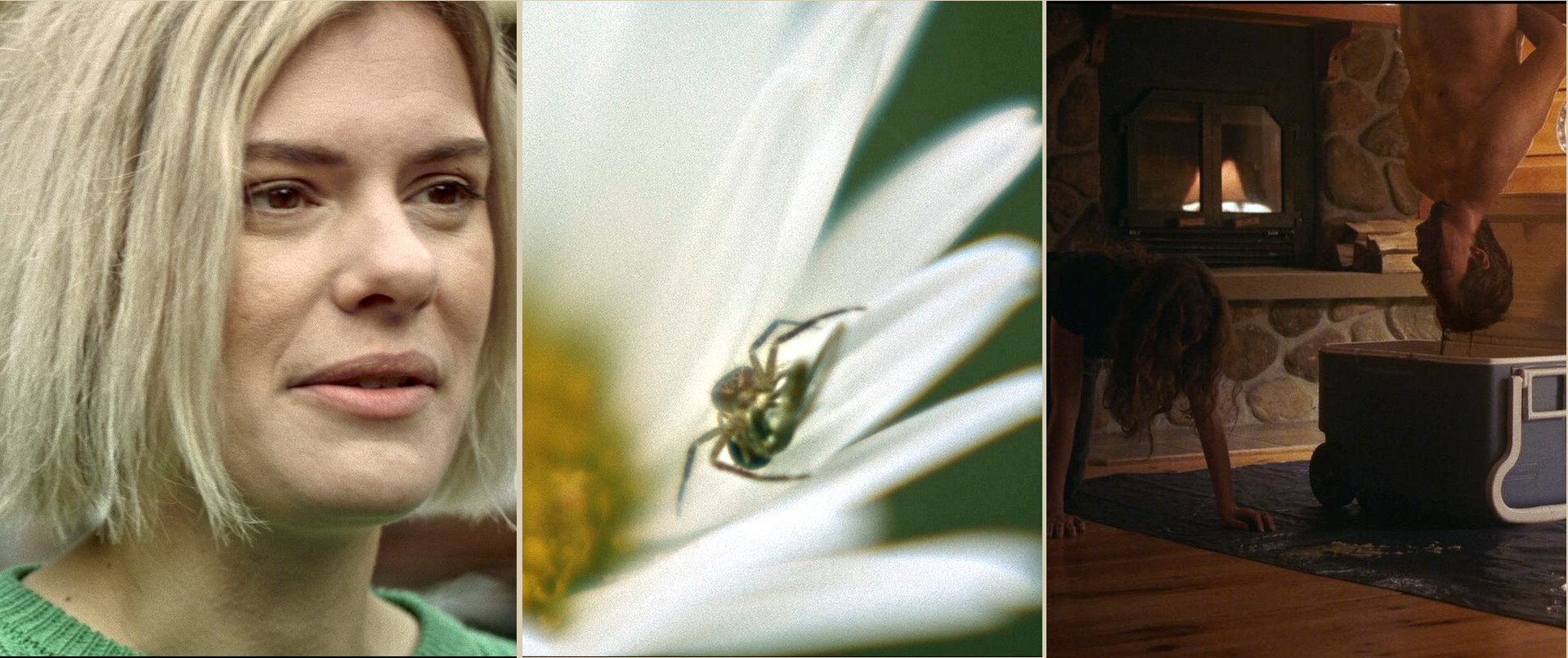
Violation soundtrack and cinematography add another dimension of storytelling. Andrea Boccadoro’s classical themed score sweeps from sublime beauty to cacophonous scratching violins as Miriam goes through her arc. Adam Crosby’s rich, evocative photography of the natural surroundings, from forests bursting with fall color to tiny flies caught in a web, complements the musical score.

The soundtrack and photography provide nonverbal cues to aid the audience through a twisting, expectation-defying story. Later in the movie, the audience sees Dylan’s and Miriam’s fireside encounter from her perspective. In this version, she doesn’t ask Dylan to keep going. She says, “Dylan, stop,” casting a pall of ambiguity on her actions in the brutal and graphic second section. The filmmakers task the audience with deciding for themselves if what happened by the fire was r*pe or seduction to drive a wedge between Greta and Dylan. Is Miriam a victim, or is Dylan the victim?
While marketing makes Violation seem like r*pe revenge film, a subgenre with well-established formulas and tropes, the filmmakers present something very different. By introducing the possibility that the gender roles are reversed, Violation plunges into seldom explored territory. Writer/director Dusty Mancinelli says in Miriam and Dylan’s scene in the second section, “we were just so sick of seeing women being sexualized in these sequences. We wanted to show a scene where a woman is fully dressed, where she has the power, and she’s disempowering the man… And it’s shocking. It’s really startling, I think, but that’s the point.” (Source) Indeed, whether Miriam is the victim or perpetrator, she is firmly in control at all times.
Violation is a dizzying film that uses a wide range of tools to ensnare the viewer in a twisted and dark maze that offers no clear exits. This ambiguity makes the film even more enthralling as the audience struggles to make sense of it. Excellent performances, a closely attached soundtrack and beautiful cinematography that make use of the film’s external settings make Violation a superb choice for people who enjoy challenging films.
More Film Reviews
Thorns (2023) is an American sci-fi horror film written and directed by Douglas Schulze. Well-versed behind the camera, Douglas is most known as the writer/director of such films as Hellmaster… In addition to those that played ahead of the main features, the Toronto After Dark Film Festival screened eight more Canadian shorts in a dedicated showcase. From stop-motion animation to… We’re Not Here to Fuck Spiders is a 2020 Australian found footage horror movie written and directed by Josh Reed, who is primarily recognized for his directing work on television… Two of the things I liked about You’re Next (directed by Adam Wingard, written by Simon Barrett) is a crafty and feisty final girl and a quick-witted script. With Seance,… Edge of Sanity is a 1989 American slasher horror, directed by French director Gérard Kikoïne in one of his last films in the director’s chair. The story combines elements from… The Sergio Blasco Gore Collection is an anthology of four extreme splatter films all created by the Spanish director – Including Burrp (1996), Mas Carnaza (1997), Plano Detalle (2008), and…![Thorns (2023) Film Review – Natural Thorn Killer [FrightFest]](https://www.grimoireofhorror.com/wp-content/uploads/2023/07/Thorns-cover-photo-365x180.jpg)
Thorns (2023) Film Review – Natural Thorn Killer [FrightFest]

Canadian Shorts After Dark Showcase – Toronto After Dark Film Festival 2022
We’re Not Here to Fuck Spiders (2020) Film Review – Found Footage from Down Under
Seance (2021) Film Review – A Giallo Flick Married To a Teen Slasher

Edge of Sanity (1989) Film Review – Anthony Perkins Exploitation Classic

The Sergio Blasco Gore Collection (2024) Film Review – Extreme Spanish Cinema

I am a lifelong lover of horror who delights in the uncanny and occasionally writes about it. My writing has appeared at DIS/MEMBER and in Grim magazine. I am also in charge of programming at WIWLN’s Insomniac Theater, the Internet’s oldest horror movie blog written by me. The best time to reach me is before dawn.