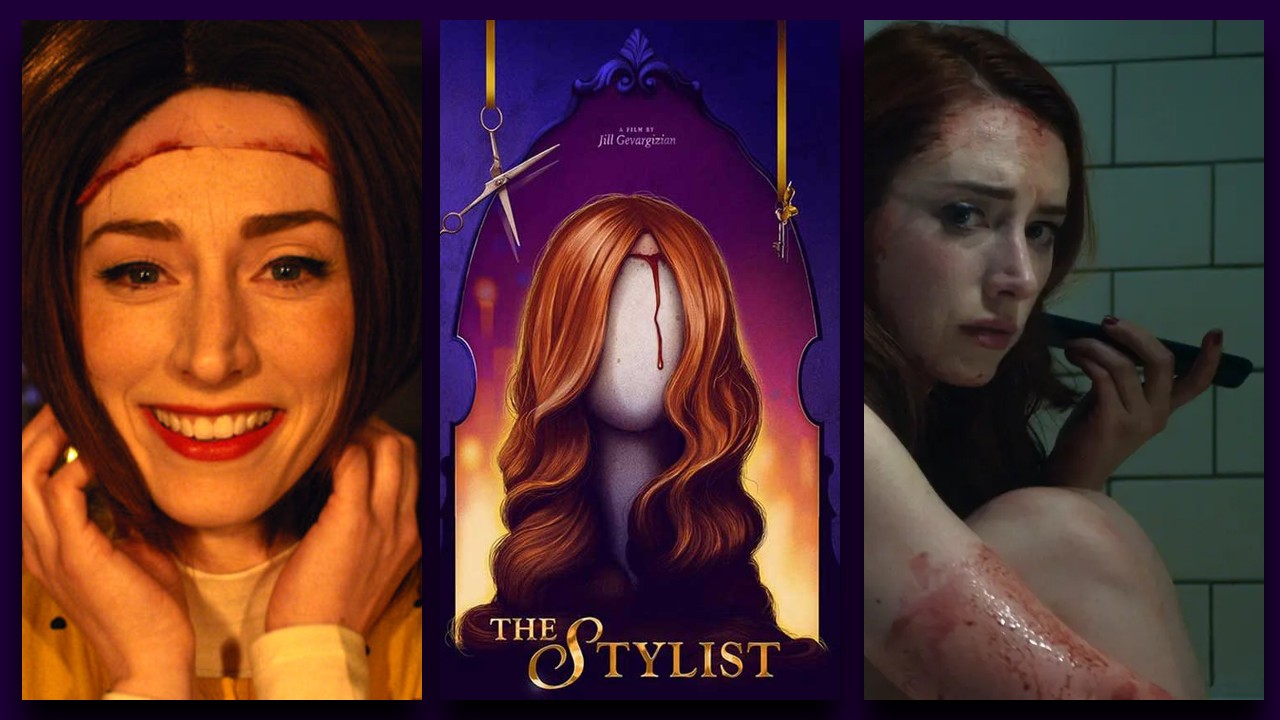





The Stylist is a stylish and incisive character study and portrayal of the effect acute isolation, alienation and obsession can have on someone. Based on the 2016 short, The Stylist offers the viewers a macabre view into Claire’s (Najarra Townsend) shrouded double life. By day, Claire is the chief comforter of her hairdressing clients, she is able to put them at ease and melt their troubles away with her tender touch, creating a sense of intimacy with anyone who comes to sit in her chair. By night, the undercurrent of sadness that is ever present within her forces itself to the forefront, and her maniacal tendencies are unleashed.
Although Claire commits unspeakable acts – literally scalping her clients’ perfectly styled hair – the viewer can’t help but feel ambivalent about her actions. Her loneliness, need for validation, and sense of belonging is visceral, almost as visceral as the gruesome scalping and murder scenes. Claire may be an exacting serial killer, but her soft femininity and perfectly stylised appearance, along with her strangely inviting basement lair, leaves the audience feeling confused. Are we supposed to find Claire abhorrent? Or feel pity for her tangible sense of desertion?
From the 2016 short, it was clear that Jill Gevargizian had created something special, a horror that haunted its viewers long after viewing, leaving them to ponder their own sense of self. The short went on to win 17 awards, including Etheria Film Night’s Best Film Award and Fantastic Film Fest’s Best Actress Award. This success has been streamlined into Gervargizian’s first solo full-length feature film thanks to the mesmerising use of camera shots, lighting, and sound effects, as well as an incredibly powerful performance from its female lead.

It’s clear that Claire feels an affinity with hair, it’s her only way to connect with people on a deeper level; one can’t help but wonder how her psyche became so deeply broken. Her shy and awkward self seems to disappear when she’s entranced in the act of cutting and styling her client’s hair, which is magnified through the use of dreamlike camera shots. Time seems to slow down, and the intimate act of washing hair is hung with a backdrop of almost romantic music. The main focus is constantly shifting from Claire’s hands to her client, then back again, and the two seem to merge when multiple scenes overlap each other on screen, both being visible at the same time. Claire’s defences appear to fall in these scenes, as it’s clear from her facial expression that she is vulnerable yet in complete bliss.
These delicate, sensual scenes are juxtaposed directly with her brutal scalping of the same client. All delicacy is gone, as she ritually gouges her victims from ear to ear and mercilessly pulls their scalps off. The use of sound effects creates a disturbing experience for the viewer; the sound of the knife dragging through the flesh and the wet, sticky noises emitting from the scalp as it’s pulled back paired with a bird’s eye view of the scene accentuates the brutality. Claire, herself is out of shot during the scalping scenes, the act is void of any humanity and cares that she previously displayed when washing and styling her client’s hair, in this moment she is reveling in only pure abhorrence.

The shocking contrast is incongruous with how Claire presents herself as a meek, shy, and perfectly stylised woman. Instead, we see her veneer slip and her true self is able to come out to play. Or perhaps it’s that she doesn’t know who her true self is, and she desperately seeks to live vicariously through other people to combat her deep sense of loneliness. As the plot progresses, Claire’s maniacal tendencies are only amplified when she is asked to be the stylist for one of her client’s weddings. What ensues is an obsession so deep-rooted, that the consequences were only ever going to be a harrowing display of a woman whose psyche is completely shattered.
The Stylist is an enjoyable and original character study, with an engaging performance from Najarra Townsend. The nuances of Claire’s character are palpable; her gruesome and distressing methods of revenge give enough to any avid horror fan to enjoy watching this psychological descent into chaos.
More Shudder Reviews
Synopsis: Childhood friends are trying to carve out their own piece of infamy online by staging exorcists and selling bunk merch. Wanting to increase their following, the two struggle to come… Explore the rural roots, occult creeds and cultural lore that continue to shape international cinema. The folk horror genre is as diverse as the countries, cultures, and eras in which… Mercenaries for hire, James and Marshall are tasked with rescuing a scientist from an underground bunker in order to obtain the research she holds. However, the complex is crawling with… “Southold, New York, 1843: Young Mary (Stefanie Scott), blood trickling from behind the blindfold tied around her eyes, is interrogated about the events surrounding her grandmother’s death. As the story… Shudder, as a platform for exclusive releases, has been an enjoyable and interesting experience. Being able to curate directly for fans of the genre has allowed an impressive range of… I want the truth. No matter how terrifying. I want the truth. ~ Masafumi Kobayashi When I think about the genre of mockumentaries, the first image that comes to my…
The Cleansing Hour (2019) Review – The Devil Wants More Followers!
Woodlands Dark and Days Bewitched (2021) Documentary Review

Death Valley (2021) Film Review – Action Packed Horror
The Last Thing Mary Saw (2021) Film Review – Religious Horror
Mosquito State (2020) Film Review – A Muddled Metaphorical Treatise on Bloodsuckers
Noroi: The Curse (2005) Film Review: Into the Twilight Zone