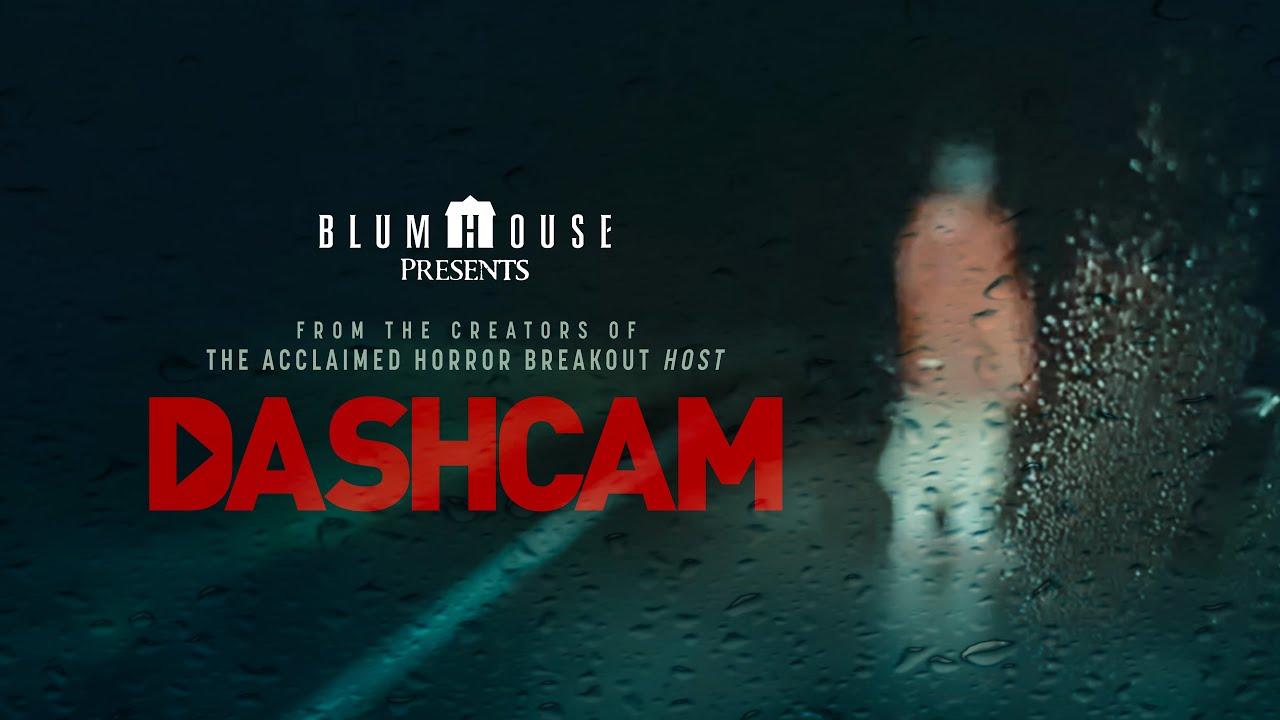





Rob Savage gave us one of, if not the best, screen-life found-footage horror films to date with Host. Brilliantly presented as a terrifying experience in the duration of a free zoom call, it was an intense yet cleverly constructed tale of the haunting of a group of friends. It was after this, that fans became curious as to what Savage would do next and if he would be able to build on that momentum with his follow-up DASHCAM.
A film about an American in the UK being sucked into a nightmare after picking up an ill woman at a shop in return for cash, DASHCAM has the same breakneck pace and shock value as Savage’s Host. In this regard, the synopsis is best kept as minimal as possible, as the production goes to some wild places and the twists are best experienced firsthand.
It is debatable if DASHCAM is the successor to Host as both films have their merits and are shot in a different format. Unfortunately, early coverage of the film on the festival circuit lead to largely mixed opinions.
Any decisiveness in early reviews of the film is going to boil down to the politics and persona of Annie Hardy, who is a right-leaning conspiracy theorist with a crass mouth. However, two elements make this a rather moot point as Hardy’s politics are just presented as is. Representation does not immediately mean promotion and the protagonist is political but the film itself is not. Secondly, this is something that has been particularly true of the horror genre for decades, allowing audiences to cheer on the lead: whether it be to have them triumph or head towards a violent demise.

That said, there is a lot to admire with Annie Hardy’s persona; her rather unapologetic and bold approach to life really helps carry her through chaotic and violent moments. For a film of this nature, she is kind of the ideal mix of both antagonist and protagonist as she makes the world difficult for those around her in a very vocal way. Hardy’s rap over the end of the credits is a highly enjoyable way to cap off the movie–it is one of the few times in a long while I stuck through to the end credit sequences.
Certainly, her character will be divisive but for the film that Rob Savage was looking to construct, but he found the perfect protagonist to push the film in awkward and comedic ways. Hardy’s performance is one of the best aspects of the film, particularly when playing off of Amar Chadha-Patel as ‘Stretch’. Their friendship (despite Hardy’s awful treatment of him) is awkwardly endearing, particularly when they reflect on their old ‘punk’ days back when they were in a band and touring together.
The issues of Hardy’s presence will only be an issue for the vocal minority, the majority will be concerned about its execution of horror elements. Thankfully, as far as frights and atmosphere go, DASHCAM knocks it out of the park with a heavy helping of effective (yet not cheap) jump scares and an abundance of disturbing imagery perfectly captured in the found footage format. The body horror elements, in particular, are conveyed in very uncomfortable hyper-focused detail–s***, gore, and blood will all splash across the screen to make the audience squirm.
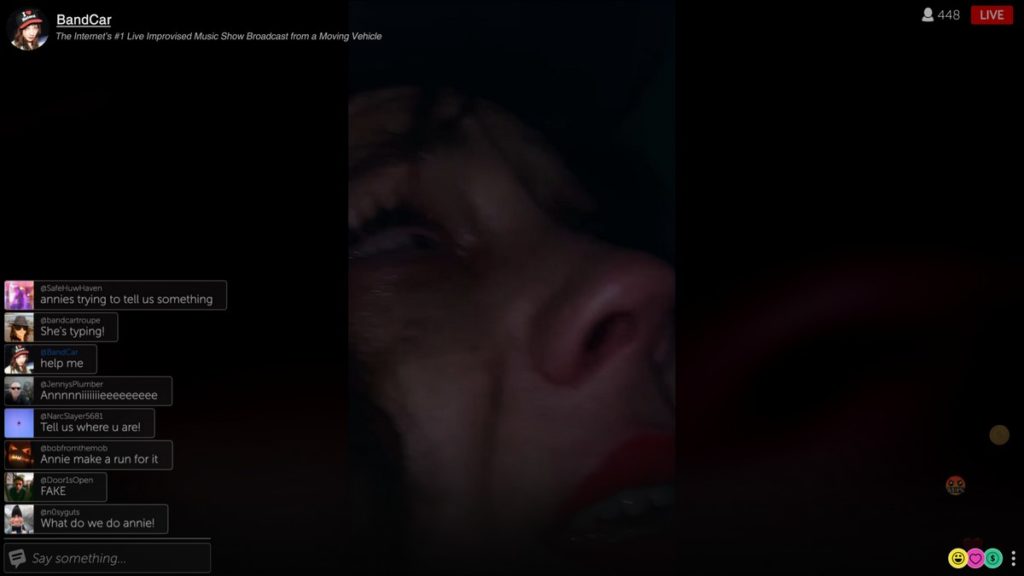
Again, to keep the spoilers minimal, there is more to DASHCAM than just its simple set-up and it goes in some weird directions that further push the violence in exaggerated and shocking ways. Essentially, the horror nerd in me wants to just go into detail about certain sequences, but it is really best to watch the film and avoid spoiler territory till after the fact.
What can be conveyed with confidence is how impeccably well executed each moment of the film is. Savage has a knack for understanding when to keep visuals vague and when to show the entirety of what is transpiring. This is bolstered by an effective sound design that also fades in and out with precision in capturing the horrors. The shots from the Dashcam, in particular, are set up perfectly and are amazing at building up the suspense. Ultimately, as a horror experience DASHCAM is near idyllic in its execution, making it the perfect theater-going experience or home with a large group–volume up high, lights down low.
To enjoy DASHCAM you have to go into it with the understanding it is okay not to like a lead character’s politics. If you can reach that point, you will be in for an intense, perfectly constructed piece of found footage horror.
DASHCAM is now in select theaters and available VOD via Blumhouse Films
More Film Reviews
From Cannes Palme D’or Winner Frida Kempf, Knocking marks the Swedish Filmmaker’s first foray into horror. Posing a dark tale of madness, the film captures the unease found in the… It goes without saying that director Hideo Nakata is one of the most celebrated filmmakers when it comes to Japanese horror. Having helmed two exceptionally well-received adaptations of Koji Suzuki… Cory Pratt’s Hide (2025) is a perfect mix of graphic imagery and careful restraint. In just a short runtime (less than 20 minutes), it manages to say more than many… The combination of source material from a writer like Joe Hill and a director like Scott Derrickson was always going to pique the interest of horror fans. After leaving production… Minore is a 2023 Greek sci-fi horror comedy, written and directed by Konstantinos Koutsoliotas, with additional writing from Elizabeth E. Schuch. Although mostly known as a visual effects artist who… Maniac Driver is a 2020 Japanese horror thriller, written and directed by Kurando Mitsutake. Mitsutake has worked in many areas of film production but is most notable as the director…
Knocking Film Review – A Slow Decline Into Madness

Stigmatized Properties (2020) Film Review – Would You Rent a Haunted Apartment?
Hide (2025) Film Review – Short, Sharp, and Served Rare

The Black Phone (2021) Film Review
![Minore (2023) Film Review – Greek Sci-fi Horror [FrightFest]](https://www.grimoireofhorror.com/wp-content/uploads/2023/08/Minore-202310-365x180.jpg)
Minore (2023) Film Review – Greek Sci-fi Horror [FrightFest]
Maniac Driver (2020) Film Review – Destination Murder